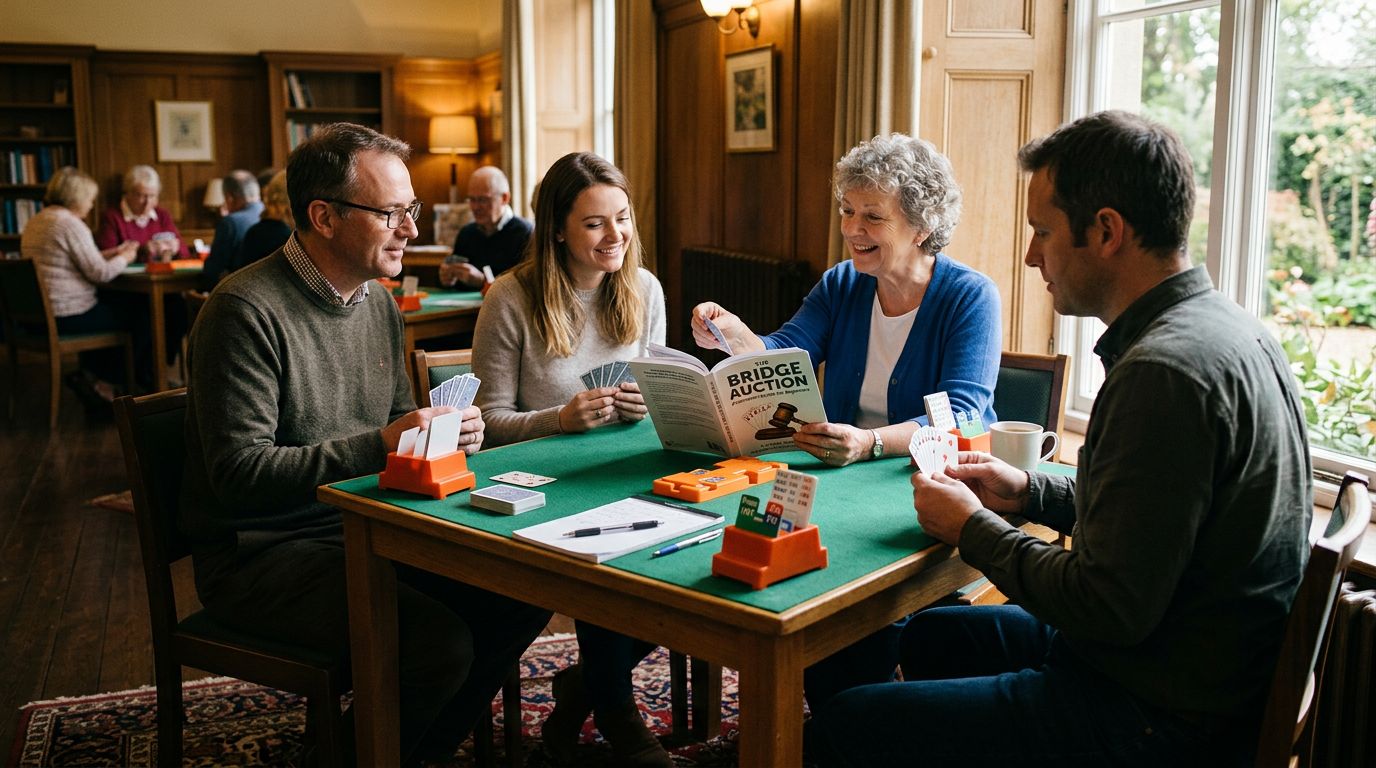
The Bridge Auction: A Complete Guide for Beginners
The bridge auction might seem mysterious at first. Players call out strange combinations like “one heart” and “three notrump” while their partners nod knowingly. But here’s the thing: the auction is just a conversation. You’re trying to figure out what your partnership should play and who should play it, all while the opponents try to do the same thing.
Think of it as a competitive negotiation where you can’t talk to your partner normally. Instead, you speak in a special language of bids that describe your hand. Once you understand the basic rules, the auction becomes the most exciting part of bridge.
What Is the Bridge Auction?
The auction happens at the start of every bridge hand, right after the cards are dealt. Each player looks at their 13 cards and, in turn, makes a call. The auction determines two critical things:
- The contract: What the partnership promises to make (like “we’ll take at least 9 tricks with hearts as trump”)
- The declarer: Which player will play the hand
The auction starts with the dealer and moves clockwise around the table. It continues until three players in a row say “pass.” When that happens, the last bid becomes the contract.
Here’s what makes it competitive: both partnerships are bidding at the same time. If you want to bid, you need to outbid what the opponents just said. The partnership that wins the auction gets to play the hand, while the defenders try to stop them from making their contract.
Making a Bid: Level Plus Strain
Every bid in bridge has two parts: a level (a number from 1 to 7) and a strain (the suit or notrump).
The five strains are:
- ♣️ Clubs
- ♦️ Diamonds
- ♥️ Hearts
- ♠️ Spades
- NT (Notrump)
When you bid “one heart,” you’re saying: “I think my partnership can take at least seven tricks with hearts as trump.”
Wait, seven tricks? Yes. Bridge has a built-in addition: your level plus six equals the tricks you’re promising. A one-level bid promises 7 tricks (1+6). A three-level bid promises 9 tricks (3+6). A seven-level bid promises all 13 tricks, which is called a grand slam.
So when someone bids:
- 1♠️ = “We’ll take at least 7 tricks with spades as trump”
- 3NT = “We’ll take at least 9 tricks with no trump suit”
- 4♥️ = “We’ll take at least 10 tricks with hearts as trump”
- 7♣️ = “We’ll take all 13 tricks with clubs as trump”
The strain matters because it determines which suit (if any) is trump. Trump cards are powerful, they beat any card from other suits. Notrump means no suit has that special power; the highest card in the suit led wins the trick.
Pass, Double, and Redouble
You don’t have to bid. You can also make three other calls:
Pass
“Pass” means exactly what it sounds like. You’re not making a bid right now. Maybe your hand is weak. Maybe your partner already described your cards perfectly. Maybe the opponents bid your best suit and you’re happy to defend.
Passing doesn’t knock you out of the auction. If the auction comes back around to you, you can bid then. Many strong hands start with a pass and only enter the auction later.
Double
“Double” is a penalty call, though in modern bridge it often means something else depending on context. When you double:
At low levels (typically 1-2 level): “Double” usually means “Partner, I have some values. If you can bid, please do: I can support whatever you choose.” This is called a takeout double.
At high levels or when they clearly have a fit: “Double” means “I don’t think you’re making that contract, and I want to increase the penalties.” This is called a penalty double.
If you double and the opponents make their contract, they score extra points. If they fail, you score more penalties. It’s a risk-reward decision.
Redouble
“Redouble” can only happen after an opponent doubles. It says: “Oh really? We’re not just making this, we think you’ve made a terrible mistake. Let’s make the stakes even higher.”
Redoubles are rare and dramatic. The points get multiplied significantly. As a beginner, you won’t use this often, but you need to know it exists.
Legal Bids: Higher Than the Previous
The auction has one fundamental rule: each bid must be higher than the last bid. But what does “higher” mean?
The ranking order is:
- ♣️ Clubs (lowest)
- ♦️ Diamonds
- ♥️ Hearts
- ♠️ Spades
- NT (Notrump, highest)
At the same level, the strains rank from clubs (lowest) to notrump (highest). If someone bids 1♣️, you can bid:
- 1♦️, 1♥️, 1♠️, or 1NT (any higher strain at the same level)
- 2♣️, 2♦️, 2♥️, 2♠️, or 2NT (any strain at a higher level)
- Any bid at 3-level or higher
But you cannot bid 1♣️ again—that’s not higher.
If someone bids 1♠️, you cannot bid 1NT at the two level—you must bid 1NT (the next legal bid in notrump) or 2♣️ or higher.
If the last bid was 3NT, your next bid must be 4♣️ or higher. You can’t go back down to 3♠️; that bid is now “off the table.”
This ranking system makes the auction competitive. If the opponents open 1♥️ and you want to bid hearts, you need to jump to 2♥️. That requires a stronger hand because you’re promising more tricks.
What Bids Mean: Strength and Distribution
Here’s where bridge gets interesting. Bids don’t just say what you want to play, they describe your hand’s strength and shape.
Hand Strength
Bridge players measure hand strength in high card points (HCP):
- Ace = 4 points
- King = 3 points
- Queen = 2 points
- Jack = 1 point
A perfectly average hand has 10 HCP (40 points divided by 4 players). Opening bids typically show around 12-13+ HCP. Strong hands might have 20+.
Distribution
Distribution means how your 13 cards break down by suit. You might have:
- A balanced hand: 4-3-3-3 or 4-4-3-2 or 5-3-3-2 (no really short or long suits)
- An unbalanced hand: 5-4-3-1 or 6-4-2-1 or 7-3-2-1 (voids, singletons, or long suits)
Long suits are valuable. If you have seven hearts, hearts should probably be trump, you’ll win lots of tricks.
Putting It Together
When you bid 1♥️, you’re typically promising:
- 12-13+ HCP (enough to open the bidding)
- At least 5 hearts (usually)
- Interest in making hearts trump
When you bid 1NT as your opening bid, you’re showing:
- 15-17 HCP (a very specific range)
- Balanced distribution
- No particular interest in any suit
When your partner opens 1♥️ and you bid 2♥️, you’re saying:
- “I like hearts too”
- “I have about 6-10 points”
- “Let’s make hearts trump”
Every bid sends a message. Your partner combines their hand with the information you’ve given, then makes their next call accordingly.
When Does the Auction End?
The auction ends when three players in a row say “pass.” The last bid before those three passes becomes the contract.
Let’s walk through an example:
- West: 1♥️
- North: Pass
- East: 3♥️
- South: Pass
- West: 4♥️
- North: Pass
- East: Pass
- South: Pass
The auction is over. Three passes in a row means the bidding has ended. The contract is 4♥️ (10 tricks with hearts as trump), and West is the declarer.
Why West and not East? The declarer is the player who first bid the strain of the final contract. West bid hearts first, so West plays the hand even though East bid the final 4♥️.
There’s one special case: if all four players pass on the first round (nobody opens the bidding), the hand is thrown in. You reshuffle and deal again. This is rare but happens when all four players have weak hands.
Example Basic Auctions
Let’s look at some simple auctions and what they mean:
Example 1: Simple Agreement
- South: 1NT (I have 15-17 balanced points)
- West: Pass (I’m not getting involved)
- North: 3NT (We have enough combined points for game in notrump)
- East: Pass
- South: Pass
- West: Pass
Contract: 3NT by South. This is a common auction. South showed a balanced 15-17, North had enough to get to game (probably 10+ points), and went straight there.
Example 2: Finding a Fit
- West: 1♥️ (I have 5+ hearts and opening values)
- North: Pass
- East: 2♥️ (I like hearts too, 6-10 points)
- South: Pass
- West: 4♥️ (We have a fit! Let’s bid game)
- North: Pass
- East: Pass
- South: Pass
Contract: 4♥️ by West. West opened hearts, East showed support, and West jumped to game knowing they had at least 8 hearts between them.
Example 3: Competitive Auction
- South: 1♠️ (5+ spades, opening values)
- West: 2♥️ (I’m strong enough to compete)
- North: 2♠️ (I support your spades)
- East: 3♥️ (I support your hearts)
- South: 3♠️ (I’m not done yet)
- West: Pass
- North: Pass
- East: Pass
Contract: 3♠️ by South. Both sides fought for the contract. South’s side won by bidding 3♠️, promising 9 tricks with spades as trump.
Example 4: Stopping Low
- North: 1♦️ (5+ diamonds, opening values)
- East: Pass
- South: 1NT (6-10 points, no major suit to show)
- West: Pass
- North: Pass (My hand isn’t strong enough to go higher)
- East: Pass
Contract: 1NT by South. Sometimes you belong in a low contract. North passed because they didn’t have extra strength, and 1NT (7 tricks) seemed like enough.
Common Auction Mistakes for Beginners
Mistake 1: Bidding Every Hand
Just because you have some points doesn’t mean you should bid. If your right-hand opponent opens 1♥️ and you have a balanced 10 HCP with no long suit, pass. You’ll get to defend, which is fine. Bidding mediocre hands gets you into trouble.
Mistake 2: Forgetting the Level
New players sometimes try to bid “1 hearts” after “1 spade” because they like hearts better. Nope! Hearts is lower-ranking than spades at the same level. You’d need to bid 2♥️, which promises 8 tricks. That’s a much bigger commitment.
Mistake 3: Passing Too Quickly With Support
Your partner opens 1♠️, and you have 3 spades and 8 HCP. Some beginners pass, thinking 8 points is “not enough.” Wrong! Raise to 2♠️. When you have a fit, your partnership can take more tricks than the points suggest. Support partner with support.
Mistake 4: Overbidding With Flat Hands
You have 14 HCP but a perfectly flat 4-3-3-3 distribution. Your partner opens 1♥️ and you have 2 hearts. Don’t jump to 4♥️ right away. Your flat distribution isn’t ideal. Bid conservatively—maybe 1NT or a simple 2♥️—and see what partner does next.
Mistake 5: Not Listening to Partner
Your partner opens 1NT (showing 15-17 balanced). You have 4 HCP. Some beginners think “I have an opening bid in clubs, I’ll bid 2♣️!” But partner just described a balanced hand. They probably have 2-3 clubs, not a fit. With only 4 points opposite 15-17, you should usually pass 1NT. Game isn’t likely (you need about 25 combined points).
Mistake 6: Being Afraid of Notrump
Notrump scores well and often makes when suit contracts fail. If you have a balanced hand and good stoppers (high cards in every suit), notrump might be perfect. Beginners sometimes avoid it because “there’s no trump suit to rely on.” But notrump is often the best spot.
Mistake 7: Ignoring Vulnerability
The opponents bid 4♠️, and you’re thinking about bidding 5♥️. But check the vulnerability! If you’re vulnerable and they’re not, going down in 5♥️ doubled could cost you 800 points while they’d only score 420 for making 4♠️. Sometimes you should defend and hope to beat them.
Learn Bridge with Brian
New to bridge? Brian is an AI bridge coach that explains concepts in plain language and helps you practice with real hands. No judgment, infinite patience. Try Brian free →
The Auction Is a Conversation
The most important thing to remember: the auction is how you and your partner exchange information. Every bid you make tells a story about your hand. Every bid partner makes helps you understand theirs.
When you’re starting out, the auction feels awkward and mechanical. You’re trying to remember rules about what bids mean and worrying about making mistakes. That’s normal.
But as you play more hands, something clicks. You start to hear the auction as a dialogue. Partner bids 1♠️, you raise to 2♠️, they jump to 4♠️—and you understand what just happened. They asked if you liked spades, you said yes, and they said “great, let’s go for game.”
The bridge auction is weird and artificial, sure. You can’t just say “I have five hearts and 15 points.” But within these constraints, you’ll find incredible depth. The auction is where bridge hands are won and lost, where brilliance shines and mistakes hurt, where partnerships develop trust and understanding.
Start with the basics. Learn what bids mean in your system. Pay attention to what the opponents bid. Count your points and your distribution. Make your calls in turn, speak clearly, and let the auction unfold.
Before long, you’ll love this strange, structured conversation. The auction will become the most thrilling two minutes in bridge.