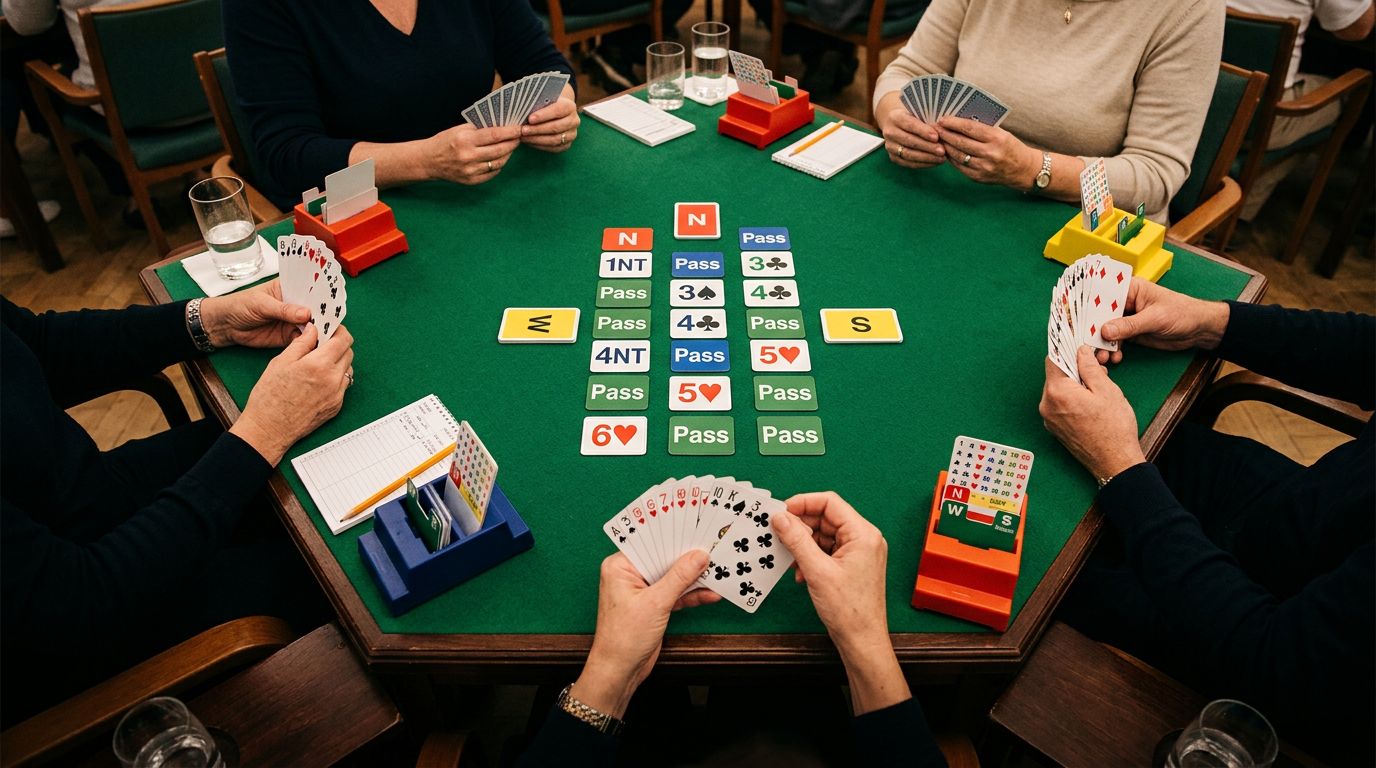
When Opponents Interfere Over Your 1NT
Partner opens 1NT. You’re about to bid 2♣ Stayman when RHO bids 2♥. Now what?
Or worse: Partner opens 1NT, RHO doubles. What does your bid mean? Is 2♣ still Stayman? Is everything the same?
When opponents interfere over 1NT, you need a system. Without one, you and partner will have disasters. This article gives you that system.
The Three Main Approaches
There are three common methods for handling interference:
- Systems On - All your normal bids (Stayman, transfers) still apply
- Systems Off - Everything is natural
- Lebensohl - A more sophisticated method using 2NT as a relay
Most serious pairs play Lebensohl or a variant. We’ll cover all three.
Systems On (Simple But Limited)
With “systems on,” you pretend the interference didn’t happen. 2♣ is still Stayman, 2♦ is still a transfer to hearts, etc.
After 1NT - (2♦) - ?
- 2♥ = Transfer to spades
- 2♠ = Transfer to clubs
- 2♣ = Stayman (if you play it still works)
- 3♦ = Natural, invitational
- Double = Penalty
Pros: Simple. You already know the system.
Cons: Limited. You can’t show weak hands wanting to compete, and you can’t show different strength ranges effectively.
Most pairs abandon systems on once they learn Lebensohl.
Systems Off (Natural)
With “systems off,” all bids become natural. 2♥ shows hearts, 2♠ shows spades, etc. No transfers, no Stayman.
After 1NT - (2♥) - ?
- 2♠ = Natural, spades, competitive
- 3♣ = Natural, clubs, competitive
- 3♦ = Natural, diamonds, competitive
- 3♥ = Cuebid (asking for stopper, forcing to game)
- Double = Penalty
- 2NT = Natural, invitational
Pros: Simple, intuitive.
Cons: Can’t differentiate between invitational and game-forcing hands. Can’t show weak hands wanting to run.
This works for beginners but lacks nuance.
Lebensohl (The Standard Expert Method)
Lebensohl solves the problems with systems on and systems off. It uses 2NT as an artificial relay to create bidding space. Here’s how it works.
The Basic Principle
After 1NT - (2♥) - ?
Direct bids at the 3-level = Game-forcing, stopper in their suit
2NT followed by 3-level bids = Competitive/invitational, no stopper (or different meaning by agreement)
The 2NT bid is artificial. It forces opener to bid 3♣, after which responder clarifies their hand.
Lebensohl After 2♥ Overcall
1NT - (2♥) - ?
Direct competitive bids:
- 2♠ = Natural, competitive (non-forcing)
- 3♣ = Natural, game-forcing
- 3♦ = Natural, game-forcing
- 3♠ = Natural, game-forcing
- 3♥ = Cuebid, Stayman (asking for four-card spades), stopper in hearts, game-forcing
- 3NT = Natural, to play, showing heart stopper
Via Lebensohl (2NT):
- 2NT = Artificial relay (forces opener to bid 3♣)
- Then pass 3♣ = Weak hand with clubs, wants to play 3♣
- Then 3♦ = Weak hand with diamonds, wants to play 3♦
- Then 3♠ = Competitive with spades (more than 2♠ immediate, but less than 3♠ immediate)
- Then 3♥ = Stayman, denies heart stopper
- Then 3NT = To play, denies heart stopper
Double: Penalty
Example Hands After 1NT - (2♥) - ?
Example 1: Competitive spades
♠ Q 10 9 6 4
♥ 8 3
♦ K 7 4
♣ 10 6 2
Bid 2♠. This is competitive, non-forcing. You’re saying “We have spades, let’s compete.” If you had game-forcing values, you’d bid 3♠ directly.
Example 2: Weak hand with clubs
♠ 8 3
♥ 7 4
♦ 10 7 4
♣ Q J 9 6 4 2
Bid 2NT (Lebensohl). When partner bids 3♣, pass. You’re getting out cheap in your suit.
Example 3: Game-forcing with clubs
♠ 8
♥ A 7
♦ 10 7 4 2
♣ A K J 9 6 3
Bid 3♣ directly. This shows a game-forcing hand with clubs. You’re not messing around with 2NT.
Example 4: Game values, heart stopper
♠ K 8 6
♥ K J 9
♦ Q 7 4 2
♣ 10 6 3
Bid 3NT directly. You have game values and a heart stopper. Done.
Example 5: Game values, no heart stopper
♠ K 8 6
♥ 7 4
♦ A Q 7 4 2
♣ K 6 3
Bid 2NT (Lebensohl), then 3NT after partner bids 3♣. This shows game values but denies a heart stopper. Partner knows to bid a suit if they don’t have hearts stopped either.
Example 6: Stayman with heart stopper
♠ A 10 8 6
♥ K J 9
♦ Q 7 4 2
♣ 10 6
Bid 3♥ (cuebid, Stayman). This asks for four spades and promises a heart stopper. Game-forcing.
Example 7: Stayman without heart stopper
♠ A Q 8 6
♥ 7 4
♦ K 9 7 4 2
♣ 6 3
Bid 2NT (Lebensohl), then 3♥ after partner bids 3♣. This asks for four spades but denies a heart stopper.
Example 8: Penalty double
♠ 8 3
♥ K Q J 10 6
♦ A 7 4
♣ Q 6 2
Double. You have hearts behind their heart bidder. Let’s defend 2♥ doubled.
Lebensohl After 2♠ Overcall
The principles are the same, but the available bids change.
1NT - (2♠) - ?
- 3♣ = Natural, game-forcing
- 3♦ = Natural, game-forcing
- 3♥ = Natural, game-forcing
- 3♠ = Cuebid, game-forcing, asking for stopper
- 3NT = To play, showing spade stopper
- 2NT = Lebensohl (forces 3♣)
- Then pass = Weak with clubs
- Then 3♦ = Weak with diamonds
- Then 3♥ = Weak with hearts
- Then 3♠ = Asks for stopper, no stopper
- Then 3NT = To play, no stopper
You can’t bid 2♥ naturally (partner opened 1NT, probably doesn’t have four hearts). Focus on minor suits and 3NT.
When They Double 1NT
If RHO doubles 1NT (showing a strong hand, usually 15+ HCP), most pairs use:
Redouble = “We’re in trouble, let’s find our best escape” (various runout systems exist)
Pass = “I have something, let’s see what happens”
2♣ = May be Stayman (by agreement) or scrambling
The most common approach: Redouble shows no great suit to run to, and asks partner to bid their suits up the line so you can pick one. Pass suggests you have something and are willing to play 1NT doubled (or planning to defend their runout).
Some pairs play “system on” where all transfers and Stayman still apply.
Example:
♠ 8 6 3
♥ J 9 7 6 4
♦ 10 7 4
♣ 8 3

Partner opens 1NT, RHO doubles
Redouble. You have nothing, and 1NT doubled is going down. Tell partner you want to find a suit to play in.
Example:
♠ K Q 8 6
♥ Q 9 7
♦ A 10 7 4
♣ 6 3

Partner opens 1NT, RHO doubles
Pass. You have 10 HCP. Between your hand and partner’s 15-17, you might make 1NT. Or they might run, and you’ll double their runout. Don’t panic.
When They Bid 2♣ (Artificial or Natural?)
If their 2♣ is artificial (showing majors, for instance), Lebensohl still applies. If it’s natural (showing clubs), decide whether you want systems on or Lebensohl by partnership agreement.
Most pairs treat all two-level interference the same: Lebensohl.
Common Mistakes
Mistake 1: Playing “systems on” and trying to transfer when your transfer bid is the suit they overcalled. If they bid 2♥, you can’t transfer to hearts anymore. Switch to a different method or pass.
Mistake 2: Bidding 3NT without a stopper. If you play Lebensohl and bid 3NT directly, you’re promising a stopper. If you bid 2NT and then 3NT, you’re denying a stopper. Mix these up and partner will be furious.
Mistake 3: Doubling for penalty with three-card length and scattered values. Penalty doubles of two-level overcalls require good trumps (4+ cards, or QJ10xxx type holding). Don’t double with ♥K83.
Mistake 4: Forgetting 2NT is a relay. After you bid 2NT (Lebensohl), partner must bid 3♣. If they bid something else, you’re not on the same page.
Mistake 5: Getting too aggressive. When they interfere, you lose bidding space. Sometimes passing is right. Don’t feel obligated to bid just because you have 8 HCP.
The Simple Lebensohl Memory Aid
Direct = Strong and/or stopper
Via 2NT (Lebensohl) = Weak or no stopper
Direct 3♥ cuebid (after 1NT-2♥-?) = Stayman with stopper
Via 2NT then 3♥ = Stayman without stopper
Direct 3NT = Stopper
Via 2NT then 3NT = No stopper
Direct 3♣ = Game-forcing
Via 2NT then pass 3♣ = Weak with clubs
When to Compete vs When to Pass
Not every hand requires action. If you have:
- Balanced 8-9 HCP with stopper in their suit → Consider passing and defending
- Weak hand (0-7) with no long suit → Pass
- Strong hand (10+) with no fit and no stopper → Bid 2NT (Lebensohl) and scramble
The key: They interfered because they think they can make something or push you too high. Don’t take the bait every time.
Example (pass):
♠ K 8 6
♥ Q 9 7
♦ J 10 7 4
♣ Q 6 3

Partner opens 1NT, RHO bids 2♠
Pass. You have 8 HCP, balanced, and no great suit. Partner has 15-17. If they can make 2♠, fine. If they can’t, you might beat it. Don’t bid 3NT without a spade stopper and no source of tricks.
Example (compete):
♠ 8 6
♥ K Q 10 9 7 4
♦ A 7 4
♣ 6 3

Partner opens 1NT, RHO bids 2♠
Bid 3♥ (game-forcing with hearts). You have a good six-card suit and game values. Don’t let them push you out.
Lebensohl vs Rubensohl
Some pairs play “Rubensohl,” which is a more complex version of Lebensohl. The principles are similar, but the “stopper” and “no stopper” meanings might reverse depending on the sequence. Rubensohl handles some edge cases better, but Lebensohl is more common and easier to learn.
For most players, Lebensohl is enough.
The Decision Tree
After 1NT - (overcall) - ?
- Do I want to double for penalty? (Need good trumps, 4+ cards, honors)
- Do I have game values (10+ HCP)?
- Yes → Bid directly (3-level or 3NT)
- No → Use 2NT (Lebensohl) or pass
- Do I have a stopper in their suit?
- Yes (and game values) → Bid 3NT directly
- No (and game values) → Bid 2NT then 3NT
- Do I want to compete with a suit?
- Game-forcing suit → Bid it directly at 3-level
- Weak suit → Bid 2NT then bid your suit
- Competitive suit (at 2-level, if available) → Bid it directly
Ask Brian About Your Bidding
Not sure what to bid? Describe your hand and the auction to Brian, the Bridgetastic AI, and get instant feedback on the right call. Try Brian free →
The Bottom Line
When they interfere over your 1NT, you need a structure. Systems on and systems off are simple but limited. Lebensohl is the standard expert method and solves most problems.
The core of Lebensohl: 2NT is an artificial relay forcing 3♣. Use it for weak hands that want to play in a suit, or to show game values without a stopper. Direct bids show game-forcing hands with stoppers.
It takes practice, but once you learn it, you’ll handle interference smoothly. And when you forget? Just bid naturally and hope for the best. Nobody dies from a bidding misunderstanding (though your partner might glare at you).
Learn Lebensohl. Your 1NT auctions will thank you.