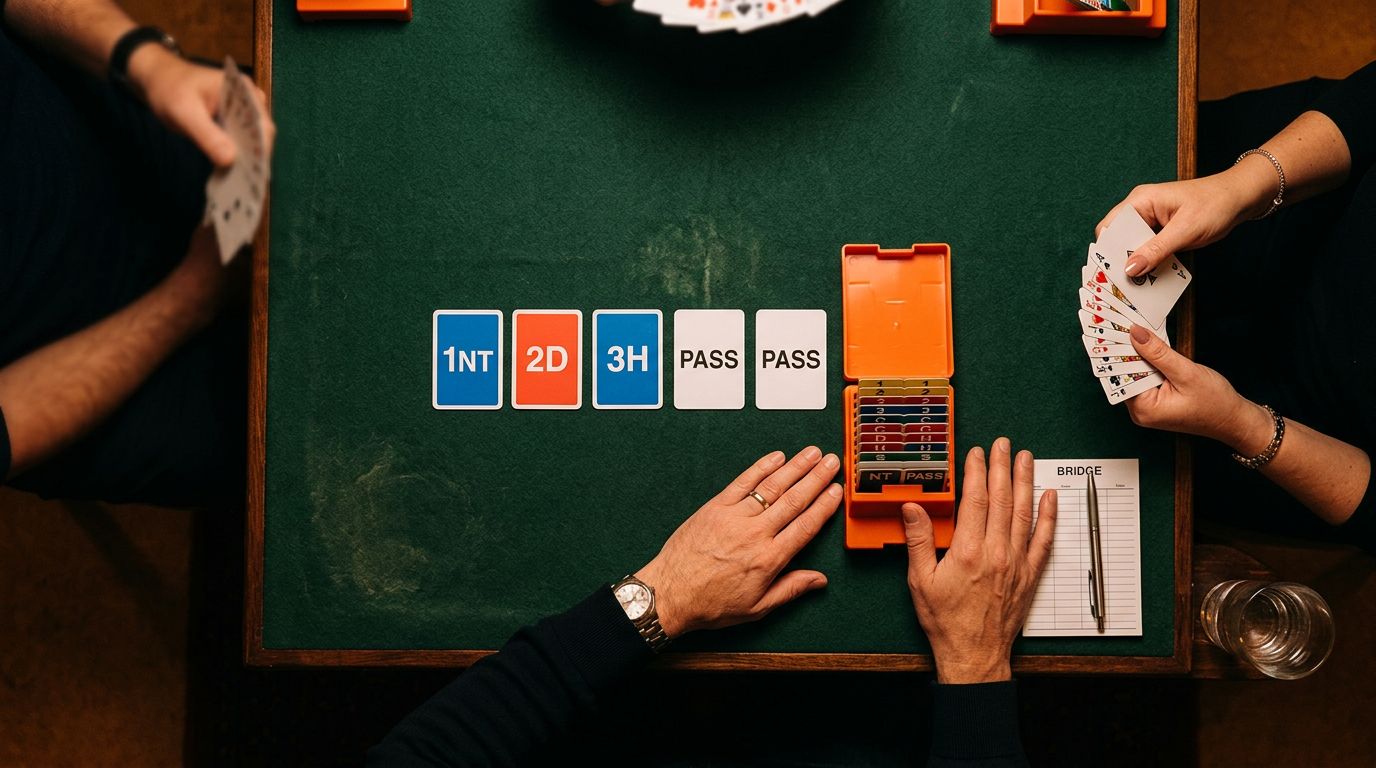
What to Do When Partner Opens 1NT
Partner opens 1NT. You pick up your cards. Now what?
This is the most common auction you’ll face, and most players have a fuzzy understanding of their options. They know Stayman and transfers exist, but when to use them? When to just raise notrump? When to run screaming to a suit?
Let’s fix that. Here’s how to handle every type of hand you’ll pick up.
The Basic Framework
When partner opens 1NT (15-17 HCP in most systems), you need to answer three questions:
1. Where are we playing? (Notrump or suit?)
2. How high are we playing? (Partscore, game, or slam?)
3. How do I get us there? (Direct bid or convention?)
The third question depends on your system, but the first two are universal. Let’s work through the hand types.
Weak Hands (0-7 HCP)
The Bust (0-5 HCP)
Pass. You’re not making anything, and bidding just helps opponents find a good lead.
Exception: If you have a six-card or longer suit, you might be better off in 2 of your suit than 1NT. Bid 2♦, 2♥, or 2♠ as a transfer (if playing Jacoby), or 2♣ if it’s a long club suit (though some pairs use 2♣ as Stayman, so know your methods).
Example:
♠ 8 6 3
♥ J 9 7 6 5 4 2
♦ 5
♣ 8 3
Transfer to hearts with 2♦. Partner bids 2♥, you pass. Seven trumps and a singleton is better than 1NT with nothing.
Garbage Stayman (6-7 HCP, shortness in one major)
This is controversial but works. You have 6-7 HCP and shortness (singleton or void) in one major, with 4+ cards in the other major. Bid 2♣ Stayman hoping to find your 4-4 fit.
If partner bids your short suit, pass 1NT. If partner bids your long suit, raise to 2 of that major. If partner bids 2♦ (no major), pass.
Example:
♠ K 8 6 4
♥ 2
♦ Q 9 7 5 3
♣ J 8 4
Bid 2♣. If partner shows spades, bid 2♠. If hearts or diamonds, pass. You’re looking for your spade fit, and 1NT opposite this shape is ugly.
Some experts hate this. I think it’s fine at matchpoints, risky at IMPs.
Invitational Hands (8-9 HCP)
You might have game if partner has a maximum (16-17).
Balanced 8-9 HCP
Bid 2NT. Partner passes with 15, bids 3NT with 16-17.
Example:
♠ K 8 6
♥ Q 9 5
♦ A 7 4 2
♣ 10 6 3
Bid 2NT. Textbook invitation.
Unbalanced 8-9 HCP with a five-card major
Transfer to your major, then bid 2NT. This shows exactly five cards in your major (not six, not four) and invitational values. Partner can:
- Pass 2NT with a minimum and doubleton in your major
- Bid 3 of your major with 16-17 and three-card support
- Bid 3NT with a minimum and three cards
- Bid 4 of your major with a maximum and three cards
Example:
♠ A Q 9 6 4
♥ 8 3
♦ K 7 5
♣ 10 6 2
Bid 2♥ (transfer to spades), partner bids 2♠, you bid 2NT. Shows five spades, invitational strength.
Unbalanced 8-9 HCP with a six-card major
Transfer, then bid 3 of your major. This shows a six-card suit and invitational values. Partner passes with a minimum, bids 4 with a maximum.
Example:
♠ 7
♥ A J 9 7 6 4
♦ K 8 3
♣ 10 5 2
Bid 2♦ (transfer to hearts), partner bids 2♥, you bid 3♥. Six hearts, invitational.
8-9 HCP with a four-card major
Bid 2♣ Stayman. If partner shows your major, bid 3 of that major (invitational with four-card support). If partner bids 2♦, bid 2NT.
Example:
♠ K 10 8 6
♥ A 5
♦ 9 7 4 2
♣ Q 6 3
Bid 2♣. If partner bids 2♠, bid 3♠ (invitational). If 2♥ or 2♦, bid 2NT.
Game-Going Hands (10-15 HCP)
You’re bidding game. The only question is which one.
Balanced 10-15 HCP, no four-card major
Bid 3NT directly. Done.
Example:
♠ K 9 6
♥ A J 8
♦ Q 10 7 3
♣ K 5 2
Bid 3NT. Don’t overthink it.
10-15 HCP with a four-card major
Use Stayman. If you find your 4-4 fit, bid 4 of the major. If not, bid 3NT.
Example:
♠ A Q 8 6
♥ K 5
♦ J 9 7 3
♣ Q 6 2
Bid 2♣. If partner bids 2♠, bid 4♠. Otherwise, 3NT.
10-15 HCP with a five-card major
Transfer, then:
- With exactly five cards and no slam interest, bid 3NT. Partner chooses between 3NT and 4 of your major.
- With six cards, bid 4 of your major after the transfer.
Example (five cards):
♠ A Q 9 6 4
♥ K 8
♦ Q 7 3
♣ 10 6 2
Bid 2♥ (transfer), partner bids 2♠, you bid 3NT. Shows five spades, game values. Partner picks between 3NT and 4♠.
Example (six cards):
♠ 7
♥ A K J 9 6 4
♦ Q 8 3
♣ 10 5 2
Bid 2♦, partner bids 2♥, you bid 4♥. Six-card suit, we’re playing in hearts.
Both majors (5-4 or 5-5)
Use Stayman first to check for a 4-4 fit. If partner shows a major, bid game in that major. If partner bids 2♦, transfer to your five-card major and bid game.
With 5-5, some play “Smolen” where you use Stayman and then bid your shorter major at the 3-level, but that’s advanced. For now, just start with Stayman.
Slam Interest (16+ HCP or great shape)
With 16+ HCP, you’re in the slam zone. Use your partnership’s methods - could be 4NT quantitative, could be transfers followed by new suits, could be Gerber.
Basic approach: Transfer to your suit (if you have one), then bid a new suit to show slam interest. Or bid 4NT quantitative if balanced.
Example:
♠ A Q 8 6 4
♥ A K
♦ K J 7
♣ Q 10 2
Bid 2♥ (transfer), partner bids 2♠, you bid 3♣. This is forcing and shows slam interest with spades.
The Decision Tree
Here’s the quick reference:
0-7 HCP: Pass (or transfer to long suit and pass)
8-9 HCP: Invite (2NT, or transfer + 2NT/3M depending on suit length)
10-15 HCP: Bid game (3NT, or Stayman/transfer first if you have a major)
16+ HCP: Explore slam
Shape modifiers:
- Six-card major: Transfer and bid it again
- Five-card major: Transfer, then decide based on strength
- Four-card major: Stayman first
- Balanced: Simpler, fewer steps
Common Mistakes
Mistake 1: Transferring with four-card majors. Use Stayman. Transfers show five.
Mistake 2: Bidding 3NT with a six-card major. Transfer and bid game in your suit. The 5-3 fit is usually better than notrump.
Mistake 3: Using Stayman with no four-card major “to explore.” Don’t. If partner bids 2♥ or 2♠, what are you going to do? Just bid 3NT directly if that’s where you’re going.
Mistake 4: Inviting with 10 HCP. You have game. Partner has 15-17, you have 10, that’s 25-27 combined. Bid it.
When You Have Length in Both Majors
If you have four cards in both majors, use Stayman. Easy.
If you have five in one and four in the other, use Stayman. If partner bids your four-card major, you’ve found a 4-4 fit. If not, transfer to your five-card suit.
If you have 5-5, Stayman looking for the 5-3 fit. If no fit found via Stayman, some players use Smolen or just transfer to the better suit.
Ask Brian About Your Bidding
Not sure what to bid? Describe your hand and the auction to Brian, the Bridgetastic AI, and get instant feedback on the right call. Try Brian free →
The Bottom Line
Responding to 1NT is systematic. Figure out how strong you are, figure out your shape, then follow the appropriate path. The conventions (Stayman, transfers) are just tools to describe your hand accurately.
Weak? Get out cheap or pass.
Invitational? Invite.
Game? Bid it.
Majors? Find the fit.
Balanced? Notrump is fine.
Don’t overthink it. Partner opened 1NT to make your life easier. Take advantage of that balanced hand and do what makes sense.