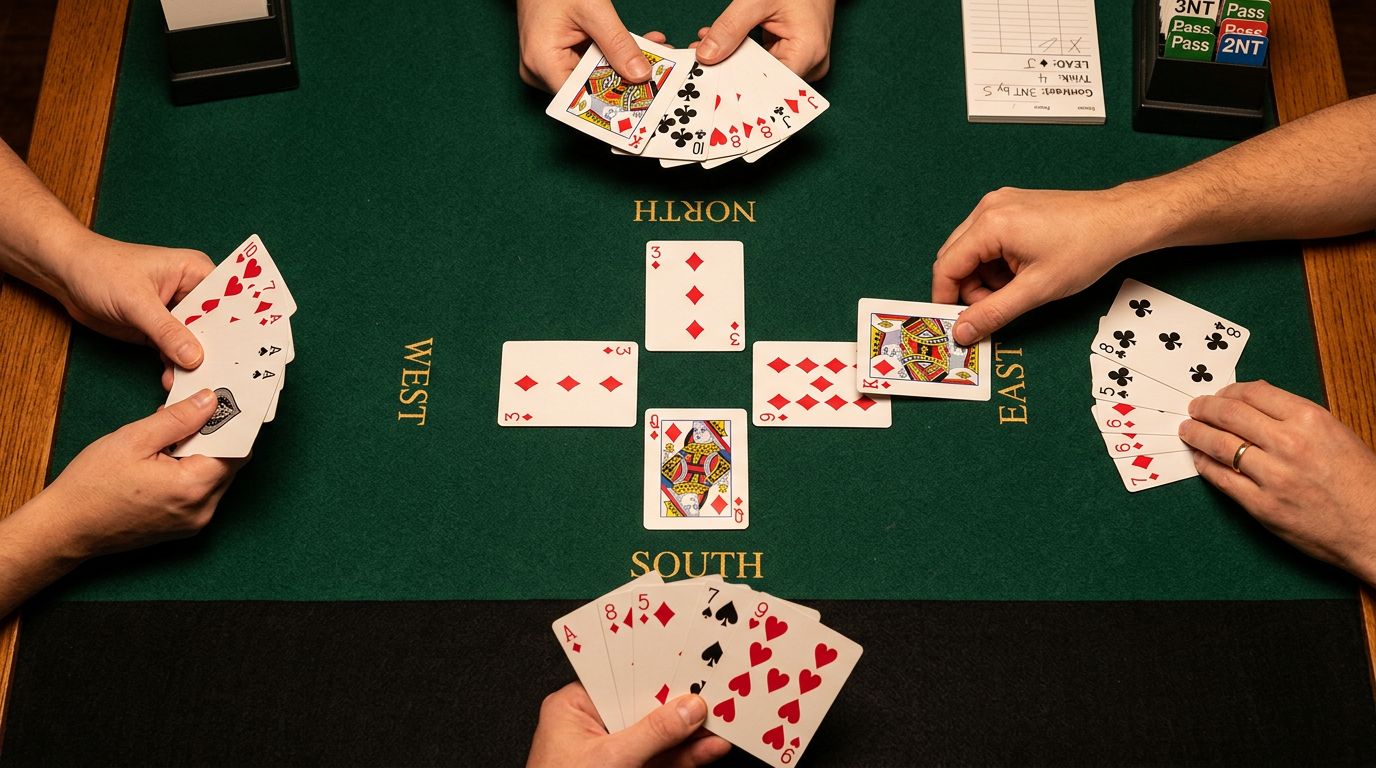
Bridge Signals: Attitude, Count, and Suit Preference
When you’re defending in bridge, you can’t speak to your partner. You can’t point at cards, tap the table, or wink knowingly across the felt. But you can signal, and if you do it well, your partner will read your cards like you’re shouting them across the room.
Signaling (also called carding) is the art of using the specific cards you play to send legal messages to your partner. Play a high card, and you might be saying “I love this suit!” Play a low one, and it’s “Please look elsewhere.” It’s a secret language that every defender needs to speak fluently.
What Is Signaling?
Signaling is partner communication during defense through the deliberate choice of which card to play when you have options. When you follow suit and have several cards that won’t win the trick, which card you play can tell your partner something valuable.
The beauty of signals is that they’re completely legal. Unlike the infamous foot-tappers and coffee-stirrers who’ve been banned from clubs worldwide, signals use only the cards themselves. Declarer can see your signals too (and good declarers watch for them), but the information usually helps the defenders more.
There are three main types of signals in bridge:
- Attitude signals – showing whether you like or dislike a suit
- Count signals – showing partner how many cards you hold in a suit
- Suit preference signals – pointing partner toward a specific suit
Attitude Signals: Do You Like This Suit?
Attitude signals are the most common and most important defensive signals. They answer one simple question: “Partner, do you want me to continue this suit?”
Standard Attitude Signals
In standard signals (used by most players worldwide):
- High card = encouraging (Yes! I like this suit!)
- Low card = discouraging (No thanks, try something else)
When your partner leads the ♠A against a notrump contract and you hold ♠Q52, you’d play the ♠5 to encourage. “Keep going, partner—I’ve got something good here!” With ♠862, you’d play the ♠2 to discourage. “Nothing for me in spades, look elsewhere.”
The key word is relative. You’re not promising specific cards, just showing interest. If you’re dealt ♥974 and partner leads the ♥A, your ♥9 is encouraging—it’s the highest card you can afford. Sure, you don’t have the king or queen, but you’ve got length. Partner can continue and maybe establish your ♥7 as a trick.
When to Give Attitude
You give attitude signals in two main situations:
1. When partner leads a suit
Partner leads the ♠K. Do you have the ♠A or ♠Q? Encourage. Got nothing? Discourage. Partner is asking a question—answer it!
2. When you’re discarding
When you can’t follow suit, your discard often shows attitude toward the suit you’re throwing away. Discard a high ♣, and you’re probably showing interest in clubs. Discard a low ♥, and you’re denying heart values.
Example: Attitude Signal in Action
         North (Dummy)
         ♠ K 7 4
         ♥ Q 6 3
         ♦ A 8 5 2
         ♣ J 9 4

West (You)                East (Partner)
♠ A Q 6 2                 ♠ 10 8 5
♥ 9 5 2                   ♥ A J 10 4
♦ J 7 4                   ♦ Q 6 3
♣ 8 6 3                   ♣ 7 5 2

         South (Declarer)
         ♠ J 9 3
         ♥ K 8 7
         ♦ K 10 9
         ♣ A K Q 10
You’re defending 3NT. You lead the ♠2 (fourth-best from your longest suit). Dummy plays low, partner plays the ♠10, and declarer wins the ♠J.
Declarer starts running clubs. On the third round, partner discards the ♥10. That’s a high heart—an attitude signal screaming “I’ve got good hearts!”
When you get in with the ♠A, you shift to hearts. Partner takes the ♥A and returns the suit, and you beat the contract. Without that heart signal, you might have continued spades and let declarer make an impossible contract.
Count Signals: How Many Do You Have?
Count signals tell partner how many cards you hold in a suit. This helps partner figure out declarer’s distribution and make the right defensive decisions.
Standard Count Signals
In standard count signals:
- High-low = even number (2, 4, or 6 cards)
- Low-high = odd number (1, 3, or 5 cards)
With ♥Q72, you’d play the ♥7 then the ♥2 (high-low) to show three cards—an odd number. With ♥Q742, you’d play the ♥2 then the ♥4 (low-high) to show four cards—an even number.
When to Give Count
Count signals are most useful in these situations:
1. When declarer (not partner) leads a suit
Declarer leads the ♥K from dummy. You should give count. If declarer has ♥AK opposite dummy’s ♥QJ3, knowing whether you have two or three hearts helps partner decide when to take the ace.
2. When partner leads an honor suggesting a solid sequence
Partner leads the ♠K (promising the queen). Give count so partner knows whether to continue the suit or switch.
3. Against suit contracts where counting trump is critical
When declarer starts drawing trump, defenders give count so everyone knows how many trump are still out.
Example: Count Signal in Action
         North (Dummy)
         ♠ 6 4
         ♥ K Q J 10
         ♦ A 5 3
         ♣ 9 7 6 2

West (Partner)                East (You)
♠ K Q J 10 3                  ♠ 8 7 2
♥ 6 5                         ♥ 9 4 3
♦ K 8 4                       ♦ Q 10 7 6
♣ J 5 3                       ♣ A 8 4

         South (Declarer)
         ♠ A 9 5
         ♥ A 8 7 2
         ♦ J 9 2
         ♣ K Q 10
Partner leads the ♠K against 3NT. Declarer ducks. Partner continues with the ♠Q, and declarer ducks again. On the third spade, you play ♠2, then ♠7, then ♠8 (low-high-higher = three cards, odd number).
Partner knows you started with three spades, which means declarer had three as well. When declarer ducks the third spade, partner can confidently exit safely in another suit rather than giving declarer a ninth trick. Partner knows declarer has no more spades and can’t run the suit.
Suit Preference Signals: Where Should I Go?
Suit preference signals don’t comment on the suit you’re playing, they point partner toward a different suit you want led.
How Suit Preference Works
When giving suit preference:
- High card = higher-ranking suit
- Low card = lower-ranking suit
- Middle card = no preference
The key is recognizing when a card is suit preference. It’s not always! Suit preference situations are specific:
1. When giving partner a ruff
You lead the ♥A, and partner follows with the ♥2. You know partner is out of hearts (from the bidding or count signals). You give partner a ruff. Your choice of heart tells partner what to return:
- Lead the ♥K (high heart) = return spades (the higher side suit)
- Lead the ♥3 (low heart) = return clubs (the lower side suit)
- Lead the ♥7 (middle heart) = I don’t care
2. When returning partner’s suit
Partner leads the ♦K, you win the ♦A and want to return the suit. You have ♦A943. Which diamond you return can show suit preference for your next lead.
3. When making an obvious discard
When you’re known to be out of a suit and you discard from it, the specific card can show suit preference.
Example: Suit Preference in Action
         North (Dummy)
         ♠ A 7 6
         ♥ 10 9 8 7
         ♦ K Q J
         ♣ K Q 5

West (You)                    East (Partner)
♠ K Q 9 4 2                   ♠ 10 3
♥ A 6                         ♥ 5 4 3 2
♦ 8 7 4                       ♦ A 6 5 3
♣ 7 4 2                       ♣ A 9 6

         South (Declarer)
         ♠ J 8 5
         ♥ K Q J
         ♦ 10 9 2
         ♣ J 10 8 3
You’re defending 4♥. You lead the ♠K, and partner plays the ♠10 (high card, encouraging). You continue with the ♠Q, and partner follows with the ♠3.
You know from the bidding that declarer has at least three hearts and probably started with three spades. You lead a third spade. Partner ruffs, but what should partner return?
Here’s where suit preference shines. You lead the ♠9 (a high spot card). Spades are the highest-ranking suit, so you’re telling partner to return the next-highest suit below spades: diamonds (not clubs, the lowest suit).
Partner returns the ♦3, you win dummy’s honor with the ♦A, and give partner another spade ruff. Down one!
Standard vs. Upside-Down Signals
Most of the world plays standard signals, but you’ll encounter upside-down signals at higher levels.
Upside-Down Signals
In upside-down signals, everything reverses:
Attitude:
- Low card = encouraging
- High card = discouraging
Count:
- Low-high = even number
- High-low = odd number
Why Play Upside-Down?
Upside-down has a practical advantage: when you want to encourage, you play a low card and keep your high cards. With ♣Q94, if partner leads the ♣A, you play the ♣4 to encourage (upside-down). You’ve kept the ♣Q9 intact.
In standard, you’d have to play the ♣9, potentially setting up declarer’s ♣8.
The downside? It’s confusing if you haven’t discussed it with partner. Always confirm your methods before you play!
Common Signaling Mistakes
Even experienced players mess up signals. Here are the biggies:
1. Giving the Wrong Signal Type
The mistake: Partner leads the ♥K against 3NT. You have ♥Q72. You play the ♥7 (high card). Partner thinks you’re giving count, showing an even number. They continue hearts—but declarer has ♥AJ and takes nine tricks before you get back in.
The fix: When partner leads against notrump, attitude matters most. Play the ♥2 to discourage (you have the queen but only three hearts—not enough to run the suit). Save count signals for when declarer leads.
2. Signaling When You Shouldn’t
The mistake: You’re sitting over dummy’s ♠KQJ10 in a suit contract. Declarer leads the ♠K. You have ♠A943 and play the ♠9 to show four cards. Declarer sees your signal, plays for the drop, and makes the contract.
The fix: Don’t help declarer! When your count helps declarer more than partner, play a random middle card. Save clear signals for when partner needs the information.
3. Mixing Up Suit Preference and Count
The mistake: Partner gives you a ruff. You have the ♦A and the ♣A. Partner leads a high spot card (which you think is count), so you return a random suit. Wrong! It was suit preference.
The fix: Context is everything. When partner is giving you a ruff, they’re not showing count, they’re out of the suit! The card is suit preference. Learn to recognize the different situations.
4. Forgetting What You’re Showing
The mistake: On the first trick, you play the ♥7 from ♥Q74 to encourage. Later, when you play the ♥4 and then the ♥Q, partner thinks you started with five hearts (playing low-high).
The fix: Stay consistent. Once you’ve shown attitude, continue with consistent carding. If you’ve already played the ♥7 for attitude, don’t try to give count later in the same suit—partner’s already confused.
5. Signaling With Cards You Need
The mistake: You have ♣Q103. Partner leads the ♣A. You play the ♣10 to encourage—but now declarer’s ♣J9 are both winners.
The fix: Signals should be free cards you can afford. With ♣Q103, play the ♣3. Yes, it’s discouraging in standard methods, but you can’t afford the ♣10. Sometimes accurate defense beats perfect signaling.
Partnership Agreements You Need
Before you sit down with a new partner, nail down these signal agreements:
1. Standard or Upside-Down?
Ask: “Do you play standard signals or upside-down?”
Most social players use standard. Tournament players increasingly prefer upside-down. If your partner says “standard,” you know:
- High = encouraging (attitude) / even (count)
- Low = discouraging (attitude) / odd (count)
2. Attitude or Count on Partner’s Leads?
Ask: “When you lead the king, do you want attitude or count?”
Standard is attitude (encourage or discourage). Some partnerships play count signals when partner leads an honor.
3. Suit Preference: Always or Selective?
Ask: “Do you play suit preference signals?”
Some players use suit preference only on ruffs. Others use it more broadly (like when returning partner’s suit). Make sure you’re on the same page.
4. Trump Signals?
Ask: “Do we give count in trump?”
Against suit contracts, when declarer leads trump, most partnerships give count. But confirm it!
5. Odd/Even Discards?
Ask: “Do you play any special discarding methods?”
Some partnerships use odd/even discards (odd card = encouraging, even = discouraging) or revolving discards. If your partner plays natural discards (discard from suits you don’t want), confirm it.
6. Smith Echo in Notrump?
At advanced levels, ask about Smith echo, a special count signal on the first trick of notrump defense. If partner hasn’t heard of it, stick to standard methods.
Your Signal Priorities
When in doubt, follow this priority order:
- Attitude when partner leads – Answer partner’s question first
- Count when declarer leads – Help partner count the hand
- Suit preference in specific situations – Only when context is clear
- When confused, follow suit smoothly – A smooth falsecard is better than a confusing signal
Practice Your Card Play with Brian
Ready to apply these techniques at the table? Brian can walk you through hands that test your card play skills. Try Brian free →
The Bottom Line
Signaling is bridge’s secret language, a completely legal way to communicate with partner when words fail you. Master attitude signals first (they’re the most frequent), add count signals next (they’re the most valuable), and sprinkle in suit preference when the situation’s right.
But remember: signals are guides, not commands. Partner might signal for hearts, but if you can see that hearts are wrong from your hand and dummy, trust your judgment. Signals show what partner sees, not what partner knows.
Play enough hands together, and you’ll start reading each other like a book. That high club your partner just played? You’ll know if it’s “I love clubs!” or “I have four clubs” or “Please switch to diamonds” based on the situation. That’s when defense becomes art.
Now go practice. Partner’s waiting, and they’ve got signals to send you.