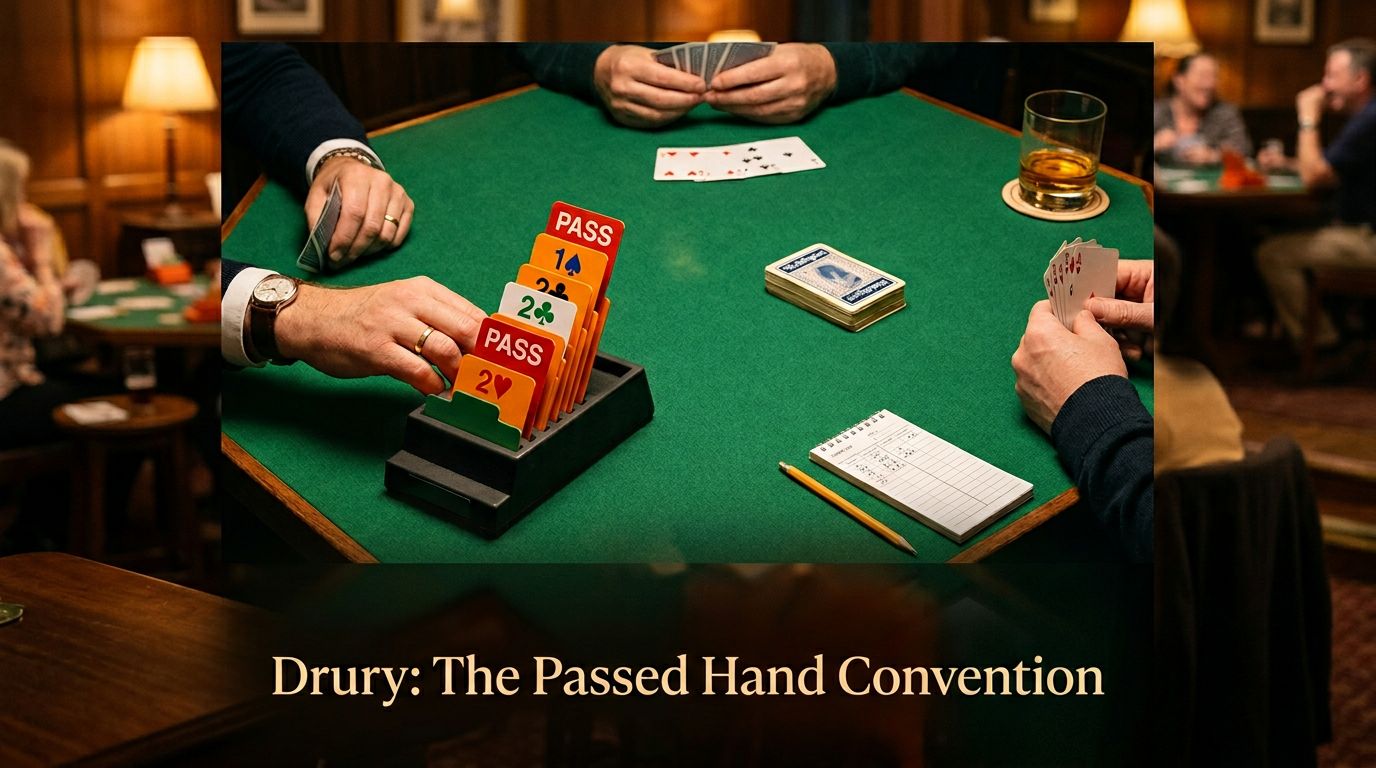
Drury Convention: Check Opener Strength After 3rd or 4th Seat Major Opening
When partner opens 1♥ or 1♠ in third or fourth seat and you’re a passed hand, you face a problem. Should you jump to 3♥ with your 10-count and four-card support? What if partner opened light—something like 9 HCP in third seat?
Drury solves this. As a passed hand, you bid 2♣ to show three-card support and 10-12 HCP (some play 8-11). Opener then clarifies: are they light or do they have a real opening?
Why Drury Exists
In first or second seat, partner’s opening bid promises full values. When you have support and 10 points, you know the partnership has at least 23 combined points, enough to explore game.
But third and fourth seat? Different story. Many players open light: that 11-count with good shape, that 10-count with two quick tricks. These are smart tactical bids, but they create a problem when partner has a genuine fit and values.
Without Drury:
Pass - 1♠ - 3♠ (10 HCP, 4-card support)If opener has 9 HCP, you’re now in 3♠ with 19 combined points. Going down. Badly.
With Drury:
Pass - 1♠ - 2♣ (Drury: support + values)
      - 2♠ (light opening)
Pass
You stop at the two-level. Crisis averted.
How Standard Drury Works
After you pass and partner opens 1♥ or 1♠ in third or fourth seat:
| Your Call | Meaning |
|---|---|
| 2♣ (Drury) | 3+ card support, 10-12 HCP |
| Other raises | Natural, but denies 10+ HCP |
Opener’s rebids:
| Opener Rebids | Meaning |
|---|---|
| 2♦ | Light opening, sign off in 2M |
| 2M | Full opening (13+), invitational |
| Other | Natural, game interest |
The 2♦ rebid is artificial—it means “I don’t have a real opener, please stop at two of my major.”
Reverse Drury: The Modern Version
Standard Drury has a flaw: the 2♦ rebid takes up space. If opener wants to show a full opening, they have to bid 2M or higher, making the auction awkward.
Reverse Drury flips the meanings:
| Opener Rebids | Meaning (Reverse Drury) |
|---|---|
| 2♦ | Full opening, 13+ HCP |
| 2M | Light opening, please pass |
Now when opener has a real hand, they bid 2♦ and responder can make further tries. When opener is light, they just rebid their major and everyone passes.
Most experienced players use Reverse Drury. It’s more efficient.
Requirements for the 2♣ Call
To bid 2♣ Drury, you need:
- You’re a passed hand - If you didn’t pass, 2♣ means something else
- Partner opened 1♥ or 1♠ - Not 1♣ or 1♦
- Three-card support minimum - Some require four
- 10-12 HCP - Or 8-11 in some partnerships
- Partner opened in 3rd or 4th seat - That’s when they might be light
If partner opened in first or second seat? Standard methods apply, they have a real opener.
Opener’s Full Rebid Structure (Reverse Drury)
After 1♠ - 2♣ (Drury):
| Rebid | Meaning |
|---|---|
| 2♦ | Full opening, extras |
| 2♥ | Natural, 5+ spades + 4 hearts, full values |
| 2♠ | Minimum opening, sign off |
| 2NT | 18-19 balanced, spade suit |
| 3♣ | Natural, game forcing |
| 3♦ | Natural, game forcing |
| 3♠ | Invitational, 6+ spades |
| 4♠ | To play |
After 2♦ (full values), responder can make further tries, check for controls, or just bid game.
Two-Way Drury
Some partnerships play Two-Way Drury, using both 2♣ and 2♦:
| Bid | Meaning |
|---|---|
| 2♣ | 3-card support, limit raise values |
| 2♦ | 4-card support, limit raise values |
This gives opener more information but requires giving up the natural 2♦ response. Most pairs stick with regular Drury (only 2♣).
Example Hands
Example 1: Light Opener, Dodge Disaster
You (responder): ♠Q73 ♥K84 ♦AJ6 ♣J965
Auction:
You    Partner
Pass   1♠ (3rd seat)
2♣     2♠ (light)
Pass
You passed initially with 11 HCP (maybe you had 3-3-3-4 shape). Partner opened 1♠ in third seat. You have spade support and values, so you bid 2♣ (Drury).
Partner rebids 2♠, showing a light opener. You stop. If you’d raised to 3♠ directly, you’d be too high with only 20 combined points.
Example 2: Full Opener, Make Game
You (responder): ♥K942 ♠A8 ♦Q763 ♣K84
Opener: ♥AQJ76 ♠K3 ♦A84 ♣Q52
Auction (Reverse Drury):
You    Partner
Pass   1♥ (3rd seat)
2♣     2♦ (full opening)
4♥
After 2♦ (showing a real opener), you know the partnership has 25+ combined points with a heart fit. Bid game.
Example 3: Game Try Accepted
You (responder): ♠KJ4 ♥873 ♦AQ6 ♣9742
Opener: ♠AQ9762 ♥AK ♦84 ♣KJ6
Auction (Reverse Drury):
You    Partner
Pass   1♠ (3rd seat)
2♣     2♦
3♣     3♠
4♠
You bid 2♣ (Drury). Partner shows full values with 2♦. You make a game try with 3♣ (help suit game try). Opener bids 3♠, invitational. With your maximum and controls, you accept.
Example 4: Stop Short
You (responder): ♥Q84 ♠K76 ♦J942 ♣A73
Opener: ♥AJ972 ♠A2 ♦K3 ♣Q842
Auction (Reverse Drury):
You    Partner
Pass   1♥ (4th seat)
2♣     2♦
2♥     Pass
You have minimum Drury values (10 HCP). After 2♦ shows full values, you sign off at 2♥. Partner has opening values but recognizes you’re at the bottom of your range. 2♥ makes, game might not.
Common Mistakes
Using Drury after 1st/2nd seat openings
Drury only applies when partner opens in third or fourth seat. If they opened in first seat, use standard methods.
Forgetting you’re a passed hand
If you open the bidding, then later bid 2♣ over partner’s major, that’s natural—not Drury. Drury requires you to have passed initially.
Bidding Drury without support
Don’t use 2♣ as a general inquiry. You need actual support for partner’s major (three cards minimum, some play four).
Wrong point range
With 6-9 HCP, raise normally. With 13+ as a passed hand, wait, you can’t have 13+ and be a passed hand. If you somehow do (maybe 4-3-3-3 with scattered queens), just raise and hope.
Confusing Standard and Reverse
Know which version your partnership plays. In Standard, 2♦ shows a light opener. In Reverse, 2♦ shows full values. Getting this backwards is catastrophic.
Partnership Agreements
Discuss these with your partner:
- Point range: 10-12 or 8-11 for the Drury bid?
- Card support: Three-card minimum or four?
- Standard or Reverse: Which rebid structure?
- Two-Way Drury: Are you using 2♦ to show four-card support?
- After 2♦ (Reverse): How do you continue? Game tries? Control bids?
- Fourth suit forcing: Does it still apply in Drury auctions?
The most common modern agreement: Reverse Drury with 10-12 HCP and three-card support minimum.
Why Passed Hand Support Is Different
When you’re not a passed hand and raise partner’s major to the three-level, you’re showing invitational values (10-12 points) and a fit. Partner knows you didn’t have enough to open but you have a good hand.
As a passed hand, the same raise creates ambiguity. Did you pass with a balanced 11-count? Or did you pass with 6 HCP? Partner can’t tell, and if they opened light in third seat, they can’t risk accepting your invite.
Drury cuts through this fog. The 2♣ bid says “I’m limited by my original pass, but I’m at the top of what a passed hand can have, with support.” Opener then shows whether they’re worth facing that or not.
It’s the difference between “I couldn’t open” (could be anything from 0-12 HCP) and “I couldn’t open but I have 10-12 HCP with support” (very specific). That precision saves you from bidding too much when opener is light and gets you to game when opener has full values.
Frequently Asked Questions
Q: Does Drury apply in first or second seat?
A: No. Drury only applies when partner opens 1♥ or 1♠ in third or fourth seat. First and second seat openings promise full values, so there’s no need for Drury.
Q: What if I’m a passed hand with four-card support but only 8 HCP, should I bid Drury?
A: Depends on your agreement. Some play 8-11 HCP for Drury, some play 10-12. If you’re playing 10-12, just raise to 2M with 8 HCP. Don’t stretch the convention.
Q: Can opener have a real club suit when they rebid 2♦ in Reverse Drury?
A: No, 2♦ is artificial in both versions. In Standard Drury, it shows a light opener. In Reverse Drury, it shows full values. Either way, it says nothing about diamonds.
Q: What if I have three-card support but 13 HCP as a passed hand?
A: This shouldn’t happen often (you’d usually open 13 HCP). If you passed with exactly 13 HCP balanced (like 4-3-3-3), bid Drury anyway, you’re still in the support-with-values category. Just be more aggressive in the subsequent auction.
Q: Should I alert Drury?
A: In ACBL, Drury should be alerted. It’s conventional (2♣ doesn’t show clubs). Announce “Drury” or “support with values” if asked. Check local regulations for other jurisdictions.
Q: What’s the difference between Standard Drury and Reverse Drury?
A: The opener’s rebid. In Standard, 2♦ = light, 2M = full values. In Reverse, 2♦ = full values, 2M = light. Reverse is more efficient and widely played.
Q: If partner opens in fourth seat, aren’t they always full values since they could have passed?
A: Not necessarily. In fourth seat, you might open light with good shape to compete or because you have the right major suit. Drury still applies, opener might have 11-12 HCP instead of 13+.
Q: What if opponents interfere after my Drury bid?
A: Good question. After 1♠ - 2♣ - (2♥), opener can pass (light), double (full values, competitive), or bid naturally. Discuss your defensive agreements.
Practice This Convention with Brian
Want to test your understanding of this convention in realistic hands? Brian, the Bridgetastic AI, can deal you practice hands, walk you through the bidding, and explain when this convention applies, and when it doesn’t. Try Brian free →