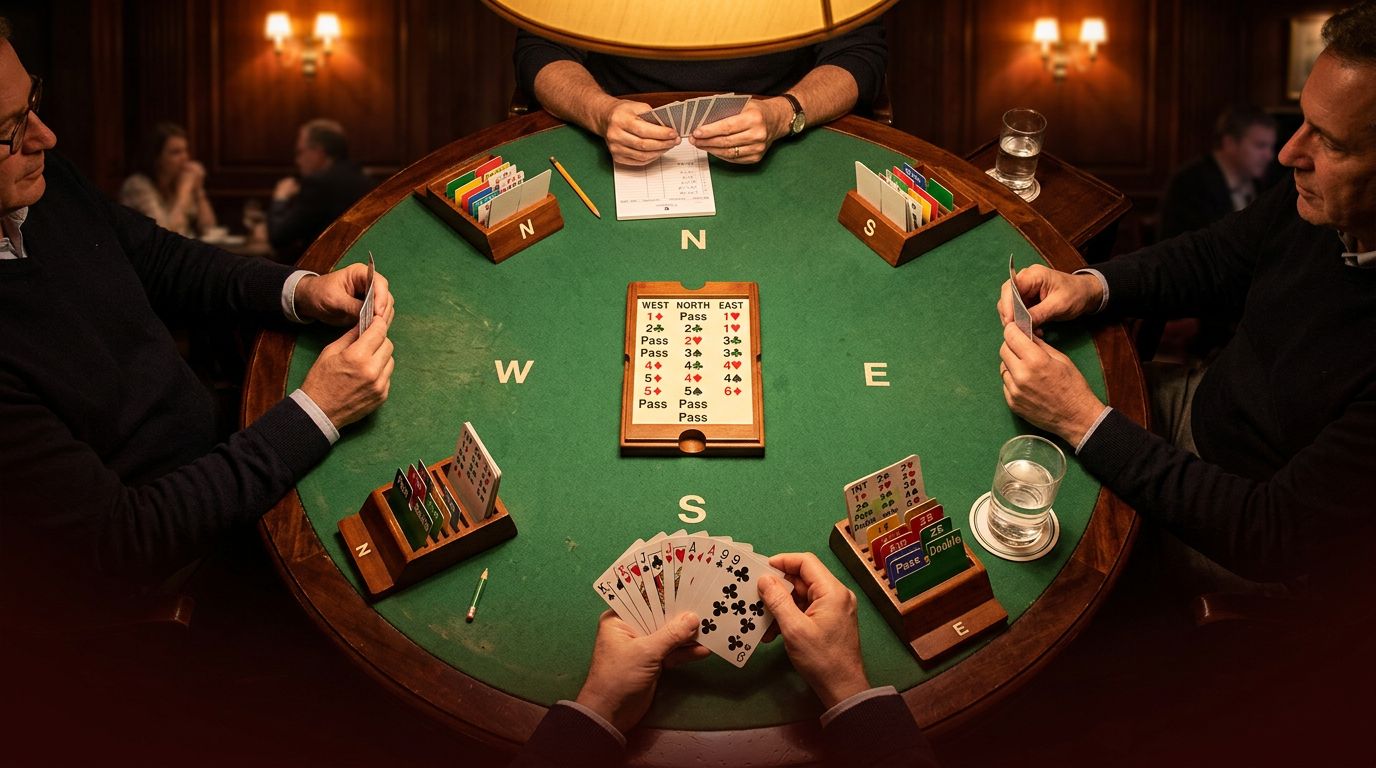
Forcing Pass: How to Share Competitive Decisions with Par...
You’re in a game-forcing auction. You and partner have 26+ points and have agreed on spades. Then the opponents bid 5♥ over your 4♠. It’s your turn.
What do you do?
If you pass, partner might think you’re done, that you’re willing to defend. But what if you want partner to decide? You have some defense but also a reason to compete. How do you share this decision instead of making it alone?
Enter the forcing pass.
A forcing pass is exactly what it sounds like: a pass that forces partner to take action. You’re not dropping out. You’re not saying “let’s defend.” You’re saying “partner, you decide, double them or bid on. I’m okay with either, but we’re not passing this out.”
This is one of the most sophisticated tools in competitive bidding. It turns high-level decisions from solo guesses into partnership conversations. Instead of one player gambling on a five-level decision, both players contribute information and share the risk.
Let’s learn when forcing passes apply and how to use them without creating disasters.
What Is a Forcing Pass?
A forcing pass is a pass that demands partner take action, either double (for penalty) or bid (to compete). You cannot pass it out. The auction must continue.
The forcing pass says three things:
- “I’m not dropping out”, We’re in a game-forcing auction, and I’m still engaged
- “I have some defense”, I’m suggesting defending might work, but I’m not certain
- “You decide”, I trust you to evaluate whether to double or bid on based on your hand
Compare this to a standard pass, which says “I’m done, let’s defend this contract.” In forcing pass situations, passing has a completely different meaning. It’s cooperative, not passive.
Example auction:
You      LHO     Partner  RHO
1♠       2♥      4♠       5♥
?
Your partnership forced to game. If you pass here, partner must act. Your pass doesn’t end the auction—it asks partner to double (penalty) or bid 5♠. You’re sharing the decision.
When Are Passes Forcing?
Not every pass is forcing. You need to establish a forcing pass situation first.
Forcing passes apply when:
- Your side has forced to game — Someone showed game-forcing values (opening 2♣, jump shift, splinter, Jacoby 2NT, etc.)
- Below the slam level — Usually applies through 5♠
- After they interfere, Opponents compete over your game-forcing auction
The key requirement is game-forcing values. If the auction is merely invitational or competitive, passes are not forcing. You need clear game-forcing action by your side before forcing pass situations kick in.
Examples of forcing pass situations:
✅ Forcing pass applies:
You      LHO     Partner  RHO
1♥       Pass    2♣ (GF)  2♠
4♥       5♠      Pass     Pass
?
Your side forced to game with the 2♣ response. Partner’s pass of 5♠ is forcing. You must double or bid 6♥.
✅ Forcing pass applies:
You      LHO     Partner  RHO
1♠       Pass    2NT (Jac) 3♦
4♠       5♦      Pass     Pass
?
Partner’s Jacoby 2NT created a game force. Now partner’s pass forces you to act.
❌ Free pass (not forcing):
You      LHO     Partner  RHO
1♥       1♠      2♥       2♠
Pass
No game force established. Your pass is natural—you’re happy to defend 2♠.
❌ Free pass (not forcing):
You      LHO     Partner  RHO
1♠       Pass    3♠ (inv)  4♥
Pass
Partner’s 3♠ is invitational, not forcing. Your pass is voluntary—you’re declining the invitation and willing to defend.
The bright line: game force = forcing pass territory. Without it, passes are natural.
The Three Options in a Forcing Pass Sequence
Once you’re in forcing pass territory, you have three meaningful actions:
1. Pass = “I Suggest Defending”
You have defensive values. Maybe you have trump tricks in their suit, or you have scattered aces and kings. You think defending might be right, but you’re not certain enough to double yourself.
Passing puts the decision in partner’s lap. If partner has offense (shapely hand, few defensive tricks), they’ll bid. If partner has defense too, they’ll double.
What pass shows:
- Defensive-oriented hand (trump tricks, side aces, balanced)
- Willing to defend if partner agrees
- Not strong enough to unilaterally double for penalty
Example hand for passing:
You      LHO     Partner  RHO
1♠       2♥      4♠       5♥
?
Your hand: ♠ A-Q-10-x-x ♥ K-J-x ♦ A-x ♣ x-x-x
Pass. You have defensive values: two aces and heart tricks sitting over their bidder. You’re suggesting defense, but you want partner’s input. If partner has all offense and no defense, they’ll bid 5♠. If they have kings and trump tricks too, they’ll double.
2. Double = “I Want to Defend”
You have significant defensive tricks and you’re confident defending is right. You’re not asking, you’re deciding.
A double in forcing pass situations is still cooperative (partner can pull with extreme shape), but it’s strongly suggesting penalty. You have trump tricks, or quick tricks, or both.
What double shows:
- Strong defensive hand (trump stack, multiple aces, trump tricks)
- Confident we can beat this contract
- Preference for defending over competing
Example hand for doubling:
You      LHO     Partner  RHO
1♠       2♥      4♠       5♥
?
Your hand: ♠ K-Q-x-x-x ♥ K-Q-J-x ♦ A-x ♣ x-x
Double. You have four likely heart tricks plus the ♦A. They’re going down multiple tricks. You want to defend, and you’re telling partner so. Partner can still pull if they have 6-5 shape and no defense, but your double makes your preference clear.
3. Bid = “I Want to Compete”
You have an offensive hand. You have distribution, or extra length in your suit, or a source of tricks. You don’t have much defense, so you’re bidding on.
This is the unilateral action. You’re deciding to compete without asking partner.
What bidding shows:
- Offensive-oriented hand (6+ card suit, shape, source of tricks)
- Minimal defense in their suit
- Confidence we can make our contract (or at least not go down much)
Example hand for bidding:
You      LHO     Partner  RHO
1♠       2♥      4♠       5♥
?
Your hand: ♠ A-Q-J-x-x-x ♥ x ♦ K-Q-x-x ♣ x-x
Bid 5♠. You have a six-card spade suit, a singleton heart, and a side source of tricks in diamonds. You have almost no defense against 5♥. Don’t wait for partner’s opinion—bid on immediately.
Forcing Pass vs. Free Pass Situations
Forcing pass situations:
- Game force established by your side
- Opponents interfere at a high level
- Pass demands partner act
Free pass situations:
- No game force (invitational or competitive auctions)
- Pass is natural and partner can pass too
- No requirement to act
Standard agreement: Game force = forcing pass. No game force = free pass.
The disaster happens when partners misunderstand. You pass thinking it’s forcing. Partner passes thinking it’s free. You defend 3♠ for +50 when you could make 4♥ for +420.
Write it on your card. Discuss with every partner. The distinction between forcing and free passes is critical.
Using Forcing Passes to Share Decision-Making
Instead of one player guessing, both contribute information.
Example of perfect cooperation:
West     North   East    South
1♠       2♥      4♠      5♥
Pass     Pass    Dbl     Pass
Pass     Pass
West: ♠ A-x-x-x-x ♥ K-x ♦ K-Q-x ♣ x-x-x
East: ♠ K-Q-J-x ♥ A-x-x ♦ A-x-x ♣ K-x-x
West passes (forcing) with defensive cards but not enough to double alone. East doubles with three aces and trump tricks. They beat 5♥ doubled for +500.
Example of intelligent disagreement:
West     North   East    South
1♠       2♥      4♠      5♥
Pass     Pass    5♠
West: ♠ A-Q-x-x-x ♥ x-x ♦ K-Q-x ♣ x-x-x
East: ♠ K-J-x-x-x-x ♥ void ♦ A-x-x-x ♣ K-x-x
West suggests defense. East bids 5♠ with a heart void—defense is terrible with West’s heart holding opposite a void. 5♠ makes for +650.
Example Competitive Auctions
Auction 1: Classic Forcing Pass Sequence
West     North   East    South
1♥       1♠      3♥      3♠
4♥       5♠      Pass    Pass
?
West’s hand: ♠ x-x ♥ K-Q-J-x-x-x ♦ A-K-x ♣ Q-x
East’s 3♥ was a limit raise (game-invitational with four trumps). When West bid 4♥, the game force was established. Now East’s pass of 5♠ is forcing.
West should double. You have six heart tricks likely (your K-Q-J sitting over their bidder) plus two diamond aces. They’re going down multiple tricks. East’s pass suggested defense, and you agree strongly.
Auction 2: Responder Uses Forcing Pass
West     North   East    South
1♠       Pass    2♣ (GF) 3♥
4♠       5♥      Pass    Pass
?
West’s hand: ♠ A-Q-x-x-x-x ♥ x ♦ K-x-x ♣ A-x-x
East’s 2♣ game force established forcing pass territory. East’s pass of 5♥ is forcing—they’re suggesting defense but asking West to decide.
West should bid 5♠. You have a six-card suit, a singleton heart, and two aces. You have no defense against 5♥—your heart singleton is useless on defense. Bid 5♠ immediately. East’s defensive-oriented hand (which caused the forcing pass) will likely provide the help you need to make it.
Common Forcing Pass Mistakes
Mistake 1: Passing When You Should Bid Immediately
The biggest error is using forcing passes when you have a clear action.
Wrong:
You      LHO     Partner  RHO
1♠       2♥      4♠       5♥
Pass (forcing)
Your hand: ♠ K-Q-J-x-x-x ♥ void ♦ A-x-x-x ♣ K-x-x
Don’t pass! You have a clear 5♠ bid. A heart void means you have no defense. Don’t ask partner to decide when you already know the answer. Bid 5♠ directly.
Forcing passes are for hands with genuine uncertainty, hands that could reasonably defend or compete. If your hand screams “bid” or “double,” do it immediately.
Mistake 2: Forgetting to Establish a Game Force
Wrong:
You      LHO     Partner  RHO
1♥       2♠      3♥       4♠
Pass (thinking it's forcing)
Your hand: ♠ x-x ♥ A-K-Q-x-x ♦ K-x-x ♣ Q-x-x
Partner’s 3♥ is invitational, not forcing. Your pass is free. If partner has a minimum raise, they’ll pass and you’ll defend 4♠ undoubled—probably a bad result.
Fix: Bid 4♥ directly if you want to compete, or double for penalty if you have spade tricks. Don’t rely on forcing passes when no game force exists.
Mistake 3: Doubling with All Offense, No Defense
Wrong:
You      LHO     Partner  RHO
1♠       2♥      4♠       5♥
Dbl
Your hand: ♠ A-Q-J-x-x-x ♥ x ♦ K-Q-J-x ♣ x-x
This is wrong. You have one defensive trick (maybe two if partner has a spade honor). Your singleton heart is worthless on defense. You have a six-card spade suit and a diamond source. You’re an offensive hand, not a defensive one.
Fix: Bid 5♠. Your distribution and suit quality scream offense. Let partner’s defensive values (which caused their forcing pass) help you make 5♠.
Mistake 4: Pulling Partner’s Penalty Double
Partner should trust your penalty double unless they have extreme distribution (6-5 or void in their suit). Pulling with a balanced hand because you’re “nervous” destroys the value of forcing pass cooperation.
Partnership Agreements Needed
Clear agreements prevent disasters. Discuss these with every partner:
1. When are passes forcing?
Standard: After a game force is established (jump shifts, splinters, Jacoby 2NT, 2/1 auctions).
2. Through what level?
Standard: Through 5♠. At the six-level, different rules apply—discuss explicitly.
3. Can partner pull a penalty double?
Standard: Yes, with extreme distribution (6-5 or void in their suit). Not with balanced hands.
4. Is pass absolutely forcing?
Standard: Yes. Partner must double or bid. Period.
Practice This Convention with Brian
Want to test your understanding of this convention in realistic hands? Brian, the Bridgetastic AI, can deal you practice hands, walk you through the bidding, and explain when this convention applies, and when it doesn’t. Try Brian free →
The Value of Forcing Passes
Forcing passes transform high-level decisions from guessing into partnership conversations. Without them, one player gambles alone. With them, both players contribute information and share the risk.
The forcing pass says “I trust you.” One player suggests defense. The other evaluates offense vs. defense based on their hand. Together, they reach better decisions than either would alone.
Use forcing passes when:
- Your side forced to game
- Opponents compete at a high level
- You have some defense but want partner’s input
Don’t use forcing passes when:
- No game force exists
- You have extreme offense (just bid)
- You have huge defense (just double)
Master the forcing pass, and you’ll turn five-level decisions from coin flips into intelligent cooperation. Your results will improve dramatically.