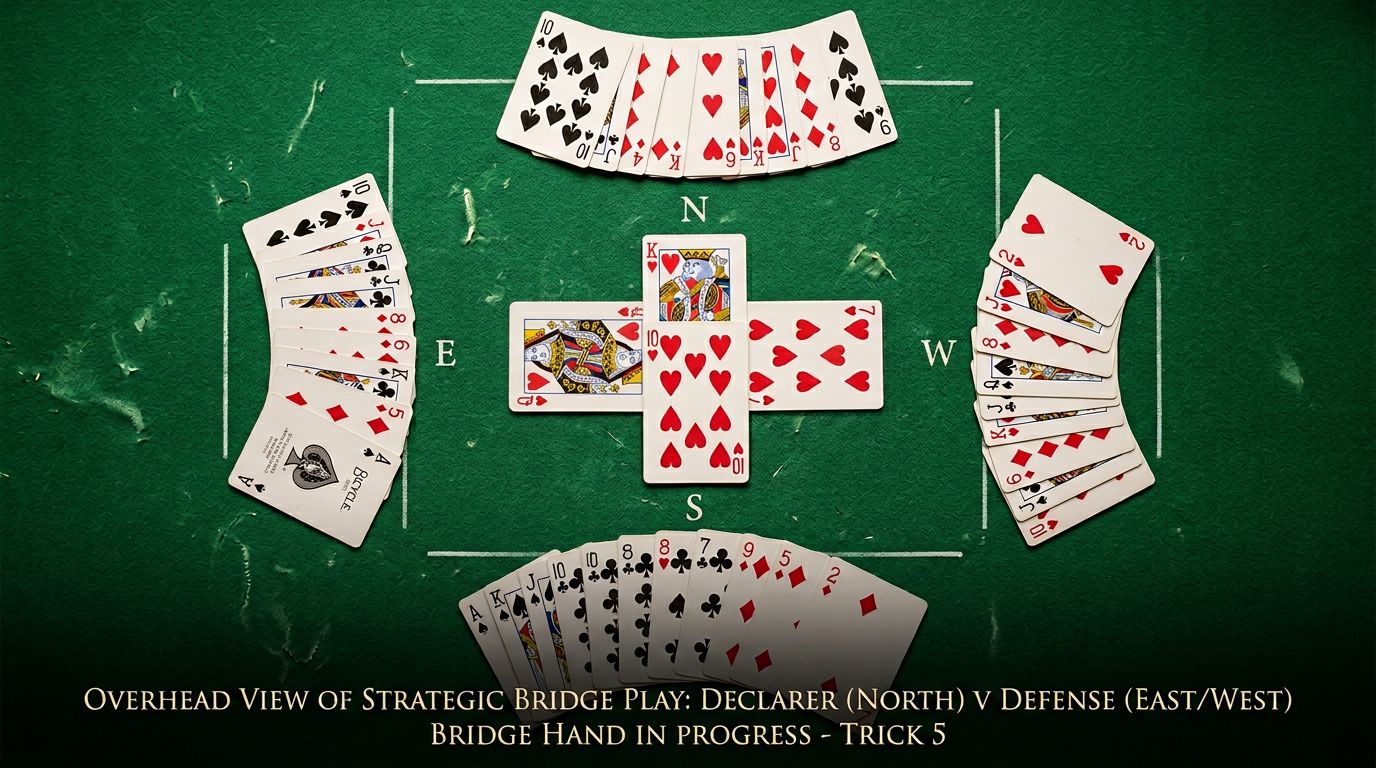
Planning the Play: How to Analyze Dummy and Form Your Str...
The opening lead hits the table. Dummy comes down. And the biggest mistake you can make? Playing a card too fast.
Stop. Look. Plan.
Most contracts are lost at trick one because declarer didn’t take 15 seconds to form a plan. You can’t undo a bad play, but you can avoid it by thinking before you touch dummy’s cards.
The Two-Count System
Your approach depends on your contract type.
In notrump: Count your winners. How many top tricks do you have? How many more do you need? Where will they come from?
In suit contracts: Count your losers. How many tricks will you lose if opponents get their way? How do you eliminate the extra ones?
This sounds basic because it is. But watch an average club game. Half the declarers don’t do it.
The Five-Question Framework
Before playing to trick one, ask yourself:
1. How many tricks do I need?
In 3NT, you need nine. Sounds obvious, but if you have ten cold tricks, don’t risk the contract trying for eleven. Take your winners and run. I’ve seen declarers blow cold contracts because they got greedy.
2. Where are my tricks coming from?
Say you’re in 3NT and have seven top tricks. You need two more. Can you establish dummy’s long suit? Do you have a finesse available? Count every possible source.
3. What can go wrong?
If you finesse immediately, what if it loses? Can they run their suit? Maybe you need to hold up in their suit first. Maybe you need to knock out their ace while you still have stoppers.
4. Do I have enough entries?
This kills more contracts than anything else. You establish five heart tricks in dummy, but you can’t get there to cash them. Count entries to both hands. Plan which ones to use when.
5. Should I draw trumps immediately?
The default is yes. But sometimes you need dummy’s trumps to ruff losers. Or you need to use dummy’s entries before they’re gone. Get this wrong and you’ll fail cold contracts.
Example Hand: Notrump Planning
You’re in 3NT. You hold:
Dummy:
♠ 7 6
♥ A K Q J 10
♦ 8 4 3
♣ 9 6 2
Declarer (you):
♠ A K 3
♥ 6 4
♦ A K Q J
♣ A 7 5 4
They lead the ♠Q. You have 12 top tricks (five hearts, four diamonds, two spades, one club). Take your ace or king and run. Don’t get fancy.
But what if you only had three diamond tricks? Now you have eight tricks and need one more. Where does it come from? You’ll need to knock out their ♣K. But what if they have five spades? You might need to hold up your spade stopper until third round so one opponent can’t reach their partner.
See the difference? Same dummy, but the plan changes based on what you need.
Example Hand: Suit Contract Planning
You’re in 4♥. You hold:
Dummy:
♠ A 7 4
♥ K 6 3
♦ A 8 5 2
♣ 9 6 2
Declarer (you):
♠ 6 3
♥ A Q J 10 9 2
♦ K 7
♣ A K 4
They lead the ♣Q. Count your losers: one spade, potentially one heart if the finesse loses, and one club. That’s three losers. You can afford three in 4♥.
But wait. You could lose two spades if they get in twice. Now you have four potential losers. You need to eliminate one.
The plan: Win the club, draw trumps, discard your spade loser on dummy’s third diamond. Cash ♦K, ♦A, ruff a diamond, and throw your losing spade on the established diamond.
If you just drew trumps and played spades, you’d go down. The plan makes the contract.
Common Mistakes
Playing too fast. Take your time. The opponents took their time to lead. You can take 20 seconds to plan.
Not counting entries. You have a beautiful five-card suit in dummy, but you used all the entries too early. Now those tricks just sit there.
Changing plans mid-stream. You made a plan, but then you saw a “better” line. Stick with your plan unless something major changes (like an opponent shows out). Changing plans usually means you didn’t think it through the first time.
Ignoring the bidding. If LHO opened 1♠, they probably have the ♠K. Don’t take a finesse into the player who’s marked with the card.
Drawing trumps blindly. Sometimes you need those trumps in dummy for ruffs. If you have three fast losers, you might need to ruff them before opponents can cash them.
The Tempo Question
Speed matters. You have seven sure tricks in notrump. They’ve led their five-card suit. Can you set up your tricks before they set up theirs?
This is a race. If you have to lose the lead twice to establish your suit, and they can run five tricks, you’re going down. Better to try a different line or finesse for an extra trick.
Conversely, if they can’t hurt you, take your time. Establish the suit safely. Don’t risk a finesse if you don’t need it.
Advanced: Combining Chances
Good declarers don’t rely on one thing working. They look for multiple chances.
Say you need to avoid a spade loser in this position:
Dummy: K 7 3
You: 6 4 2
If you lead toward the king, you need LHO to have the ace. That’s 50-50.
But if you have a side suit to establish, you can play for either the king to be right OR the suit to break evenly. Now you have multiple chances. Your total odds are better than 50%.
The best plans have backup options.
The Rule of Patience
When the contract looks cold, don’t blow it by getting careless. Play it out methodically.
When the contract looks impossible, don’t give up. Look for the only distribution that gives you a chance. Play for that layout. You’ll be surprised how often it’s there.
Practice Makes Planning Automatic
At first, running through these questions takes time. Eventually, it becomes automatic. You’ll see the dummy and instantly know:
- I have eight tricks, I need one more from the heart finesse
- I have three losers, I need to ruff one in dummy before drawing trumps
- I have enough tricks if clubs split 3-2, but no other chance
The planning process moves from conscious to unconscious. But you have to do it consciously first.
Improve Your Declarer Play with Brian
Brian analyzes your hands and explains the best declarer strategy, from planning your play to executing endplays. Try Brian free →
What the Experts Do
Watch a good player. They think at trick one, then play fast for the next few tricks. They already know what they’re doing.
Average players play fast at trick one, then slow down later when they realize they’re in trouble. By then, it’s too late.
Be the player who thinks first, plays fast later. Your results will improve immediately.
The difference between making and going down often comes down to those 20 seconds of planning before you play from dummy. Use them.