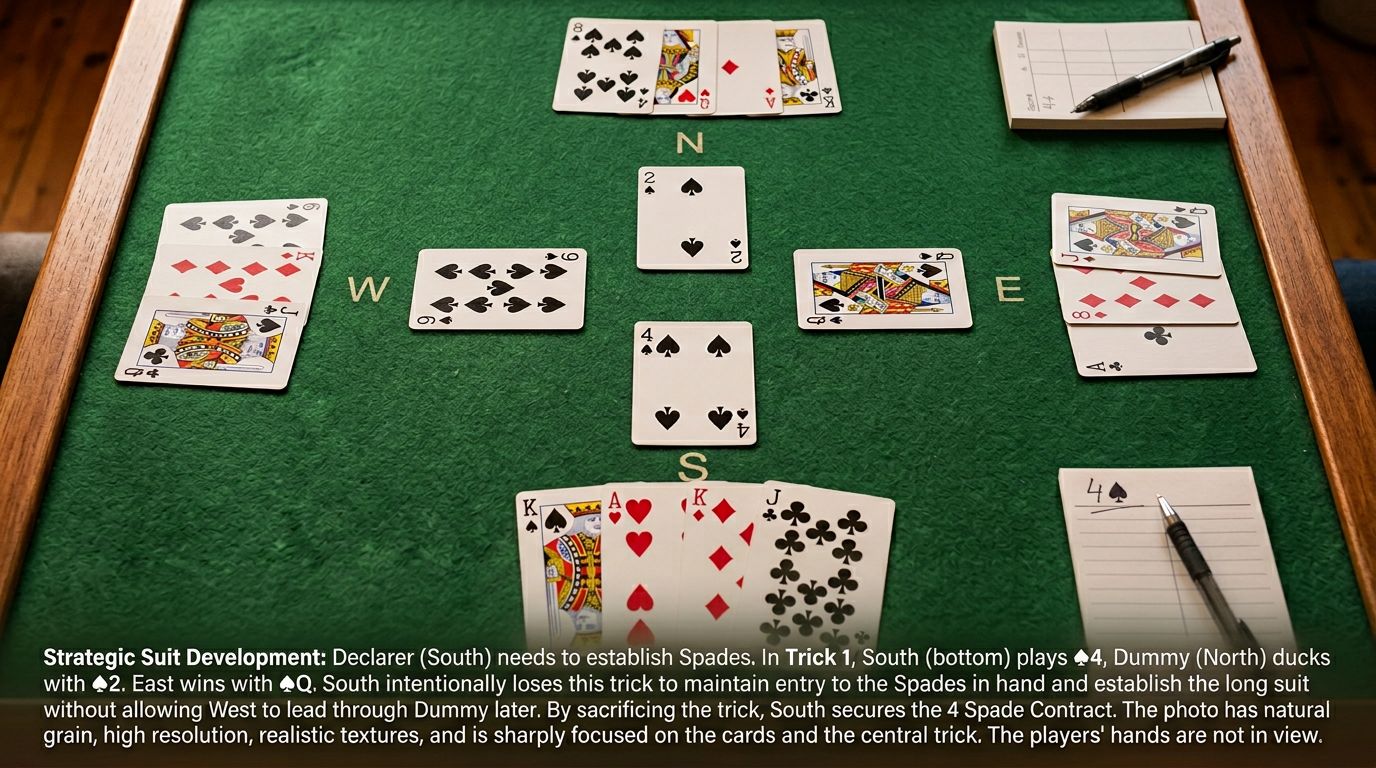
Ducking Plays: When to Lose a Trick to Win the Contract
You’ve got a long suit and need the tricks. The problem? If you take that first trick, you’ll never get back to enjoy the rest. Welcome to ducking plays, one of the most counterintuitive techniques in bridge.
A ducking play means deliberately losing a trick you could win, usually to preserve entries or establish a long suit. It feels wrong at first. You’re supposed to win tricks, right? But sometimes losing early means winning later.
The Basic Duck: Establishing Long Suits
Here’s the classic situation. You’re in 3NT with this diamond holding:
Dummy: A K 6 5 2
Declarer: 7 3
You’ve got five diamonds with the ace and king. Play them both and you’ll have three small diamonds left in dummy with no way to get there. Instead, duck the first round entirely. Lead the 3, West plays the 8, play the 2 from dummy. East wins with the 9 or 10.
Now when you regain the lead, play your 7 to dummy’s ace. If diamonds split 3-2 (68% of the time), you can cash the king and run the remaining two small diamonds. You’ve turned one entry into three tricks.
When This Works
The basic duck works when:
- You have enough entries to get back after ducking
- You can afford to lose the lead
- The suit will likely split favorably
- You need multiple tricks from the suit, not just one or two
When It Doesn’t
Don’t duck if:
- Opponents can shift to a dangerous suit
- You’re in a race to establish tricks before they cash theirs
- The suit is splitting badly (you can sometimes tell from early plays)
- You have plenty of entries anyway
The Double Duck
Sometimes you need to duck twice. Look at this layout:
Dummy: A 8 6 5 2
Declarer: 7 3
Same idea, but now you don’t have the king. You need to duck twice to clear the suit and still have the ace as an entry. Lead low from hand, duck in dummy. Get back in, lead low again, duck again. Now when the ace wins, the suit is good and you’re in the right hand.
This requires three entries to your hand and nerves of steel. Miss one duck and you’re eating crow.
The Hold-Up Duck
You’ve seen this in notrump. Opponents lead a suit and you refuse to win immediately, even though you have the ace or king. Classic example:
Contract: 3NT
Opening lead: ♠4 (fourth best)
Dummy:
♠ 7 6
♥ A Q 8
♦ K Q J 10 9
♣ 6 5 3
Declarer:
♠ A 8 3
♥ K 7 2
♦ A 6 5
♣ A K 7 2
East plays the ♠Q. You have the ace. Win it?
No. Hold up. Let East win the trick. If East continues spades, duck again. Win the third round.
Why? East might have started with only three spades. By holding up twice, you’ve exhausted East’s spades. Now when you knock out the ♦A (presumably with West), East can’t return a spade even if East gets in later.
Reading the Count
The hold-up duck works best when:
- You can count the suit (watch for count signals)
- One opponent is more dangerous than the other
- You have stoppers but they’re thin
- You need to knock out a key card and suspect bad splits
Don’t hold up automatically. If you can see nine tricks without risking anything, just take your ace and run. But when entries are tight or one defender is dangerous, the hold-up can cut communication.
The Bath Coup
Here’s a sneaky duck that looks like a mistake but isn’t. You hold:
Dummy: 7 5 2
Declarer: A J 10
The opponent on your left (West) leads the king. You’ve got the ace. Take it?
Not if you can afford to duck. West is leading from K Q (probably K Q 9). If you duck, West is stuck. Leading the suit again runs into your A J 10 tenace. West will likely shift, and now you’ve got two tricks instead of one.
This is the bath coup, named after a famous hand played in Bath, England in the 1890s. It only works when:
- The honor lead is from a touching sequence
- You can afford to lose the trick
- The suit won’t be continued from the other side
- You need an extra trick in the suit
Don’t get fancy with this one unless you’re sure. If the lead is a singleton, or if the next hand can continue the suit through your tenace, you’ll look silly.
Communication Ducks
Sometimes you duck to preserve the right entry. Classic situation in a suit contract:
Dummy: A 8 6 5 2
Declarer: K 3
You need to ruff something in dummy, then get back to run the long cards. You can’t afford to use the ♠A to get to dummy because you need it later. So at trick one, when you lead a spade to establish the suit, play the king from hand instead of the ace from dummy.
Opponents win, you regain the lead, and now the ace is still in dummy as an entry after you’ve ruffed your loser.
The Deceptive Duck
Good defenders count. Sometimes you duck to mess with their count. Say you hold:
Dummy: A K 4 3
Declarer: 8 7 2
You need three tricks from this suit in notrump. If you cash the ace and king, defenders know you have a little one left and can hold up their stopper.
Instead, duck the first round completely. Opponents think you only have four cards total. When you cash the ace and king later, they might not hold up, thinking you’re out.
Sneaky? Sure. But bridge rewards the sneaky.
Ducking in Suit Contracts
Ducks aren’t just for notrump. In suit contracts, you often duck to control when opponents get the lead. Example:
Contract: 4♥
Dummy: A Q 7 6 5 (spades)
Declarer: 3 2 (spades)
You need to establish dummy’s spades for discards. If you lead low and finesse the queen, East might win the king and give West a ruff. Instead, duck the first spade entirely. Even if West wins and gives East a ruff, you’ve still got the ace and queen sitting over East’s remaining honor.
Timing matters. Duck too early and you might go down before you can draw trumps. Duck too late and they’ve already found their ruff.
Common Mistakes
Ducking with no entry back. You duck to establish a suit but forget you can’t get back to enjoy it. Count your entries before you duck.
Ducking when you can’t afford to lose the lead. Against aggressive opponents, ducking might let them shift to a killing suit or grab their setting tricks immediately.
Not ducking when you should. This is actually more common. Players grab their ace too quickly, then wonder why they couldn’t run the suit.
Ducking in the wrong hand. If you need to keep entries in dummy, duck in hand and preserve dummy’s honors.
The Rule of 7
Here’s a shortcut for hold-up plays in notrump. Count your cards in the suit led. Subtract from 7. That’s how many times to hold up.
Example: They lead spades. You have three spades. 7 minus 3 = 4. Hold up four times?
Wait, that can’t be right. You only have the ace. What this really means: you can afford to hold up twice (they have four cards between them minus the two times you hold up leaves them with one each, ideally).
Honestly, the Rule of 7 confuses more people than it helps. Just count the suit and think about which opponent is dangerous. But you’ll hear people mention it, so now you know.
Practice Positions
Try these:
Position 1:
Dummy: A J 9 6 5
Declarer: 3 2
You need four tricks. Missing K Q 10 8 7 4. How do you play?
Answer: Duck the first round completely. If they split 3-3, you’ll get four tricks. If you play the ace first, you’ll only get two.
Position 2:
Dummy: K 8 3
Declarer: A 5 2
They lead the queen. East plays the 4. Hold up or win?
Answer: Usually duck. If West has Q J 10, you’ll get two tricks later. If you win the ace, you only get one.
Position 3:
Dummy: A K 7 6 5
Declarer: 4 3 2
You can afford one loser but need all the rest. Plan?
Answer: Cash the ace. If the queen or jack drops, you’re golden. If not, duck the second round. This combines safety with the duck.
Improve Your Declarer Play with Brian
Brian analyzes your hands and explains the best declarer strategy, from planning your play to executing endplays. Try Brian free →
When in Doubt
Ask yourself:
- Can I afford to lose this trick now?
- Will this preserve an entry I need later?
- Does this cut their communication?
- Am I racing them to establish tricks?
If you can afford it and it helps with entries or communication, duck. If you’re in a race or can’t afford the lead, grab your trick and move on.
Ducking plays aren’t fancy. They’re practical. Master them and you’ll make contracts other players go down in, simply because you knew when to lose a trick to win the contract.