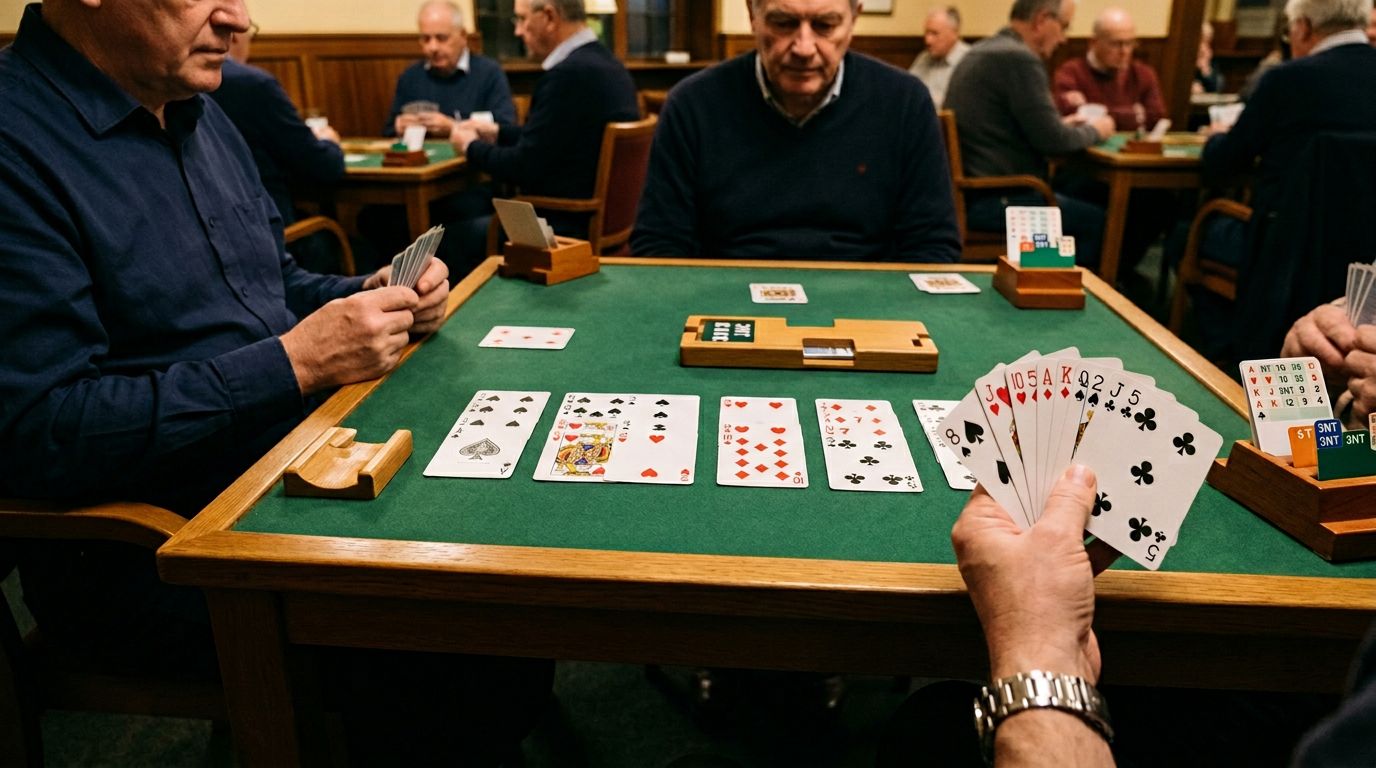
Opening Leads in Bridge, Complete Guide to Lead Selection
The opening lead is your first and often best chance to beat a contract. Make the wrong choice and you might hand declarer a gift they don’t deserve. Make the right one and you can set contracts that should make.
There’s no perfect system for leads, but there are good guidelines. Here’s what works.
Leading Against Notrump
Against notrump, you’re usually trying to establish your long suit before declarer establishes theirs. Time is everything.
Lead Your Longest Suit
Most of the time, lead from your longest and strongest suit. If you have ♠KJ832, that’s where you start. You want to set up those small cards while you still have entries.
The exception? When partner bid a suit. Then lead partner’s suit unless you have a really compelling reason not to. Partnership trust matters more than your six-card suit.
Fourth-Best Rule
With a long suit headed by honors, lead fourth from the top. From ♠KJ832, lead the 3. From ♥AQ1064, lead the 6.
Why fourth-best? It helps partner read your hand. The “rule of eleven” lets them figure out how many higher cards are in the other three hands. Subtract your spot card from 11, and that’s how many cards higher than your lead are held by partner, dummy, and declarer.
You lead the 3, partner subtracts from 11 and knows there are 8 cards higher than the 3 in the other three hands. If they can see 6 in dummy and 2 in their hand, declarer has none higher than the 3.
Honor Sequences
When you have a sequence of honors (three touching cards), lead the top.
- From KQJ, lead the K
- From QJ10, lead the Q
- From J109, lead the J
This tells partner you have the next card down. When you lead the queen and it holds, partner knows you have the jack.
Two touching honors isn’t quite enough. From KQ32, still lead fourth-best (the 3), not the king. You need three in a row.
What About Aces?
Don’t lead aces against notrump unless you have AK together. Leading an unsupported ace just sets up declarer’s honors. From A842, lead the 4, not the ace.
The exception is when you need to grab tricks fast before a long suit runs. If dummy showed 6-7 spades in the bidding and you hold ♥A83, grab that ace now before it goes away.
Leading Against Suit Contracts
Suit contracts are different. You can’t just set up a long suit because declarer will ruff. You’re looking for fast tricks or to help partner ruff.
Top of a Sequence
Against suits, leading from honor sequences is your safest bet.
- KQJ: lead the K
- QJ10: lead the Q
- J109: lead the J
- 1098: lead the 10
These leads are safe and informative. Partner knows what you have.
Short Suit Leads (Ruffs)
If you have a singleton or doubleton and some trumps, lead it. You might get a ruff later if partner has the ace or gets in quickly.
Singleton leads are clear: lead your only card. With a doubleton, lead the higher card (top of nothing). From 83, lead the 8. When you follow with the 3 next time, partner knows you started with exactly two.
Trump Leads
Sometimes the auction screams “lead a trump.” When declarer and dummy are planning to ruff losers in dummy, leading trumps cuts down their ruffs.
Lead trumps when:
- Opponents bid three suits and landed in the fourth (they’re short everywhere)
- Declarer rebid their suit weakly (5-3 fit, planning dummy ruffs)
- You have all the high cards and just want to stop dummy’s ruffs
Don’t lead trumps just because you have them. You need a reason.
Underlead Aces?
Against notrump, sure. Against suits, usually not. Leading low from an ace gives away tricks more often than it sets them up.
The exception is when you’re pretty sure partner has the king. Maybe they opened the bidding, or the auction marks them with honors. Then underlead the ace to find their king before declarer discards dummy’s losers.
But as a random shot? Bad odds.
Specific Honor Holdings
Here’s what to lead from common holdings:
Strong holdings:
- AKx: Lead the A (then K shows this holding)
- KQJ: Lead the K
- QJ10: Lead the Q
- AKJ10: Lead the A
Broken holdings:
- KJ10x: Lead low (fourth-best)
- Q10x: Usually lead low, unless partner bid the suit
- AQJx: Lead the Q (top of interior sequence)
Weak holdings:
- xxx: Lead the top (top of nothing)
- xx: Lead the higher card
- Single card: Lead it
When Partner Bid a Suit
This is easy: lead partner’s suit.
If you have three small, lead the top. From 874, lead the 8.
If you have two, lead the higher. From 84, lead the 8.
If you have an honor, lead low. From K84, lead the 4. You want partner to think you’re helping their suit, not showing your own values.
The exception is when you have a sequence. From QJ4 in partner’s suit, lead the Q.
Common Mistakes
Leading partner’s suit just because they mentioned it
If partner bid spades three rounds ago and then supported your hearts, they don’t want a spade lead. They want you to use your judgment. Lead what makes sense.
Fourth-best from junk
From 8632, don’t lead the 3. Lead the 8 (top of nothing). Fourth-best is for when you have honors and length. From junk, help partner read that you have nothing.
Being too clever
The straightforward lead works most of the time. Trying to find the killing lead when you don’t have much information usually backfires. When in doubt, lead from length against notrump, from strength against suits.
Assuming the worst
Don’t make a desperate lead just because the opponents sound confident. If they bid smoothly to 3NT and you have ♠Q10842, lead the 4. Your normal lead. Don’t talk yourself into something weird.
Listening to the Auction
The bidding tells you a lot:
If opponents used Stayman and didn’t find a fit, they’re short in the majors. Leading a major might work.
If responder bid 1NT and opener raised to 3NT without looking for a major, opener probably has a balanced hand. Their longest suit is probably only 4 cards.
If they stopped in a partial after exploring, they have a misfit. Go passive. Don’t give anything away.
If they bid quickly to game, they have a fit and values. Be aggressive. Set up tricks before they set up theirs.
Strengthen Your Defense with Brian
Defense is half the game. Brian can analyze defensive situations and explain the winning approach. Try Brian free →
The Real Skill
Opening leads aren’t about memorizing rules. They’re about judging each hand based on what you heard and what you hold. The rules are guidelines, not laws.
Sometimes you have ♥8632 and ♠A5 and nothing else. The “right” lead by the rules is the 8 of hearts. But if the auction went 1♠ - 3♠ - 4♠ and you think partner might have a singleton heart, maybe you lead the ace of spades to look at dummy first.
That’s bridge. Use the guidelines until the situation tells you otherwise.
Start with what works most of the time, then learn when to break the rules.