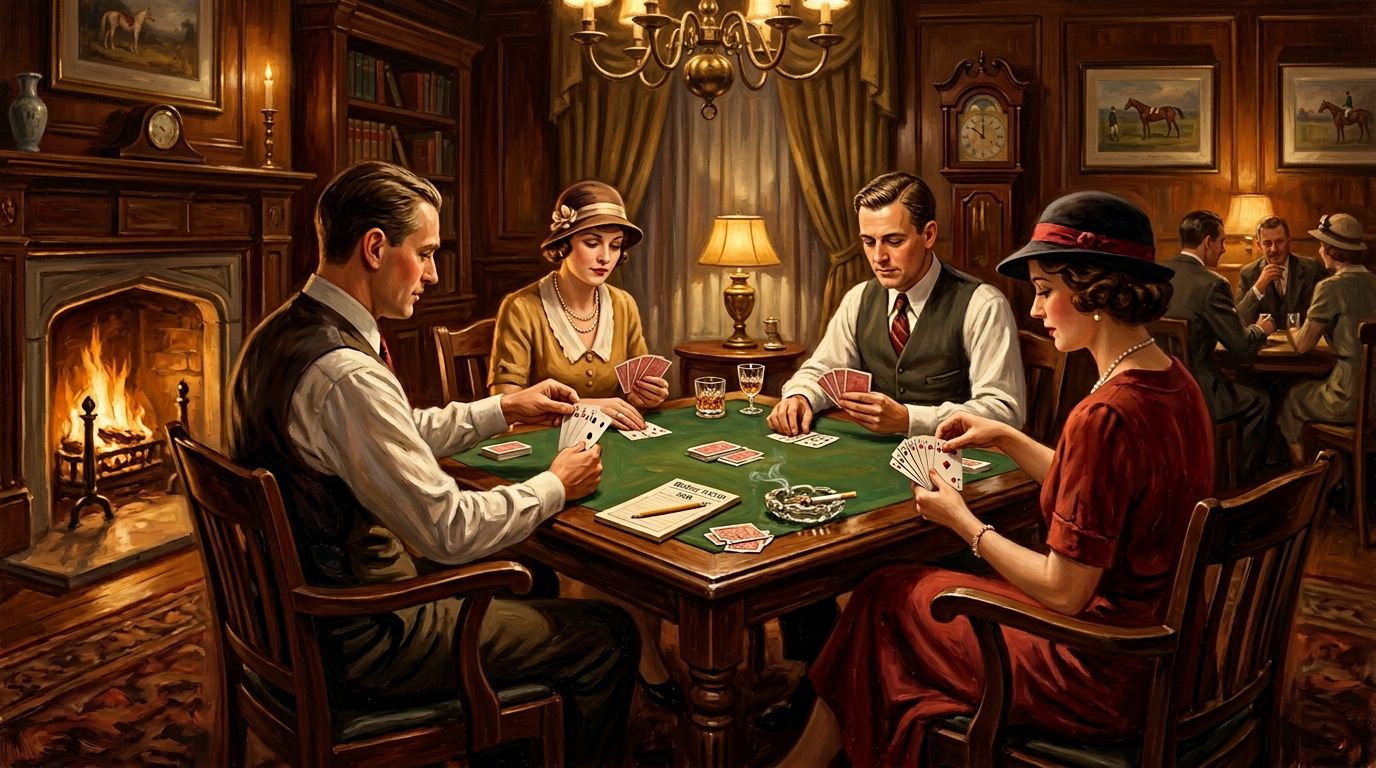
The Culbertson-Lenz Match
December 1931. America is deep in the Great Depression. People are desperate for distraction, for entertainment, for something to follow besides unemployment numbers and bread lines. And somehow, impossibly, what captures the nation’s attention is a bridge match.
Not a boxing match. Not baseball. Bridge.
The Culbertson-Lenz match became the most publicized card game in history, drew crowds to packed auditoriums, filled newspaper columns for weeks, and turned Contract Bridge from an upper-class fad into an American obsession.
All because two men with massive egos decided they couldn’t stand each other.
The Characters
Let’s start with Ely Culbertson, because you can’t tell this story without understanding the man.
Culbertson was born in Romania to an American engineer father and Russian Cossack mother. His early life reads like a spy novel: revolutionary activities in Russia, narrow escapes, wandering through Europe living on his wits and whatever money he could win at cards. He ended up in America in his twenties, married a woman named Josephine Dillon who was better at bridge than he was, and together they turned themselves into Contract Bridge’s first power couple.
Culbertson was a showman, a promoter, and a self-proclaimed genius. He published The Bridge World magazine starting in 1929. He wrote books on bidding systems. He organized tournaments. He claimed his “Culbertson System” was the scientific approach to bridge, the only correct way to bid.
Was he the best player in America? Debatable. Was he the best at telling people he was the best player in America? Absolutely.
Sidney Lenz was old money and old school. A successful businessman, expert on magic and card manipulation, author of books on games. Lenz had been a Whist champion before switching to Auction Bridge and then Contract Bridge. He was widely respected, well-connected, and represented the established bridge elite.
Lenz thought Culbertson was a blowhard who was more about publicity than skill. He had a point. Culbertson thought Lenz was a relic from the Auction Bridge era who didn’t understand modern bidding. He had a point too.
By 1931, they were openly feuding. The bridge world buzzed with arguments about whose system was better, whose methods would prevail. Someone needed to settle this.
The Challenge
The match was conceived by William Liggett Jr., publisher of The Bridge World (though Culbertson owned it, Liggett ran the business side). Liggett understood that a high-stakes match between bridge’s biggest names would generate publicity the game desperately needed.
Contract Bridge was only six years old in 1931. It needed stars. It needed drama. It needed something to make ordinary people care about a card game played in smoke-filled rooms.
The match was announced for December 1931 at the Chatham Hotel in New York. The format: 150 rubbers of bridge, which would take weeks to play. The Culbertsons (Ely and Josephine) would play as partners. Lenz would partner with Oswald Jacoby, the young mathematical genius widely considered the best technical player in America.
Why would Jacoby partner with Lenz instead of Culbertson? Good question. The answer involves egos, money, and the politics of the bridge world, none of which matters now. What matters is that the match pitted the two biggest names (Culbertson and Lenz) against each other with genuine stakes.
The Stakes
No money changed hands, which sounds weird until you realize the real stakes were vastly higher than money. The winner would claim supremacy in the bridge world. The winner’s system would be THE system to learn. The winner’s books would sell. The winner’s reputation would be made.
For Culbertson, this was existential. His entire business depended on being recognized as bridge’s leading authority. Lose badly, and the empire crumbles.
For Lenz, it was about respect. He wanted to prove that experience and card sense mattered more than Culbertson’s self-promoting “scientific” approach.
The press ate it up. Newspapers ran daily updates on the match. Radio broadcasters gave results. Crowds gathered to watch through thick cigar smoke at the Chatham Hotel. This was appointment viewing before television existed.
The Match Begins
The first session started on December 8, 1931. Right away, things got tense.
Culbertson and Josephine played a tight, disciplined game. They followed their system religiously. Their bidding was aggressive but structured. Josephine, in particular, was a superb technical player who made very few mistakes.
Lenz and Jacoby, on the other hand, had problems. Lenz favored a more intuitive, old-fashioned approach. Jacoby’s style was mathematical and precise. They didn’t mesh well. Worse, the pressure got to Lenz. He made errors he normally wouldn’t make. He misplayed hands. He got rattled.
Culbertson, meanwhile, was in his element. He played to the crowd. He gave quotes to reporters. He explained his brilliant plays (and glossed over his errors). He turned the match into theater, with himself as the star.
By the end of December, the Culbertsons were ahead by about 15,000 points. Lenz was reeling. The press was writing that the match was over.
The Jacoby Substitution
On January 2, 1932, after 47 rubbers, Lenz did something that saved his dignity but probably sealed his fate: he dumped Oswald Jacoby.
Lenz and Jacoby hadn’t been getting along. Jacoby later said he felt like he was playing with a partner who was having a nervous breakdown. Lenz felt Jacoby wasn’t supporting him properly. The partnership was toxic.
Lenz brought in Commander Winfield Liggett Jr. (yes, related to the publisher) and later Waldemar von Zedtwitz, both excellent players. But the damage was done. Replacing your partner mid-match signaled weakness. The press had a field day.
Culbertson twisted the knife in newspaper interviews. He praised Jacoby (who’d been on the losing side) and suggested that Lenz was the problem. It was masterful psychological warfare.
The Contract That Changed Everything
The most famous hand from the match came on December 12, 1931. Lenz held:
♠ A K 10 8 7 5 4
♥ None
♦ A Q 7 6
♣ 10 6
Lenz opened the bidding. After a complex auction, he ended up in 7♠ doubled. He had an excellent hand, and the grand slam looked reasonable.
But Josephine Culbertson, sitting West, had a freak hand with all the hearts. The grand slam had no play. Down three doubled vulnerable: minus 2000 points.
Culbertson used this hand as a teaching moment in every article and interview afterward. He explained how proper hand evaluation would have kept Lenz out of the doomed grand. He positioned it as proof that “scientific” bidding beat intuition.
Was that fair? Not really. The hand was a genuine judgment call, and plenty of experts would have bid the grand slam with Lenz’s cards. But fairness didn’t matter. Culbertson controlled the narrative.
The Final Results
The match ended on January 9, 1932, after 150 rubbers played over five weeks. The Culbertsons won by 8,980 points, which sounds close but really wasn’t in the scoring of the era.
Newspapers across America ran the story. The New York Times gave it front-page coverage. Radio programs analyzed it. An estimated 10,000 people had watched the match in person at various times.
For context: this was bridge. Not heavyweight boxing. Not baseball. Bridge.
The Aftermath
The match made Culbertson a household name. His books sold hundreds of thousands of copies. His system became THE system. He appeared on radio shows, gave lectures, made a fortune. Contract Bridge exploded in popularity, with an estimated 20 million Americans playing by 1933.
Lenz’s reputation never recovered. He’d been exposed as fallible, even vulnerable. He continued playing and writing, but he never regained his preeminence. The man who’d been bridge royalty became a cautionary tale.
Jacoby, interestingly, came out fine. He was young, had played well, and distanced himself from the loss by blaming the partnership with Lenz. He went on to a legendary career as player, writer, and theorist.
Josephine Culbertson deserves special mention. She was probably the best player at the table but got less credit because 1930s sexism meant her husband got the spotlight. They later divorced (bridge partnerships and marriages don’t always mix), but during the match, she was the steady hand that kept the Culbertson side together.
What the Match Meant for Bridge
The Culbertson-Lenz match did for bridge what the Bobby Fischer-Boris Spassky match later did for chess: it made an intellectual game into spectator sport. It created stars. It showed that card games could generate drama and excitement.
More importantly, it established that bridge was something worth caring about. If newspapers gave it front-page coverage, if crowds paid to watch, if everyone was talking about it, then maybe you should learn this game.
Bridge clubs sprang up across America. Department stores sold bridge supplies. Teachers offered lessons. The game spread from the elite clubs to middle-class living rooms to working-class social halls.
Was Culbertson’s system actually better than Lenz’s approach? Honestly, probably not by much. Both were reasonable methods for playing 1930s bridge. But Culbertson won the match and controlled the narrative, so his system became synonymous with “correct” bridge.
The Legacy of Egos
Looking back, the Culbertson-Lenz match was less about bridge theory and more about personalities. Two proud men with massive egos couldn’t coexist, so they went to war. One was a better showman and won. The other couldn’t handle the pressure and lost.
But in the process, they gave us something valuable: proof that bridge mattered. That people cared. That a card game could capture the public imagination.
Every major bridge broadcast, every Vugraph show, every high-stakes match with spectators and commentary exists because Culbertson and Lenz couldn’t stand each other in 1931. They showed that bridge was watchable, dramatic, worth following.
We’re still riding that wave.
The Human Element
The saddest part of the story is what happened to the relationships. Lenz and Jacoby’s partnership was destroyed. The Culbertsons eventually divorced. Lenz’s reputation never fully recovered. These weren’t abstract figures moving pieces on a board. They were real people with egos, insecurities, and pride.
Culbertson himself later admitted that he wasn’t as good a player as he’d claimed during his prime. He was a solid player and an excellent psychologist, but not the technical genius he’d marketed himself as. By the time he made this admission, it didn’t matter. He’d won the war that counted.
What We Remember
The Culbertson-Lenz match happened over ninety years ago. The bidding systems they argued about are obsolete. The hands they played would be bid differently today. The techniques they used have been surpassed.
But the story remains. Two men, one game, five weeks of combat with newspapers watching and crowds cheering. It’s a reminder that bridge, at its best, isn’t just about cards and points. It’s about people. Their pride, their skill, their ability to perform under pressure.
Next time you sit down for a big match with something on the line, remember: Culbertson and Lenz felt that same nervous energy in December 1931. They made brilliant plays and terrible errors. They felt the thrill of victory and the agony of defeat.
The difference is, they had The New York Times covering it.
Lucky them? Or lucky us, for getting the story.