The Duke of Cumberland Hand: Bridge's Most Legendary Deal
Every card game has its legendary hustles, but none match the Duke of Cumberland Hand. This deal, dating back to 18th-century England, features something players dream about: a hand so good it looks unbeatable. And that’s exactly what makes it a trap.
The story goes that the Duke of Cumberland, son of King George II, was hustled for £20,000 (millions in today’s money) on this single hand of whist. Whether it actually happened or it’s just bridge folklore doesn’t matter. The hand itself is real, and it’s been teaching players about overconfidence for 250 years.
The Setup
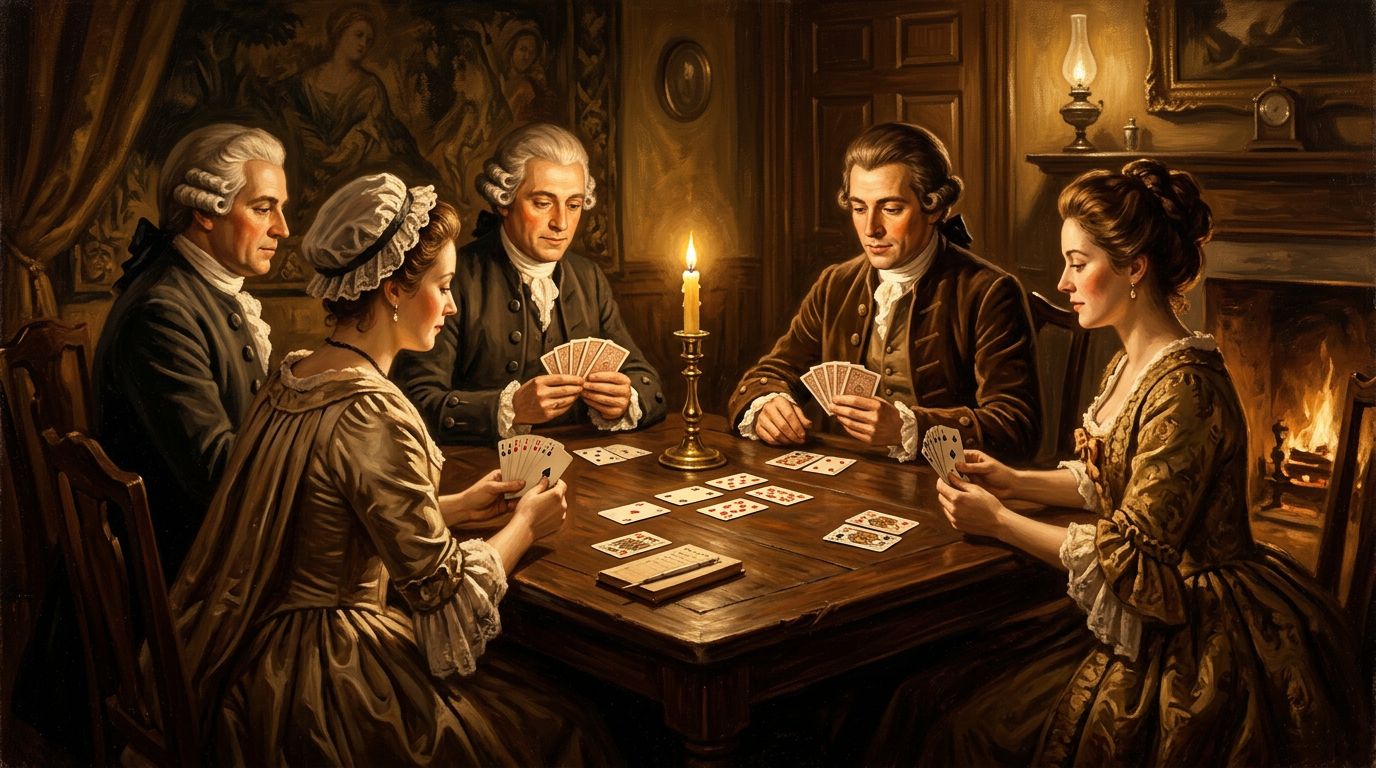
Picture a London gentleman’s club, 1743. The Duke holds what looks like an unbeatable hand. His opponent, supposedly a card sharp named Mr. North, offers to let him pick the trump suit. The Duke, seeing his hand, jumps at it. They agree to massive stakes.
Here’s the deal:
        North (Dealer)
        ♠ A K Q J
        ♥ A K Q J
        ♦ A J
        ♣ A J 10

West                East
♠ 10 9 8 7         ♠ 6 5 4 3 2
♥ 10 9 8 7         ♥ 6 5 4 3 2
♦ 10 9 8 7         ♦ 6 5 4 3 2
♣ 9 8              ♣ none

        South (Duke)
        ♠ none
        ♥ none
        ♦ K Q
        ♣ K Q 7 6 5 4 3 2
The Duke is South. He looks at his hand and sees seven solid clubs. He declares clubs as trumps and expects to win all 13 tricks. After all, he’s got eight clubs headed by the K-Q, plus the ♦K-Q. That’s a grand slam, right?
Wrong.
The Play
North leads the ♠A. The Duke has no spades, so he ruffs with the ♣2. He’s feeling good.
But now the Duke has to lead. He tries the ♣K. North takes it with the ♣A.
North leads the ♥A. Duke ruffs with the ♣3.
Duke leads the ♣Q. North takes it with the ♣J.
See the pattern? Every time the Duke gets in, he has to lead a high club. Every time he does, North wins it with a higher club. And every time North gets in, he cashes a top card in a side suit, forcing the Duke to ruff with a small club.
The Duke’s seven solid trumps disappear one by one. North’s ♣10 becomes the master club. The Duke, who thought he’d win all 13 tricks, wins exactly zero.
The Mathematics
This hand works because of a perfect storm:
North has four perfect suits. Each suit has the top four honors (A-K-Q-J). That’s 16 of the top 20 cards in the deck.
The Duke’s trumps are worthless. Despite having eight clubs, he can never draw trumps because North’s clubs are all higher. The Duke’s ♣K-Q-7-6-5-4-3-2 might as well be eight deuces.
Entry problems are fatal. In whist (and rubber bridge), the defense leads first. North cashes winners, forcing the Duke to ruff. When the Duke leads trumps, North wins and forces him again. The Duke runs out of trumps before he can establish anything.
West-East can’t help. With 26 cards between them, West and East hold nothing but small cards. They’re spectators to the Duke’s destruction.
Why It Still Matters
You’ll never see this exact hand at the table. It’s constructed, artificial, probably never actually dealt. But it teaches real lessons.
Don’t count trumps, count tricks. The Duke had the second-longest trump suit. Didn’t matter. He had no way to make them good.
Entry management trumps high cards. North’s hand wins because every card is an entry. The Duke’s hand loses because he has no way to get in and draw trumps.
Perfect defense doesn’t need communication. North doesn’t need signals from East-West. The defense is automatic: cash winners, force the ruff, win the trump lead, repeat.
Suit quality matters more than length. Eight to the K-Q sounds great. Against A-J-10, you’re broke.
The Historical Quirk
In whist, there was no bidding. The dealer picked trumps (or turned up a card). That’s why the hustle worked. North dealt, offered to let the Duke choose trumps, and the Duke walked into the trap.
In modern bridge, North would never get to play this hand. South would be declarer, and even if clubs were trumps, the defense would have to lead from West or East. The hand only works with North on lead.
But the lesson survives the rule change. You can have a great-looking hand and still be dead in the water. Trump length without trump quality is a mirage. And if you can’t draw trumps, you’re not in control of the hand.
The Legend Lives On
Card players have been talking about this hand for nearly 300 years. It shows up in whist books from the 1700s. Bridge books in the 1900s. Online forums today.
Did the Duke of Cumberland actually lose £20,000 on it? Probably not. The Duke was a real person (William Augustus, Duke of Cumberland, who died in 1765), and he did gamble heavily. But there’s no solid evidence this specific hand ruined him.
What matters is the hand itself. It’s a perfect example of card play deception. It looks like a sure thing, and that’s exactly why it’s a disaster.
Every bridge player should know this deal. Not because you’ll ever play it, but because it reminds you that high cards don’t guarantee tricks. You need entries, timing, and control. Without those, even a great hand can go down in flames.
The Duke learned that lesson the hard way. You can learn it for free.
Key Takeaways
Trump quality beats trump quantity. Eight small trumps lose to four top honors.
Entries are everything. Without a way to draw trumps, you’re at the defense’s mercy.
Force plays win. North forces the Duke to ruff until he has no trumps left, then runs winners.
Overconfidence is expensive. The Duke saw eight trumps and stopped thinking. Big mistake.
This hand has survived three centuries because it’s simple, dramatic, and instructive. You’ll remember it the next time you look at a long suit and think you’re unbeatable. Maybe you are. But maybe you’re the Duke.