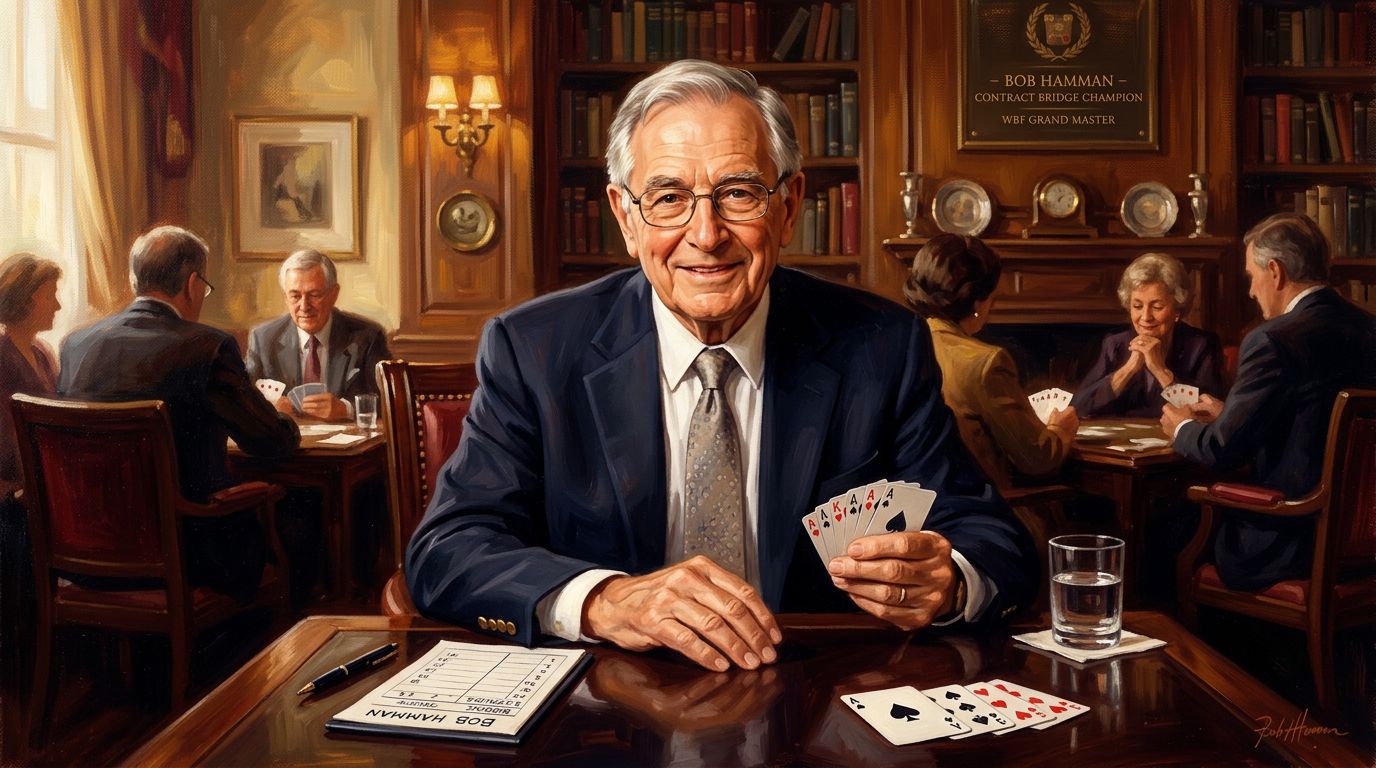
Bob Hamman: The Greatest Bridge Player Ever
SEO Title: Bob Hamman - #1 Bridge Player for 20+ Years, GOAT Candidate | Bridge Encyclopedia
Meta Description: Bob Hamman dominated world bridge as #1 ranked player for over 20 years. Multiple world titles, Aces team founder, still competing in his 80s. The GOAT argument starts here.
If you want to argue about the greatest bridge player of all time, start with Bob Hamman. Not because the answer is obvious (it’s not), but because any serious argument includes him. Hamman was ranked #1 in the world for more than 20 consecutive years. He won 22 world championships. He founded the Dallas Aces, the first professional bridge team. And at 86, he’s still playing world-class bridge. That resume doesn’t settle the GOAT debate, but it sure as hell starts the conversation.
The Aces
In 1968, Hamman and Ira Corn assembled something bridge had never seen: a fully professional team. The Dallas Aces would train together, practice daily, analyze their games, and compete with the singular goal of beating Italy’s Blue Team. Corn provided the money. Hamman provided the bridge talent.
The original lineup was Hamman, Jim Jacoby, Bobby Wolff, Mike Lawrence, Bobby Goldman, and Billy Eisenberg. These weren’t unknown players. They were already national champions. But Corn’s approach was different. Treat bridge like a professional sport. Study, practice, prepare. The Blue Team had been doing this for years. The Aces would do it better.
In 1970, they won the Bermuda Bowl in Stockholm. Finally broke the Blue Team’s dominance. The victory wasn’t a fluke. The Aces outplayed Italy through preparation and execution. Hamman’s contribution went beyond his seat at the table. He shaped strategy, analyzed opponents, pushed the team to higher standards. At 32, he was already a bridge mastermind.
The Aces continued winning through the 1970s and early 1980s. World championships, national titles, Spingolds, Vanderbilts. Hamman was the constant. Teammates changed, partnerships evolved, but Hamman kept winning.
The Wolff Partnership
Hamman’s longest and most successful partnership was with Bobby Wolff. They played together for over 40 years, won multiple world championships, and developed a partnership understanding that became legendary in bridge circles.
Their bidding was aggressive but disciplined. They pushed thin games, bid slams on distributional hands, and competed fiercely in partials. But the aggression was calculated. They knew when to back off, when to defend, when to let opponents make their own mistakes. That judgment separates great partnerships from merely good ones.
Defensively, they were devastating. Both players could read cards from minimal information, and they trusted each other’s signals. Watch old Vugraph records of Hamman-Wolff defending a contract. The opening lead looks normal. The second trick looks routine. By trick four, declarer is in an impossible position and doesn’t know why. That’s card reading and partnership coordination at the highest level.
Their partnership wasn’t without friction. Both are strong personalities with definite opinions. They argued about hands, criticized each other’s plays, and disagreed on bidding approaches. But they stayed together because the results spoke louder than the disagreements. When you win world championships together for four decades, you figure out how to handle personality conflicts.
The Mind
What separated Hamman from other world-class players wasn’t technique. At that level, everyone can execute squeezes and coups. The separation was in reading the game.
Hamman could construct opponents’ hands from scraps of information. A hesitation in tempo, a slightly unusual bid, the spots that appeared on the first two tricks. Other players noticed these things. Hamman combined them into a complete picture. Then he played as if he could see all four hands.
His competitive bidding judgment was probably his greatest edge. When to push to 3♥ over 2♠, when to double, when to pass and defend. These aren’t technical problems with clear answers. They’re judgment calls based on vulnerability, opponents, hand shape, and feel for the auction. Hamman got them right more often than anyone else.
He also understood pressure. In close matches, when one board could decide the championship, Hamman’s play got sharper. Not because he tried harder (he always tried), but because pressure clarified his thinking. The noise fell away and he saw the position clearly. That’s a psychological edge you can’t teach.
The Professional
Hamman made a living from bridge, which few players manage at any level. He played professionally for sponsors, competed in major events, and later became successful in the bridge cruise and teaching markets. But he never softened his game for commercial reasons.
Some professional players adjust their style when playing with weaker sponsors or clients. They avoid complex auctions, play safe lines, prioritize making the contract over squeezing out overtricks. Hamman played to win. His sponsors knew that. They hired him because he was Hamman, not a gentler version.
This occasionally created tension. Sponsors want to enjoy playing, not feel like they’re being dragged through boot camp. Hamman’s solution was direct: he found sponsors who wanted to win more than they wanted comfort. Warren Buffett sponsored his teams for years. Buffett understood: you hire the best, you let them do their job.
The Longevity
Hamman is in his 80s and still competing in world championships. That’s not ceremonial participation. He’s still playing at a level most experts never reach. His game has evolved as he’s aged - fewer complex squeezes, more reliance on judgment and partnership coordination - but the results remain elite.
Part of this is genetic luck. Good health, sharp mind, and steady hands into old age. But part is approach. Hamman has stayed current with bidding theory, adapted to new methods, and continued learning. Many older players ossify, playing the same style they learned decades ago. Hamman keeps updating.
His recent partnerships have been with younger players who bring energy and modern methods. He brings experience and judgment. The combination keeps working. In 2018, at 80, he won the Mixed Board-a-Match at the Spring NABC. Still winning national championships six decades after the first ones.
The Controversies
Hamman’s career hasn’t been without controversy. Accusations of slow play, claims of taking advantage of unclear regulations, disagreements with tournament directors. Some of this is the baggage of any long career in competitive bridge. Some is legitimate criticism of pushing boundaries.
His response to controversy has always been consistent: the rules are the rules, he plays within them, and if opponents don’t like it, they should play better. That’s not diplomatic. It’s made him enemies. But it’s also honest. Hamman came to win, not make friends.
The slow play issue is real. Hamman thinks deeply about difficult hands, which takes time. In an era of increasingly strict pace-of-play rules, this creates problems. His defenders say you can’t rush genius. His critics say everyone else manages to think and play at reasonable speed. Both have a point.
The GOAT Case
Arguing Hamman is the greatest of all time comes down to longevity plus peak performance. Belladonna won more world championships but over a shorter peak period. Meckstroth has the modern numbers but played in a different era. European stars like Helness and Helgemo have strong cases but less sustained dominance.
Hamman’s edge is that he was the best player in the world for over 20 years, remained elite for 60+ years, and won across multiple eras of bridge. He beat the tail end of the Blue Team. He dominated the 1970s-1990s. He’s still competitive in modern bridge. No other player has that span.
The counterargument is that Hamman benefited from strong partnerships and well-funded teams. Put him on weaker teams with weaker partners, would he still have won 22 world championships? Maybe not. But that’s true of every great team athlete. You can’t separate individual excellence from team context.
What He Represents
Hamman represents the professional approach to bridge. Serious, disciplined, focused on winning. He’s not playing for fun or social connection or anything except victory. That makes him intimidating, sometimes off-putting, always effective.
He proved you could make a career from bridge through excellence. Not through personality or teaching or writing, though he’s done all those things. Through playing the game better than almost anyone else for longer than anyone else.
His legacy is visible in how modern professional bridge operates. Teams hire strong players, practice seriously, analyze their games. That’s the Aces model, and Hamman built it. The fact that it’s now standard doesn’t diminish the innovation. It confirms it worked.
Related Articles
Still Going
At 86, Hamman is still showing up at world championships. Still thinking through complex hands. Still executing difficult plays. The wins are less frequent now, but they still happen. And when they do, it’s a reminder: this is what mastery looks like when it doesn’t quit.
The GOAT debate will never settle. Too many eras, too many players, too many variables. But any list that doesn’t include Bob Hamman near the top isn’t serious. Twenty-two world championships, 20+ years at #1, still competing in his 80s. That’s not just a great career. That’s bridge excellence across a lifetime.
The kid from Los Angeles who started the Aces became the standard by which greatness gets measured. Not bad for a guy who just wanted to win at cards.