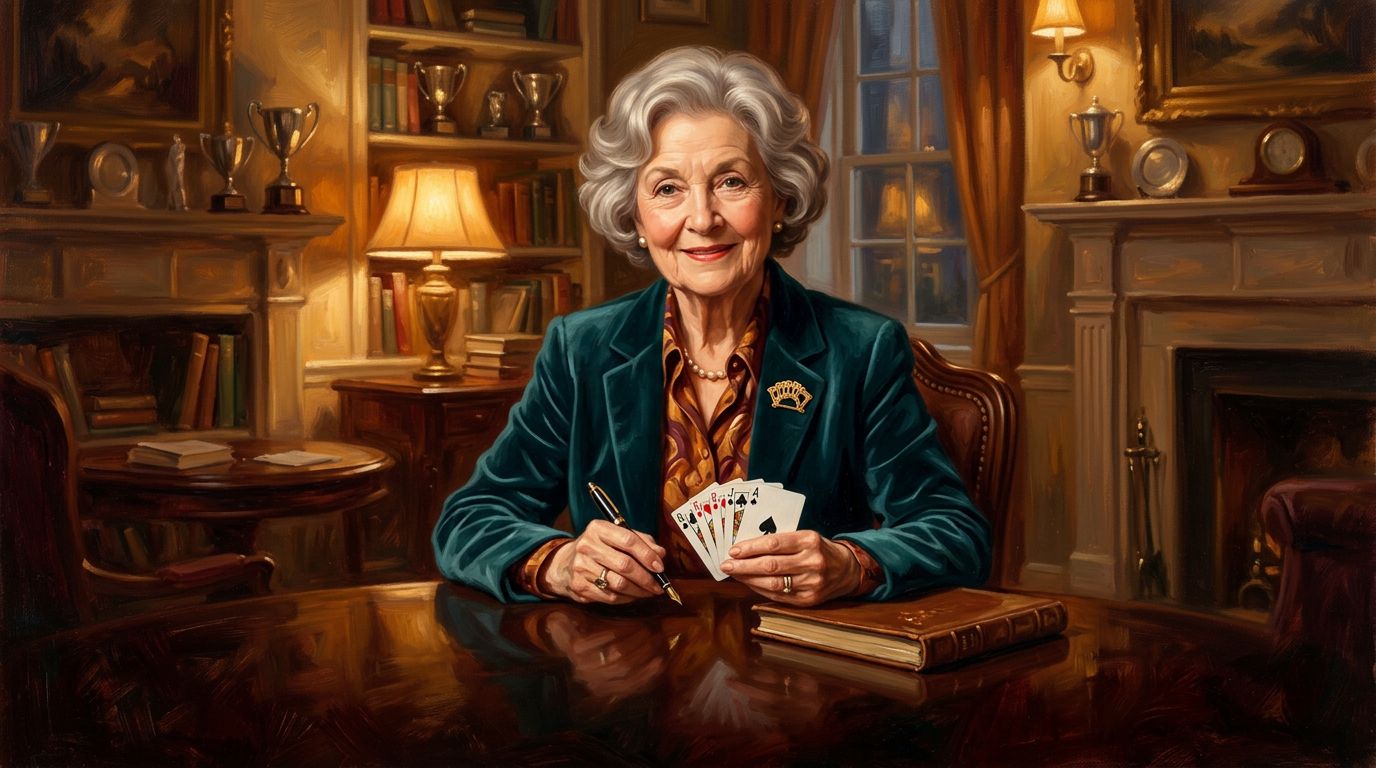
Dorothy Hayden Truscott
SEO Title: Dorothy Hayden Truscott - World Bridge Champion and Author | Bridge Encyclopedia
Meta Description: Dorothy Hayden Truscott won three consecutive world championships (1964-66-68), wrote influential bridge books, and earned ACBL Hall of Fame recognition for playing and teaching excellence.
Dorothy Hayden Truscott won the world championship for women three times in a row. That’s 1964, 1966, and 1968. Nobody else did that. She also wrote some of the clearest instructional books in bridge literature and spent decades as The New York Times bridge columnist. Player, author, teacher, champion. Most people get good at one of those. Dorothy mastered all four.
The Academic Path to Cards
Born Dorothy Hayden in Los Angeles in 1925, she came to bridge through an unusual route: mathematics. She studied at UCLA, got serious about math, and found bridge through the college bridge club. The mathematical mind translated well to card analysis, probability, and position evaluation. She wasn’t a natural card player, she was a trained analytical thinker who learned bridge systematically.
That background shows in her play. She didn’t have flashy intuition or brilliant table feel. She counted, calculated, and executed properly. When other players made decisions on instinct, Dorothy worked them out logically. Different path, same results.
She moved to New York in the 1950s and quickly entered serious tournament play. By the early 1960s she was winning national championships and getting selected for international teams. Her partnership with Joan Abelow was strong but not legendary. They complemented each other well enough to win consistently.
The Three-Peat
The World Women’s Team Championship started in 1960 as a biannual event. The American team won in 1964 with Dorothy as a key player. Then won again in 1966. Then again in 1968. Three straight world championships, six years of dominance. The American women’s team was simply better than everyone else, and Dorothy was part of that excellence.
Her role on those teams was solid second pair. Not the flashy stars, not the weak link. The pair you could count on to do their job, make their contracts, beat the bad ones, and not donate points through errors. Championship teams need reliability more than brilliance, and Dorothy provided it.
The 1968 championship was particularly satisfying because by then she was 43 and some critics suggested the team needed younger blood. Instead, they won decisively. Age isn’t the problem if skill stays sharp.
The Writing Excellence
Dorothy’s bridge books are still worth reading, which can’t be said for most bridge instruction from the 1960s and 70s. Her prose was clear, her examples were practical, and she didn’t waste words on obvious points. “Winning Declarer Play” (1969) remains one of the better intermediate texts on technique.
What separated her writing from other champion-authored books was organization. Many top players write books that dump knowledge without structure, assuming readers can organize it themselves. Dorothy built systematic instruction from fundamentals through advanced concepts. That’s the teacher’s gift, and not all champions have it.
She also wrote “Bid Better, Play Better” which covered both sides of the game competently. The bidding sections aged faster than the play sections because bidding systems evolved more quickly. But the underlying logic still works.
The Times Column
When Alan Truscott died in 2005, Dorothy had been contributing to his New York Times bridge column for decades. After his death, she took over fully and continued until her own death in 2006. That column reached millions of casual players who never attended a tournament but enjoyed reading about bridge.
Her columns mixed instruction with interesting deals from recent tournaments. She explained complex positions clearly enough for intermediate players while including enough detail to interest experts. That balance is hard to achieve. Most writers aim at one audience and lose the other.
The Times column had authority because Dorothy was a world champion, not just a journalist who covered bridge. When she said a play was right, you trusted that she’d made similar plays under pressure herself.
The Marriage and Partnership
She married Alan Truscott in 1966, becoming Dorothy Hayden Truscott. Alan was already a prominent bridge writer and theorist, having invented the Truscott card and contributed significantly to modern bidding theory. The marriage combined two sharp analytical minds with complementary skills.
They didn’t often partner at the table, which was probably wise. Married couples playing bridge together face extra pressure, and neither needed that complication. But they collaborated on writing, discussed hands constantly, and pushed each other’s thinking. The marriage was intellectual partnership as much as romantic one.
Alan was more flamboyant in personality, Dorothy more reserved. He courted controversy in his writing, she stuck to analysis. Together they were probably the most accomplished married couple in bridge history, which is a weird distinction but true.
The Playing Style
Dorothy’s game was technically correct without being fancy. She didn’t go for brilliant coups or spectacular plays. She made the percentage play, trusted the odds, and let the math work over time. That’s boring to watch but effective in results.
Her bidding was disciplined. She followed system, didn’t stretch values, and trusted partner to do the same. This made her easy to play with for partners who wanted reliable auctions. It also made her somewhat predictable for opponents who could read Standard American well.
Her defensive card play was her strongest area. She counted distribution religiously, tracked high cards, and found the winning defense through logic rather than inspiration. Defense rewards systematic thinking more than declarer play does, which fit her analytical approach.
The Teaching Philosophy
Dorothy taught bridge through her books and occasional classes. Her philosophy was systematic: learn the fundamentals perfectly, then build complexity on that foundation. She didn’t encourage creative deviation or intuitive leaps. Master the basics, apply them correctly, win through superior technique.
This approach works well for serious students who want to improve through study and practice. It works less well for social players who want quick tips and flashy tricks. Dorothy aimed at the serious students and gave them comprehensive instruction.
Her books assume the reader will work through the examples, think about the principles, and practice the techniques. They’re not casual reading, they’re textbooks. But they’re well-written textbooks that respect the reader’s intelligence.
The ACBL Hall of Fame
Dorothy was inducted into the ACBL Hall of Fame in 1999, recognition for both playing achievement and contributions to bridge literature. Three world championships plus decades of quality writing made the selection obvious. The only question was why it took so long.
Hall of Fame selections sometimes wait until a player’s career is clearly over. Dorothy kept playing and writing into her seventies, so the career never really ended. She just gradually did less tournament play and more writing.
The Later Years
After Alan died in 2005, Dorothy continued the Times column and stayed active in bridge circles. She was 80, past serious competitive play, but still sharp mentally and still interested in the game. The column gave her purpose and kept her connected to the bridge world.
She died in 2006, less than a year after Alan. Whether that’s coincidence or the common pattern of long-married couples dying close together isn’t knowable. But it ended the Truscott partnership that had shaped American bridge journalism for four decades.
What Made Her Different
Dorothy wasn’t the most naturally talented player, the most charismatic personality, or the most innovative theorist. What she brought was completeness: strong technical skills, clear analytical thinking, ability to communicate complex ideas, and sustained excellence over decades.
That combination of playing and teaching ability is rare. Most champions can’t explain what they do well enough to teach it. Most teachers never played at championship level. Dorothy did both at high standards.
The Mathematical Legacy
Dorothy’s mathematical background influenced her approach to bridge in ways that became more common later. She thought in terms of probability, expected value, and optimal strategy before those concepts were standard in bridge thinking. Modern bridge has embraced mathematical analysis more fully, and Dorothy was ahead of that curve.
Her books include probability tables and mathematical reasoning that some readers found intimidating but serious students found valuable. She didn’t hide behind “feel” or “judgment” when math gave clearer answers. That honesty helped move bridge instruction toward more rigorous analysis.
The Quiet Champion
Dorothy never sought publicity or celebrity. She played well, won championships, wrote good books, and lived a private life. No scandals, no feuds, no dramatic conflicts. Just steady excellence sustained across five decades.
That makes her less interesting for biographical drama but more valuable as a role model. You don’t need flamboyant personality to reach the top. You need skill, discipline, analytical rigor, and sustained effort. Dorothy proved that path works.
What She Left Behind
Three world championships establish playing excellence. Multiple well-regarded books establish teaching ability. Decades of quality bridge journalism establish communication skill. The combination is the legacy: Dorothy Hayden Truscott showed that systematic analytical thinking applied to bridge produces championships and clear instruction.
Modern women players might have more world titles, but they play in an era with more championships available. Dorothy dominated her era completely, then contributed to the game’s literature significantly. Both matter.
The bridge world needs champions who can teach and writers who can play. Dorothy was both. That’s rarer than being the best at either one alone, and it’s why her influence extends beyond the trophy count. She won, then she explained how winning works. The game is better for having had her do both.