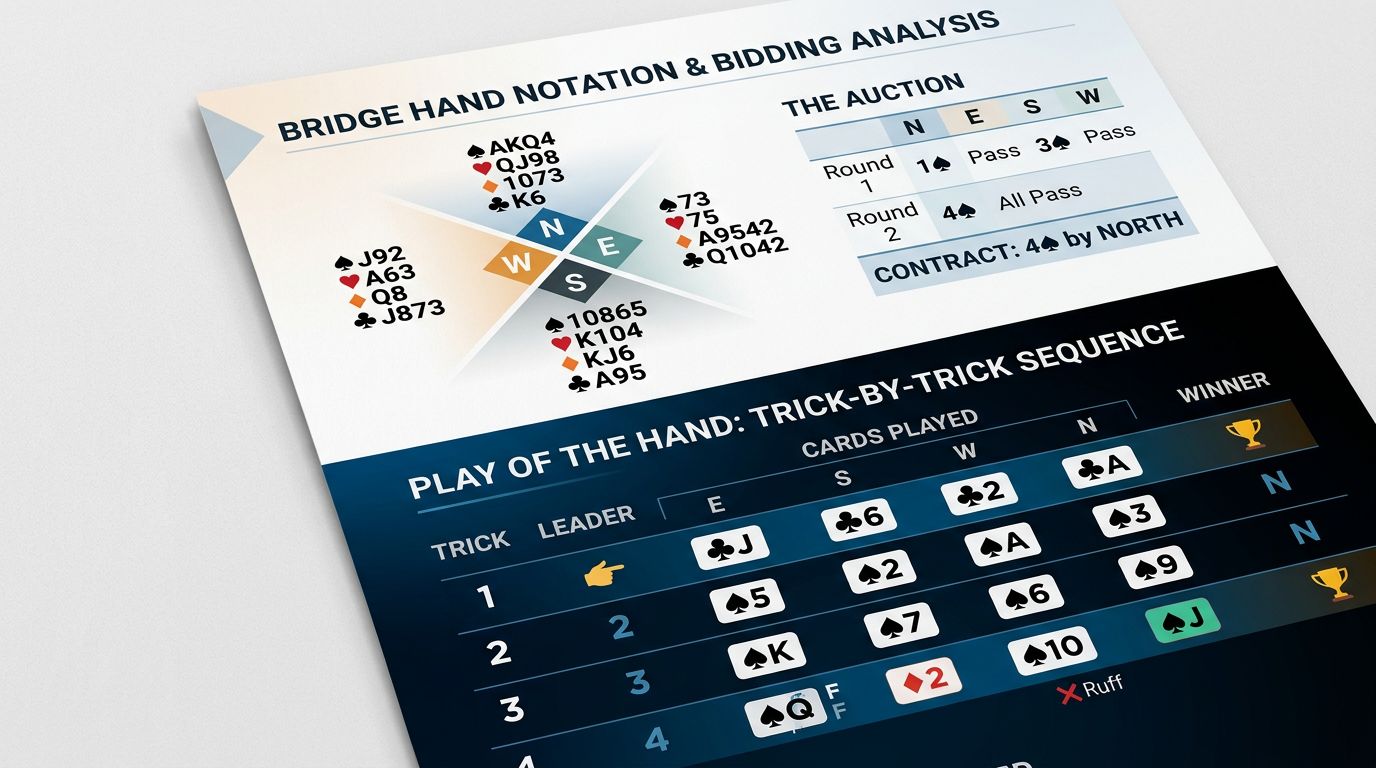
Bridge Notation and Symbols: A Complete Guide
If you’ve ever looked at a bridge column and felt lost in a sea of symbols, you’re not alone. Bridge has its own language, and learning to read it unlocks a world of hands, analysis, and theory. This guide covers everything from basic suit symbols to the digital formats that power modern bridge software.
The Four Suit Symbols
Bridge uses four suit symbols, and you’ll see them everywhere:
- ♠ Spades (black)
- ♥ Hearts (red)
- ♦ Diamonds (red)
- ♣ Clubs (black)
The color coding isn’t just pretty. It helps you scan hands quickly and spot patterns. Red suits are hearts and diamonds, black suits are spades and clubs. In printed materials, this visual distinction prevents mix-ups, especially when you’re speed-reading through a deal.
Rank Order Matters
The suits have a rank order that matters for bidding: spades (highest), hearts, diamonds, clubs (lowest). That’s why 1♠ is higher than 1♥, which is higher than 1♦, which is higher than 1♣. Notrump (NT) outranks all suits at the same level.
You’ll also hear spades and hearts called the “major suits” and diamonds and clubs the “minor suits.” This matters because major suit games require 10 tricks (4♥ or 4♠) while minor suit games require 11 tricks (5♣ or 5♦). That’s why most partnerships try to find major suit fits first.
Bidding Notation
When you see an auction written out, it follows a standard format that’s been around for decades.
Basic Bids
A bid shows the level (1-7) and the strain (a suit or NT):
- 1NT = one notrump
- 2♠ = two spades
- 3♥ = three hearts
- 4♦ = four diamonds
- 7♣ = seven clubs (a grand slam!)
The number tells you how many tricks above six your side is contracting for. So 3NT means you’re promising to take nine tricks (6 + 3). A bid of 7♠ is committing to all 13 tricks.
Special Calls
Beyond basic bids, the auction includes several special calls:
Pass is written as “Pass” or sometimes just “P.” It means you’re not making a bid right now.
Double is shown as “X” or “Dbl.” When the opponents have bid, double says “I think we can beat that contract” or “I have values, partner.” The meaning depends on the situation.
Redouble appears as “XX” or “Rdbl.” After the opponents double you, redouble says “We’re making this, and we’re making you pay.”
Reading an Auction
Auctions are typically shown in a table with four columns (one per player) or in a linear format. Here’s a simple auction:
West    North   East    South
1♣      Pass    1♠      Pass
2♠      Pass    4♠      Pass
Pass    Pass
This reads: West opened 1♣, North passed, East responded 1♠, South passed, West raised to 2♠, North passed, East jumped to game at 4♠, and everyone passed. The final contract is 4♠ played by East.
Sometimes you’ll see it written linearly: 1♣ - P - 1♠ - P - 2♠ - P - 4♠ - P - P - P.
Three passes in a row ends the auction. That’s the rule.
Card Play Notation
When bridge writers describe a hand, they use a shorthand that packs all 13 cards into one line.
Hand Diagrams
A hand is typically written with suits in rank order (spades, hearts, diamonds, clubs):
S: AKJ5
H: Q73
D: 862
C: AJ4
This shows a hand with the ace, king, jack, and five of spades; queen, seven, and three of hearts; and so on. You can also write it in a single line: ♠AKJ5 ♥Q73 ♦862 ♣AJ4.
Sometimes you’ll see a void (no cards in a suit) shown as a dash or simply omitted:
S: AKQ8642
H: —
D: J53
C: 742
That’s a seven-card spade suit with a heart void. Sweet pre-empt potential.
Full Deal Diagrams
Bridge problems and columns show all four hands in a compass layout:
            ♠ A73
            ♥ KJ4
            ♦ Q652
            ♣ 842
♠ J2                    ♠ 96
♥ Q1087                 ♥ 9652
♦ K94                   ♦ J1087
♣ QJ105                 ♣ A76
            ♠ KQ10854
            ♥ A3
            ♦ A3
            ♣ K93
North is always at the top, South at the bottom. West is on the left, East on the right. The player who actually plays the cards (declarer) is typically shown at the bottom, with dummy at the top.
Describing Play
When describing how a hand was played, you’ll see notation like:
- “Lead: ♠K” (the opening lead was the king of spades)
- “Win ♠A” (declarer won the ace of spades)
- “Cash ♥AK” (declarer played the ace and king of hearts)
- “Ruff in dummy” (declarer trumped in the dummy hand)
More specific notation shows the exact cards: “♠K, ♠A, ♠Q, ♠2” describes the cards played to one trick in clockwise order.
Lead Conventions and Symbols
Opening leads carry information, and the card chosen has meaning.
From a suit headed by touching honors (like KQJ or QJ10), you typically lead the top card. So “K from KQ4” or “Q from QJ10” tells partner what you hold.
From suits with the ace, standard practice is to lead “A from AK” (showing the king behind it) but “K from AKx” in some methods. This gets confusing, which is why partnerships discuss their agreements.
You’ll see notation like:
- “Lead: ♠A (from AK)”
- “Lead: ♥4 (fourth best)”
- “Lead: ♦K (asking for count)”
Fourth best means you’re leading your fourth-highest card from a long suit. It’s standard practice against notrump.
Common Bridge Abbreviations
Bridge players love abbreviations. Here are the ones you’ll see constantly:
Scoring and Points
- HCP = High Card Points (A=4, K=3, Q=2, J=1)
- TP = Total Points (HCP + distribution points)
- MP = Matchpoints
- IMP = International Match Points
Vulnerability
- Vul = Vulnerable
- NV = Not Vulnerable
- All vul = Everyone vulnerable
- None vul = Nobody vulnerable
Contract Types
- NT = Notrump
- Slam = 6-level contract (small slam) or 7-level (grand slam)
- Part score = Contract below game level
- Game = 3NT, 4♥, 4♠, 5♣, or 5♦
Table Positions
- LHO = Left Hand Opponent
- RHO = Right Hand Opponent
- Pard = Partner (informal)
Card Positions
- Qx = Queen and one small card (x = any small card)
- AKx = Ace, king, and one small card
- xxxx = Four small cards (no honors)
- Axx = Ace and two small cards
The “x” is a placeholder for an unimportant spot card. “Kxx” could be K73, K62, or K84. It doesn’t matter which specific small cards.
Portable Bridge Notation (PBN)
When bridge moved online, it needed a standard format for sharing hands. That’s PBN.
PBN is a text format that captures every detail of a bridge deal: the four hands, the dealer, vulnerability, the auction, the play, even the scoring. It’s what online platforms use to save and share games.
A PBN hand looks like this:
[Event "Casual Game"]
[Site "Online"]
[Date "2025.02.12"]
[Board "1"]
[Dealer "N"]
[Vulnerable "None"]
[Deal "N:AJ4.K73.Q652.842 K87.Q1094.K94.QJ5 Q32.J652.J1087.A6 T965.A8.A3.K10973"]
[Scoring "IMP"]
[Declarer "S"]
[Contract "3NT"]
[Result "9"]
The Deal line is the magic. It shows all four hands in a compact format: dealer’s position (N/E/S/W), then the hands separated by spaces. Each hand shows suits separated by periods (spades.hearts.diamonds.clubs).
You won’t hand-write PBN, but you’ll encounter it when downloading hands from BBO, importing deals into bridge software, or sharing interesting hands online. Most bridge programs can read and write PBN files.
Reading Bridge Columns
Newspaper and magazine bridge columns have their own conventions.
Most columns start with a full diagram showing all four hands. Then comes the auction, usually in a table format. After that, the author describes the play and the key decision points.
Good columns tell you the vulnerability and sometimes the form of scoring (matchpoints vs IMPs). This matters because your bidding and play decisions change based on these factors.
You’ll often see annotations in the auction or play:
- ”?” means questionable bid or play
- ”!” means good bid or play
- ”!!” means brilliant
- ”??” means terrible blunder
These are subjective judgments by the author, showing where players went wrong or found the winning line.
Special Symbols in Analysis
When discussing hands, you’ll see additional notation:
- = means “equals” (two lines of play are equivalent)
- > means “better than”
- → means “leads to” or “forcing”
- ↑ means “better”
- ↓ means “worse”
Some authors use checkmarks (✓) for correct plays and X marks for errors. Others use plus (+) for winners and minus (-) for losers when counting declarer’s tricks.
Digital Bridge Formats
Beyond PBN, other formats exist:
LIN (Linear format) is used by Bridge Base Online for storing game records. It’s more compact than PBN and includes timing information.
DLM files are used by some bridge software for lesson materials and practice hands.
PGN (Portable Game Notation) is borrowed from chess but occasionally adapted for bridge variants.
For practical purposes, PBN is the universal standard. If you’re sharing hands between different bridge programs, convert to PBN first.
Why This Matters
Learning bridge notation isn’t busywork. It’s how you access the vast library of bridge knowledge. Books, columns, articles, online forums… they all use this notation. Once you’re fluent, you can read a bridge column in 30 seconds and understand exactly what happened.
You’ll also write hands more clearly in emails to your partner, post questions in forums without confusion, and import interesting deals into your practice software.
The notation is standardized worldwide. A bridge player in Japan and one in Brazil use the same symbols, same auction format, same hand diagrams. That’s pretty cool. Bridge truly is a universal language, and these symbols are its alphabet.
Start with the basics (suit symbols, simple auctions, hand notation), and the rest will click as you see it used in context. Before long, you’ll be scanning bridge columns like a native speaker.