Bridge Partnership Agreements: The Complete Guide
You’re sitting down with a new partner for the first time. You shuffle the cards, cut for dealer, and then… wait. Do you know what their 2NT response to your opening means? Are they playing weak or strong jump shifts? What about their leads, fourth from longest, or third and fifth?
Bridge partnership agreements aren’t just nice to have. They’re the foundation of every successful partnership. Without them, you’re not playing as a team, you’re playing as two individuals who happen to be sitting at the same table.
Why Written Agreements Matter
Here’s the uncomfortable truth: most bridge disasters don’t happen because someone made a bad play. They happen because partners weren’t on the same page.
You might think you’re both playing “Standard American” or “2/1,” but those systems have dozens of variations. Does your 1NT forcing response promise a rebid? Is a jump to 2NT invitational or forcing? What does 4NT mean after you’ve agreed on a suit?
Written agreements solve three critical problems:
First, they force clarity. When you have to write down “1♠️-2♣️ shows 5+ clubs and is forcing to 2♠️,” you can’t hide behind vague assumptions. You have to decide exactly what your bids mean.
Second, they create accountability. When your partner bids 3NT with 4-3-3-3 shape and 12 points, you can check: did they follow your agreements, or did they freelance? Without written agreements, every auction becomes a negotiation.
Third, they’re required. In tournament play, you must disclose your agreements to opponents. A convention card isn’t optional paperwork, it’s part of the game’s ethics. Your opponents have the right to know what your bids mean.
But the real reason written agreements matter? They make you a better player. The process of discussing and documenting your methods forces you to think deeply about bridge theory. Why do you play a certain way? What are you trying to accomplish? What problems does your system solve?
Essential Conventions to Discuss
Before you play your first hand together, you need to agree on the fundamentals. These are non-negotiable conversations:
Opening bid structure. What’s your 1NT range? Are you opening light in third seat? Do you open 1♣️ with 3-3-3-4 shape, or do you start with 1♦️? These decisions cascade through your entire system.
Major suit raises. This is where most partnerships get tangled. You need to define:
- Direct raises (1♥️-2♥️, 1♥️-3♥️, 1♥️-4♥️)
- Delayed raises (1♥️-1NT-2♥️-3♥️)
- Limit raises (do you use 3♥️ or a conventional 2NT?)
- Splinter bids (if you play them)
- Jacoby 2NT (if applicable)
Notrump responses. Is 1NT forcing or semi-forcing? What does 2NT show, invitational balanced, or a conventional bid? These agreements affect how you handle awkward hands.
Two-over-one responses. If you play 2/1 Game Force, define the boundaries. Is 1♠️-2♣️ absolutely forcing to game, or can you stop in 3♣️? What about after a 1NT rebid?
Fourth suit forcing. This one trips up intermediate players constantly. Is it forcing to game, forcing one round, or artificial and forcing? What does it show, a stopper ask, general strength, or just a temporizing bid?
Competitive bidding basics. Agree on negative doubles (through what level?), responsive doubles, support doubles, and whether you play Michaels or Unusual 2NT.
These aren’t the only conventions you’ll need, but they’re the chassis your system is built on. Get these wrong, and everything else crumbles.
Defensive Agreements (Leads, Signals)
Defense is where partnerships win or lose matches. You can’t see your partner’s hand, so you’re communicating through card play. But that only works if you’re speaking the same language.
Opening leads are your first message to partner. Standard agreements include:
- Against notrump: Fourth from longest and strongest (or third and fifth if you prefer)
- Against suits: Top of a sequence, low from three small, attitude from honor combinations
- From doubleton: High-low or low-high? (Most play high)
- From three small: Bottom or middle-up-down?
Here’s what many partnerships miss: you also need agreements about what you’re not leading. If you lead the ♣️2 against 3NT, partner knows you don’t have a five-card major (because you would have led that instead). These negative inferences are just as important as the positive information.
Signals during the hand come in three flavors:
Attitude signals tell partner whether you like a suit. High card = encouragement, low card = discouragement. Simple, right? Except you need to agree: when do you give attitude? On partner’s leads? On declarer’s leads? On the opening lead only?
Count signals show length. High-low shows even count; low-high shows odd. Critical for helping partner count out declarer’s hand. But again, when do you give count? Some partnerships give count on declarer’s first lead of a suit, attitude on partner’s leads.
Suit preference signals point partner toward a specific suit. High card suggests the higher-ranking suit; low card suggests the lower-ranking. These are powerful but dangerous, only give suit preference when the context is clear.
The biggest mistake? Trying to signal too much. You only have 13 cards, and most of them need to do something other than send messages. Agree on priorities: attitude first, count second, suit preference only in specific situations.
Discarding deserves special attention. Are you playing standard (discard from weakness) or upside-down (discard from strength)? Do you use suit preference discards? Lavinthal discards? The more complex your methods, the more you need them written down.
Competitive Bidding Agreements
Bridge gets interesting when opponents interfere. Your careful bidding structure gets disrupted, and you need a different toolkit.
Takeout doubles are standard, but the follow-ups aren’t. After 1♥️-(X)-Pass-1♠️, what does doubler’s 2♣️ mean? What about 2NT? Is a jump to 3♣️ invitational or game-forcing? These auctions happen constantly, and most partnerships just guess.
Negative doubles solve the “I wanted to bid the unbid major” problem. But through what level? 2♠️? 3♠️? 4♠️? And what do you promise? Four cards in an unbid major, or five? Can you make a negative double with a good hand, or is that a penalty pass?
Balancing is where aggressive partnerships gain points. Do you balance with lighter values? Is a balancing 1NT weaker than a direct 1NT? Does a balancing double show extras, or can you do it with a minimum? Write it down.
Cuebids in competition are incredibly useful but confusing. After (1♥️)-2♥️, are you showing a limit raise in spades, or are you making a Western Cue showing a strong hand with hearts stopped? Different partnerships play this differently, and there’s no “standard.”
Jump bids in competition need definition. Is 1♦️-(1♥️)-2♠️ weak, intermediate, or strong? What about 1♦️-(1♥️)-3♣️? These hands come up often enough that you can’t afford to guess.
Two-suited overcalls (Michaels, Unusual 2NT) need detailed agreements. What’s your high card point range? Do you promise 5-5 or accept 5-4? How does partner ask which is your better suit?
Slam Bidding Agreements
Slams are worth huge bonuses, but only if you reach them. And only if you make them.
Control bidding (cuebidding) is the most accurate slam method, but it requires precise agreements. When you bid a new suit after agreeing on trumps, are you showing:
- First-round control (ace or void)?
- First or second-round control (ace, king, singleton, or void)?
- A working card in that suit?
Also crucial: does bypassing a suit deny a control? If you bid 4♦️ after agreeing on spades, and you skip clubs, do you promise no club control? Many partnerships say yes—but you need to discuss it.
Blackwood and variations seem simple until you actually use them. Basic agreements:
- Is 4NT always Blackwood, or can it be natural?
- Are you playing Roman Keycard (and which version, 1430 or 0314)?
- What does 5NT mean after a Blackwood response?
- How do you ask for the queen of trumps?
- What do you do with a void?
Gerber (4♣️ as ace-asking) is less common now, but if you play it, define when 4♣️ is Gerber versus natural. Most partnerships reserve it for auctions starting with 1NT or 2NT.
Quantitative 4NT is the natural slam try: “Partner, I have about 33 points combined. Do you have a maximum?” But this only works if both partners know when 4NT is quantitative versus Blackwood. Generally, 4NT is quantitative when no suit has been agreed and the last bid was notrump.
Exclusion Blackwood is an advanced agreement where you jump to five of a suit to ask for keycards excluding that suit. Useful with voids, but you absolutely must discuss it beforehand.
Here’s the thing about slam bidding: the methods matter less than the communication. You don’t need sophisticated conventions to reach good slams. You need to understand what your partner is trying to tell you.
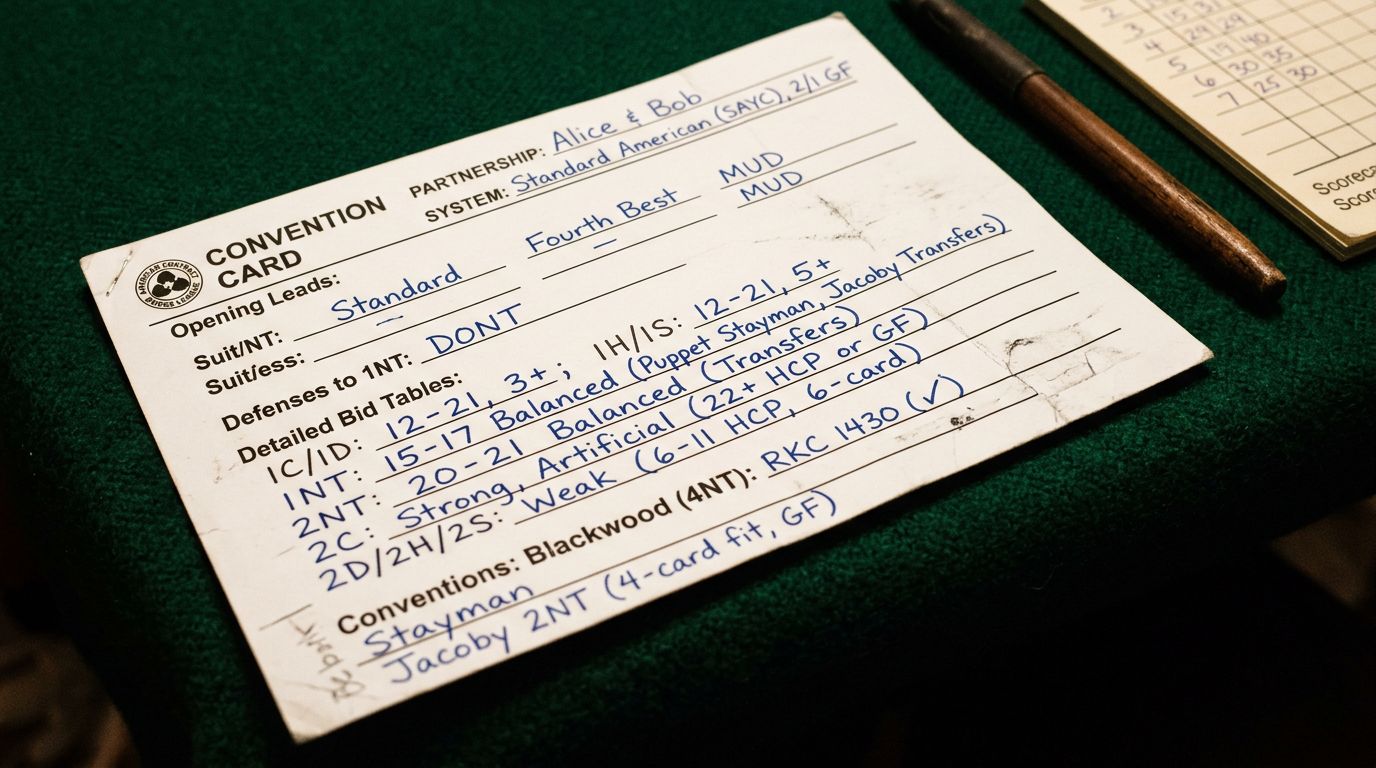
Creating a Convention Card
The convention card is your partnership’s contract. Here’s how to fill one out effectively:
Start with a template. Don’t create from scratch. The ACBL provides a standard convention card that covers 90% of what you need. Download it and work through it section by section.
Fill it out together. Don’t let one partner fill it out and hand it to the other. The discussion is the point. When you disagree about what you play, that’s exactly what you need to discover.
Be specific. Don’t write “Standard American” in the general approach section and call it done. What does that mean? Define your actual methods. If you play 15-17 notrump, write “15-17.” If you open light in third seat, note that.
Update regularly. Your agreements will evolve. When you discuss a new treatment after a hand, update the card immediately. Keep it current or it becomes useless.
Bring it to the table. Your convention card isn’t homework, it’s a reference document. When you’re not sure what partner’s bid meant, check the card. When opponents ask about your agreements, show them the card.
Common sections to focus on:
- General approach and point ranges
- Opening bids (especially 1NT range and minor suit openings)
- Responses to opening bids
- Overcalls and competitive bidding
- Doubles (takeout, negative, responsive, support)
- Slam conventions
- Defensive carding
- Special conventions and treatments
One pro tip: use the back of the card. Every convention card has space for additional notes. Write down your agreements on specific auctions that don’t fit the standard boxes.
How to Discuss with a New Partner
You’ve just been paired with someone new. How do you figure out what to play?
Start with the big picture. “I play 2/1 with a 15-17 notrump. What about you?” If you’re playing the same general system, you’re 80% of the way there.
Focus on frequent situations. Don’t spend 20 minutes discussing Spiral Scan when you need to agree on what 1♠️-2♣️ means. Cover the fundamentals first: major suit raises, notrump structure, common competitive sequences.
Ask about preferences. “Do you prefer weak jump shifts or strong?” “Weak twos, what’s your range?” Some conventions are player preference, not system requirements.
Highlight your quirks. Everyone has agreements that aren’t standard. “Just so you know, I play support doubles through 3♠️, not just 2♠️.” Give partner a heads up about unusual methods.
Discuss hand types. Instead of memorizing bid sequences, talk about how you handle common problems. “How do you show 6-4 in the majors after 1♣️ opening?” “What do you do with invitational hands after 1NT?”
Fill out a card together. Even for a casual game, spend 10 minutes going through a convention card. It forces you to cover the basics.
Play your first session conservatively. Don’t try fancy conventions on round one. Stick to simple, standard agreements until you get a feel for each other’s style.
Discuss hands afterward. After each session, talk about 2-3 hands where you had misunderstandings. “On board 7, what did you think my 3♦️ bid meant?” These discussions are how you improve.
Common Partnership Misunderstandings
Even experienced partnerships have blind spots. Here are the disasters that happen over and over:
The “forcing” confusion. Partner opens 1♥️, you respond 1NT (forcing), partner rebids 2♣️, you bid 2♥️. Partner passes. “But it was forcing!” you say. “Not after 1NT forcing—you could have passed 2♣️,” partner replies. Know what’s forcing and what isn’t.
Invitational versus forcing. You bid 1♠️-2♠️-3♠️. Is that inviting game or forcing? Some partnerships play that repeating your suit at the three level is forcing; others play it shows a sound raise but isn’t forcing. Guess wrong and you miss game or get too high.
The fourth-suit ambiguity. You bid 1♦️-1♥️-2♣️-2♠️ (fourth suit). Partner jumps to 4♥️. You’re shocked—you had 11 HCP and wanted to check for a spade stopper. Partner thought fourth suit showed a game-forcing hand. This one kills partnerships.
Support double misfire. Opponents overcall your opening, and partner makes a negative double. You have three-card support, do you support immediately or wait? Are support doubles “on” in all sequences or just some?
Slam confusion. Partner bids 4NT, you show one keycard, partner bids 6♣️. Wait—you thought partner was setting clubs as trumps three bids ago! They thought they were cuebidding. Nobody knows what suit is trumps, and you’re already at the six level.
Lead confusion. You lead the ♠️K against a suit contract. Partner plays the ♠️2. At trick two, you lead the ♠️A and partner ruffs. “Why did you give me count?” you ask. “That was attitude—I hated spades!” partner says. Your carding agreements just cost you a trick.
Balancing miscommunication. In fourth seat after three passes, you balance with 1NT showing 11-14 HCP. Partner raises to 3NT. They thought you had 15-17 because “balancing is still 15-17, isn’t it?” Down three.
The “extras” question. Partner opens 1♣️, you respond 1♥️, partner jumps to 3♥️. What does partner have? Exactly four hearts and a good hand? Or possibly three hearts with extras? If you’re not sure, you can’t bid accurately.
The solution to all of these? Discussion and documentation. When a misunderstanding happens, talk about it immediately. Figure out what each of you thought and what the agreement should be. Write it down. And then honor that agreement next time.
Partnership agreements aren’t bureaucracy, they’re freedom. When you and partner know exactly what your bids mean, you can communicate with incredible precision. You can describe hands that would be impossible to show otherwise. You can compete aggressively without fear. You can find slams that other partnerships miss.
The best partnerships aren’t the ones with the fanciest conventions. They’re the ones with crystal-clear agreements and the discipline to follow them. Start with simple, solid agreements. Write them down. Discuss them regularly. And trust your partner to do the same.
That’s how good partnerships become great ones.