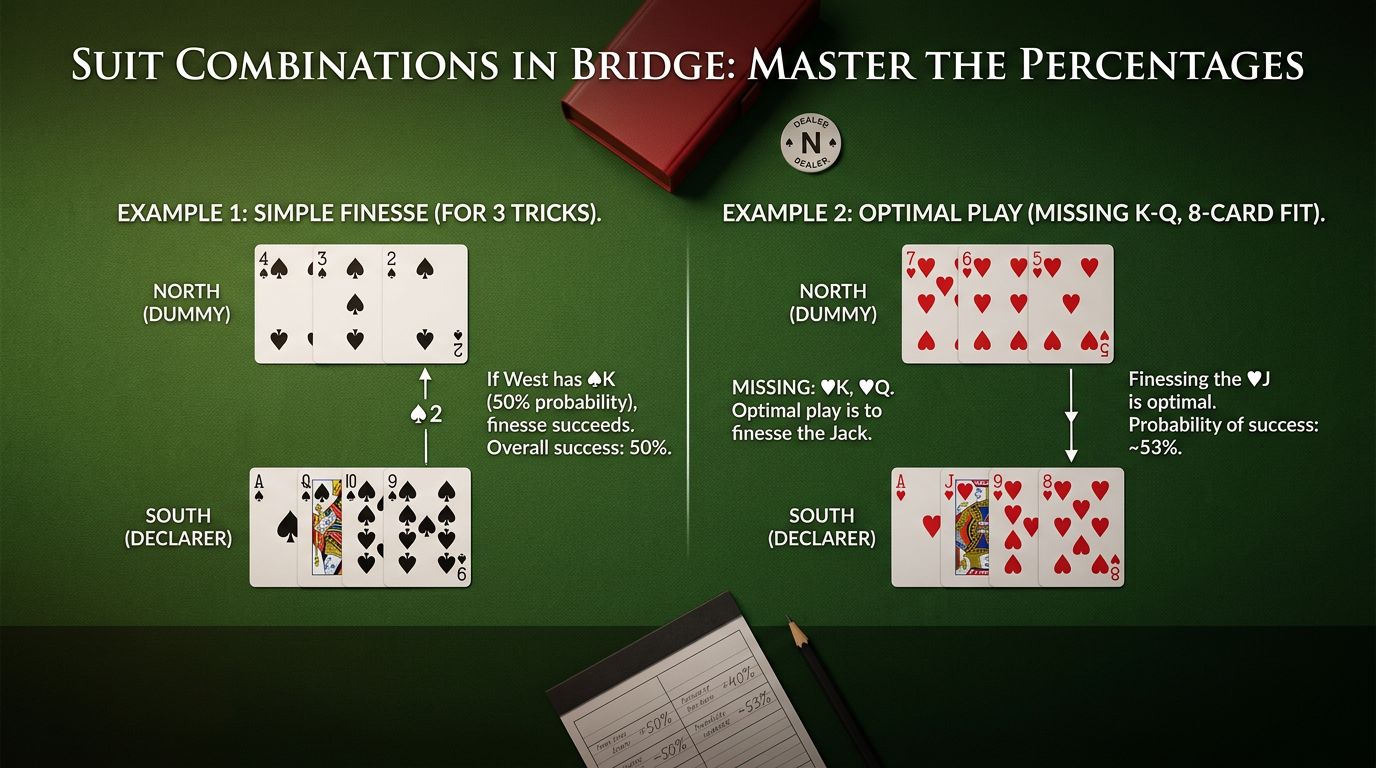
Suit Combinations in Bridge: Master the Percentages
You’re sitting in 3NT with eight tricks and need one more from your diamond suit. You have ♦AKJxx in dummy opposite ♦xxx in hand. Do you finesse the jack, or do you cash the ace-king hoping the queen drops? Get it right and you make your contract. Get it wrong and you’re writing down -50.
This is where knowing your bridge suit combinations pays off.
Why Suit Combinations Matter
Bridge isn’t just about bidding to the right contract, it’s about making that contract once you get there. And making your contract often comes down to squeezing every possible trick out of your suits.
Here’s the thing: declarer play isn’t about memorizing hundreds of positions. It’s about understanding the patterns. When you know the standard suit combinations, you’ll recognize similar positions at the table. You’ll know whether to finesse or play for the drop. You’ll know when that 53% line is better than the 50% alternative.
The best players don’t think “I have AKJxx opposite xxx.” They think “nine cards missing the queen, that’s a finesse position.” It becomes second nature.
And there’s a bonus: understanding suit combinations makes you a better defender too. When you know what declarer is trying to do with a suit, you can see the killing play more easily.
AKJxx Opposite xxx: The Classic Finesse Question
Let’s start with the position that stumps newer players more than any other.
You have ♠AKJxx in dummy and ♠xxx in your hand. You’re missing the queen. Do you finesse, or do you play ace-king hoping the queen drops?
The answer: Finesse.
You have nine cards in the suit, so the opponents have four. The queen is either:
- With the hand that has 3 cards (finesse works)
- With the hand that has 1 card (drop works)
The four missing cards will split 3-1 about 50% of the time and 2-2 about 40% of the time. When they’re 3-1, the queen is in the three-card holding three times out of four. When they’re 2-2, the finesse works half the time.
Do the math: finessing gives you about 53% success. Playing for the drop gives you about 47%.
It’s not a huge edge, but 53% is better than 50%. Over a lifetime of bridge, those extra three percentage points add up to a lot of made contracts.
But wait, what if you have outside information? Say West opened the bidding and East passed. Now West is more likely to hold any missing honor. Lead toward the jack and finesse through West. If East has the queen, you weren’t making this trick anyway.
AQ10xx Opposite xxx: The Double Finesse
Here’s another common combination: ♥AQ10xx in dummy opposite ♥xxx in hand. You’re missing both the king and jack.
The beginner’s play is to lead toward dummy and finesse the queen. If it loses to the king, you’re getting zero tricks from this suit beyond the ace.
The correct play: Take two finesses.
Lead low from hand toward dummy. When West plays low, finesse the ten. If it loses to the jack, come back to hand and lead toward the queen.
What are you playing for? You want West to hold the king, the jack, or both. That’s three of the four possible positions. The only time this line fails is when East has both honors.
The double finesse works about 75% of the time. That’s way better than the 50-50 queen finesse.
Here’s the trick sequence:
- Lead low from hand toward ♥AQ10xx
- West plays low, you finesse the ♥10
- If it loses to ♥J (from East), return to your hand
- Lead toward dummy again, finesse the ♥Q
- If West had ♥KJ, you’ve just picked up four tricks
Even when West has one honor and East the other, you still get three tricks total. The only disaster is when East has both honors, and that’s only a 25% chance.
KJ9x Opposite xxx: The Deep Finesse
This is a sneaky one that separates the experts from the rest.
You have ♣KJ9x in dummy and ♣xxx in hand. You’re missing the ace, queen, and ten. You need to develop tricks from this suit.
The losing play is to lead toward the king and hope it holds. It won’t, the opponents have the ace.
The correct play: Lead low from hand and finesse the nine.
Yes, the nine. This is called a “deep finesse.”
What you’re hoping for is that East holds ♣A10x or ♣AQ10. When you lead low from hand and West plays small, you insert the ♣9 from dummy. If East wins with the ten, you’ve promoted your jack. If East wins with the queen, you’ve promoted your jack. If East has to win with the ace, your king-jack are now equals.
Later, you lead toward dummy again and finesse the jack. If West has ♣Qxx, you’ll lose only to the ace.
This line maximizes your tricks when the honors are split between the opponents. You’re playing combinations instead of hoping for miracles.
AJ10 Opposite Kxx: Finding the Best Line
Shorter combinations require just as much thought. Take ♦AJ10 in dummy opposite ♦Kxx in hand.
You have six cards missing the queen. Your best chance for three tricks is to finesse twice.
The correct play:
- Lead low from hand toward dummy
- Finesse the ♦10
- If it loses to the ♦Q, cash the ♦A and ♦K
Why finesse the ten first instead of the jack? Because when the ten forces the queen (or wins), you can later finesse the jack through the other opponent if needed.
If East has ♦Qxx, the ten loses to the queen. You win the return, cross to hand, and lead toward ♦AJ. West shows out, and you finesse the jack, picking up the whole suit.
This combination has a wrinkle: if your hand is ♦Kx (only two cards), you get one finesse attempt. Lead toward ♦AJ10 and finesse the jack. That’s the percentage play with limited entries.
Missing Honors: Playing the Percentages
Bridge suit combinations come down to percentages. The more you know about how cards split, the better your decisions.
Key splits to remember:
Missing 4 cards:
- 3-1 split: 50% (most likely)
- 2-2 split: 40%
- 4-0 split: 10%
Missing 5 cards:
- 3-2 split: 68% (big favorite)
- 4-1 split: 28%
- 5-0 split: 4%
Missing 6 cards:
- 4-2 split: 48%
- 3-3 split: 36% (even splits become less likely!)
- 5-1 split: 15%
Notice something? Even splits are NOT the most likely. With four cards out, 3-1 is more common than 2-2. With six cards out, 4-2 is more common than 3-3.
This is why “playing for the drop” often fails. You’re betting on the even split, which is usually the underdog.
Another principle: Restricted Choice
When an opponent plays an honor (say, the jack from ♦QJ doubleton), they had no choice if they held only that honor. But if they held both the queen and jack, they could have played either one.
This means when East drops the jack, it’s twice as likely they have only the jack (and you should finesse for the queen next) than that they have both honors. This is called “restricted choice,” and it’s one of bridge’s most useful mathematical principles.
When to Lead Toward vs. Away From Honors
New players often lead the wrong direction through a suit.
Lead toward honors you want to win tricks with. If you have ♠KQx in dummy, lead from your hand toward dummy. That way, if the ace is on your left, your king-queen are protected behind the ace.
Lead away from honors when you want to set up lower cards. If you have ♥AKQxx opposite ♥xx and are missing the jack, lead the suit from the top. You’re not finessing—you’re just cashing winners and hoping the jack drops.
The finesse direction matters. If you have ♣AQ in dummy, you must lead from your hand toward dummy to finesse. Leading the queen from dummy doesn’t work—your right-hand opponent will cover with the king.
Think of it this way: you want to put the opponent who might have the missing honor in the position of playing before your finesse card. If you suspect West has the ♠K, lead from your hand (East) toward dummy (West), so West has to play before you decide whether to finesse.
When you have a two-way finesse: Sometimes you can finesse either direction. You hold ♠KJ10 opposite ♠Q98. You can lead toward the king-jack OR toward the queen for a finesse. This is when you use other clues—bidding, opening leads, count signals—to guess which opponent has the ♠A.
Common Suit Combination Mistakes
Even experienced players blow suit combinations. Here are the classics:
1. Finessing the wrong card
With ♥AQ10x opposite ♥xxx, players lead toward dummy and finesse the queen. Wrong! Finesse the ten. If it loses to the jack, you can still finesse the queen later. But if you finesse the queen and it loses to the king, you’ve learned nothing about the jack.
2. Cashing the wrong honor first
You have ♠AJ10xx opposite ♠Kx. Some players cash the king first, then lead toward the ace-jack. But if East has ♠Qxxx, you’ve just blocked the suit! Better to finesse the jack first. If it loses to the queen, you can still cash ace-king and hope for a 3-3 split.
3. Forgetting about entries
You plan a double finesse in diamonds, but you only have one entry to your hand. Oops, you can’t get back to take the second finesse. Always count your entries before you start playing a suit.
4. Not watching the spots
Card combinations change dramatically with different spot cards. ♣KJ9 opposite ♣xxx lets you finesse the nine. But ♣KJ7 opposite ♣xxx? The seven isn’t high enough to finesse effectively. Spot cards matter.
5. Playing too fast
The biggest mistake is playing a suit combination on autopilot. Before you play a single card, visualize how the suit might lie. Where are the missing honors? What splits are you playing for? What’s your best chance?
Take an extra five seconds. Make a plan. Then execute.
6. Ignoring the bidding
If West opened 1NT showing 15-17 high card points, and you can see 20 points between your hand and dummy, West has nearly all the missing honors. Don’t finesse into East, they have nothing. Use the bidding to place the cards.
7. Giving up when the finesse loses
Just because a finesse lost doesn’t mean the suit is dead. Maybe the honors were split and you can still develop tricks. Maybe the suit will come in on a squeeze later. Keep counting your tricks and looking for chances.
Practice Makes Permanent
You won’t memorize every suit combination overnight. But start with the common ones: nine cards missing the queen, AQ10 combinations, deep finesses with KJ9.
As you play more hands, you’ll start recognizing patterns. “Oh, this is like that AKJxx position, I should finesse.” Or “This is a two-way finesse, let me think about the bidding.”
Here’s a practice drill: Before you watch a hand on BBO or at the club, look at just one suit. Decide how you’d play it for maximum tricks. Then watch what declarer does. Did they get it right? Would your play have worked better?
Understanding bridge suit combinations turns you from someone who hopes to make contracts into someone who maximizes their chances. You’re not guessing anymore, you’re playing percentages.
And in the long run, the percentages always win.