Bridge Tournament Types: Pairs, Teams, and Scoring Explained
Walk into any bridge club on game night and you’ll see the same question on newcomers’ faces: “What kind of game is this?” Bridge tournaments come in more flavors than you might expect, each with its own rhythm, scoring, and strategy. Let’s break down what you need to know.
Pair Games: The Classic Club Experience
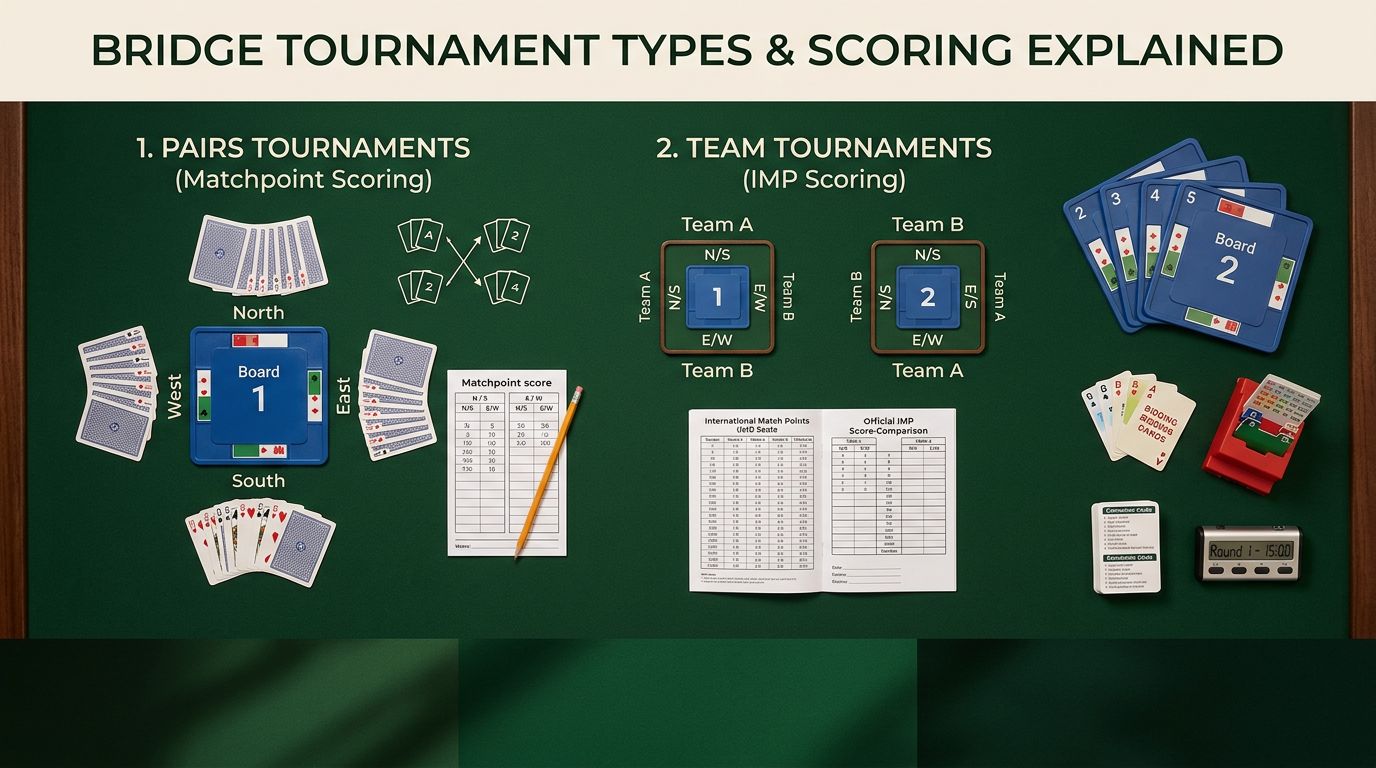
Most bridge players start with pair games, and for good reason. You and your partner sit across from each other, play against different pairs each round, and try to outscore everyone else who held the same cards.
Here’s how it works: Every table plays the same boards. You hold ♠AKQ and everyone else at different tables gets the same hand. Your job? Do better with those cards than they do. Make 3NT when others go down. Take 11 tricks when others settle for 10. Go down one doubled instead of two.
That’s matchpoint scoring in action. You get 1 point for every pair you beat on a board, half a point for ties. If 12 pairs play a board and you have the best result, that’s 11 matchpoints. Third-best gets you 9. Dead average? You’re looking at 5.5.
The scoring system changes everything about how you play. Making an overtrick matters just as much as making a tight game. Going down one instead of two can be the difference between a 60% game and a 40% game. It’s why experienced players in pair games take finesses they’d reject in team play, and why 3NT gets bid even when 5♣ is safer.
Pair games run at clubs weekly, at sectionals on Friday afternoons, and in side games at every major tournament. They’re social, they move quickly (you play against a new pair every 15-20 minutes), and you get immediate feedback on how your decisions compare to the field.
Team Games: Four Players, One Goal
Team events flip the script. Now it’s four players working together, two pairs, with your teammates playing the same boards at a different table. They sit North-South while you’re East-West (or vice versa). After each round, you compare scores.
Say you bid and make 4♥ for +620. At the other table, your opponents in the same seats make 4♥ too. Your teammates were defending and gave up 620 points. The board’s a wash, zero IMPs gained or lost.
But if you make 4♥ while your teammates set the contract at the other table? Now you’re cooking. You scored +620 and your teammates got +100 for setting them. That’s a 720-point swing, worth 12 IMPs. That’s the kind of board that wins matches.
Swiss Teams
The most common team format. You play a match (usually 6-8 boards) against another team. Win and you get Victory Points based on your IMP margin. Then the computer pairs you with a team that’s doing about as well as you are.
Go 3-0 in the first three matches and you’re playing other strong teams for the rest of the event. Struggle early and you’ll face teams with similar records. By the end of a single-session Swiss (typically 7 matches), you’ve played 42-56 boards and gotten a fair shake regardless of how you started.
Swiss events run everywhere: weekly at clubs, all weekend at sectionals and regionals, and as qualifying rounds at national tournaments. They’re fair, they’re friendly, and you can recover from a bad start.
Knockout Events
Single elimination. Lose a match and you’re done. These run at regionals and nationals, usually with longer matches (32-64 boards in later rounds). The strategy changes, you can afford to be conservative, waiting for opponents to make mistakes. One big swing won’t kill you over 64 boards, but staying solid on the routine hands wins matches.
Knockout events are where serious teams compete. The masterpoint awards are bigger, the competition’s tougher, and yes, losing in the finals after two days of bridge stings a bit.
Board-a-Match
Less common but worth knowing about. Each board is a separate match—win it, lose it, or tie. Make 4♥ while teammates set it? That’s 1 point. Go down at both tables? Half a point.
The scoring’s similar to matchpoints but the strategy’s closer to IMPs. You care about winning boards, not maximizing your score. It’s a nice middle ground between pair games and traditional team play.
Individual Events: Every Player for Themselves
Individual tournaments are weird and wonderful. You don’t have a partner. Instead, you rotate through different partners each round, playing with 7-8 different people over the course of an event.
Your score is yours alone. Play well with weak partners? You’ll outscore them. Draw strong partners? They’re competition, not teammates. It’s the purest test of individual skill in bridge.
These events are rare, you’ll find them at nationals and some regionals, usually as side events. They’re fun, they’re nerve-wracking, and they’ll teach you to be a good partner fast because you can’t blame your results on anyone else.
IMP Scoring vs. Matchpoint Scoring: Why It Matters
Understanding the difference between these scoring systems is crucial because it completely changes how you bid and play.
Matchpoint scoring is about frequency. How often does this line work? If doubletons split 3-3 about 36% of the time, you might take that line when you need one more trick for an overtrick. That extra 30 points beats everyone who made 10 tricks instead of 11.
IMP scoring is about magnitude. How many IMPs are at stake? Going down in a close game costs 10-12 IMPs if it makes. Making an overtrick gains 1 IMP, maybe 2. The math says: bid games that are 50% or better, avoid risky plays for overtricks, and focus on making your contract.
Here’s a practical example: You’re in 3NT and can guarantee 9 tricks by playing safe in ♠. Or you can finesse for a 10th trick, risking the contract. At matchpoints, you probably take the finesse—half the field will. At IMPs, you take your 9 tricks and run.
The conversion table from points to IMPs is nonlinear. A 500-point swing is 11 IMPs. A 1000-point swing is 14 IMPs. Doubling that to 2000 points only gets you 18 IMPs. Big swings matter, but not as much as consistent, solid bridge.
Stratified and Bracketed Events: Playing Against Your Peers
Most tournaments offer stratified or bracketed sections so you’re not getting crushed by Life Masters every round.
Stratified games put everyone in the same room playing the same hands, but award masterpoints in separate flights. A typical club game might have:
- Flight A: 750+ masterpoints
- Flight B: 200-750 masterpoints
- Flight C: 0-200 masterpoints
If you’re in Flight C, you compete for masterpoints against other C players even though you’re playing against everyone. Finish top in C and you’ll earn points even if A and B players outscored you overall.
Bracketed events actually separate fields. Instead of one 26-table game, you have four 6-7 table games grouped by masterpoint levels. You only play against teams or pairs in your bracket. The masterpoint awards are smaller than open events but winning is more realistic.
Most sectionals and regionals offer both options. Check the tournament schedule and pick the flight or bracket that matches your skill level.
Online vs. In-Person Tournaments
The pandemic changed bridge forever. Online tournaments are now a permanent fixture, running daily on BBO, Swan Games, and other platforms.
Online play is fast. Boards take 6-8 minutes instead of 15. You can play in your pajamas. No driving to the club. The downsides? Screens replace faces, connection issues happen, and you miss the social element that makes bridge fun for many players.
In-person tournaments give you the full experience. Reading opponents across the table, chatting between rounds, and grabbing lunch with friends. The masterpoint awards are typically higher too, a regional win online might award half what the same event gives in person.
Both count for ACBL masterpoints. Both are real bridge. Many players do both, playing online for practice and convenience, then hitting regionals a few times a year for the full tournament experience.
ACBL Masterpoint Levels: Club to Nationals
ACBL tournaments come in four levels, each awarding different colored masterpoints and different amounts.
Club games run weekly at your local bridge club. Awards are black masterpoints, typically 0.25-1.0 points for a decent finish. These are where you learn tournament bridge without traveling.
Sectional tournaments run Friday through Sunday, covering a geographic section (hence the name). You’ll earn silver points here, with bigger awards than clubs. A typical sectional might have 200-300 tables across all events.
Regional tournaments last a week to 10 days, drawing players from multiple states. Red points are awarded, and the competition steps up. Regionals have everything: knockouts, Swiss teams, stratified pairs, side games, and pro-am events. Plan to play multiple sessions if you go.
North American Bridge Championships (NABCs) happen three times a year in major cities. Nationals award gold points for open events and red points for non-life master events. Attendance runs 3000-6000 players. The Spingold (knockout teams), the Vanderbilt (another knockout), and the Blue Ribbon Pairs are among the most prestigious events in American bridge.
You need gold points to become a Life Master (500 total points including specific gold and silver requirements). The system encourages you to play in tougher events as you improve.
How to Enter Your First Tournament
Ready to jump in? Here’s what actually happens.
Find a sectional in your area through the ACBL website. Register online or at the door (online is cheaper and guarantees you a spot). Entry fees run $12-20 for most events.
Show up 20-30 minutes early. Find the partnership desk if you need a partner, they’ll match you with someone at your level. Grab a convention card and fill it out with your partner.
Pick an event in your stratification. Friday afternoon pair games are typically more relaxed than Saturday morning knockouts. Look for “199er” games if you have under 200 masterpoints, these are designed for newer players.
Sit at your assigned table. The director will make announcements, boards will be placed, and you’ll start playing. Between rounds, you can ask the director questions, check your scores on the recap sheet, or grab coffee.
After the event, results post online and masterpoints show up in your ACBL account within a few days. Whether you finish first or last, you’ll have played real tournament bridge and learned something.
Most important: tournament players were all beginners once. Ask questions. Watch how others handle the mechanics. Enjoy the experience. The first one’s always a little overwhelming, but by your third event, you’ll wonder why you waited so long to try it.
Bridge tournaments offer something for everyone, fast pair games, strategic team matches, online convenience, and in-person competition. Pick a format, find an event, and see what tournament bridge is all about. Your regular club game is great, but tournaments bring a different energy. They’re worth trying at least once.