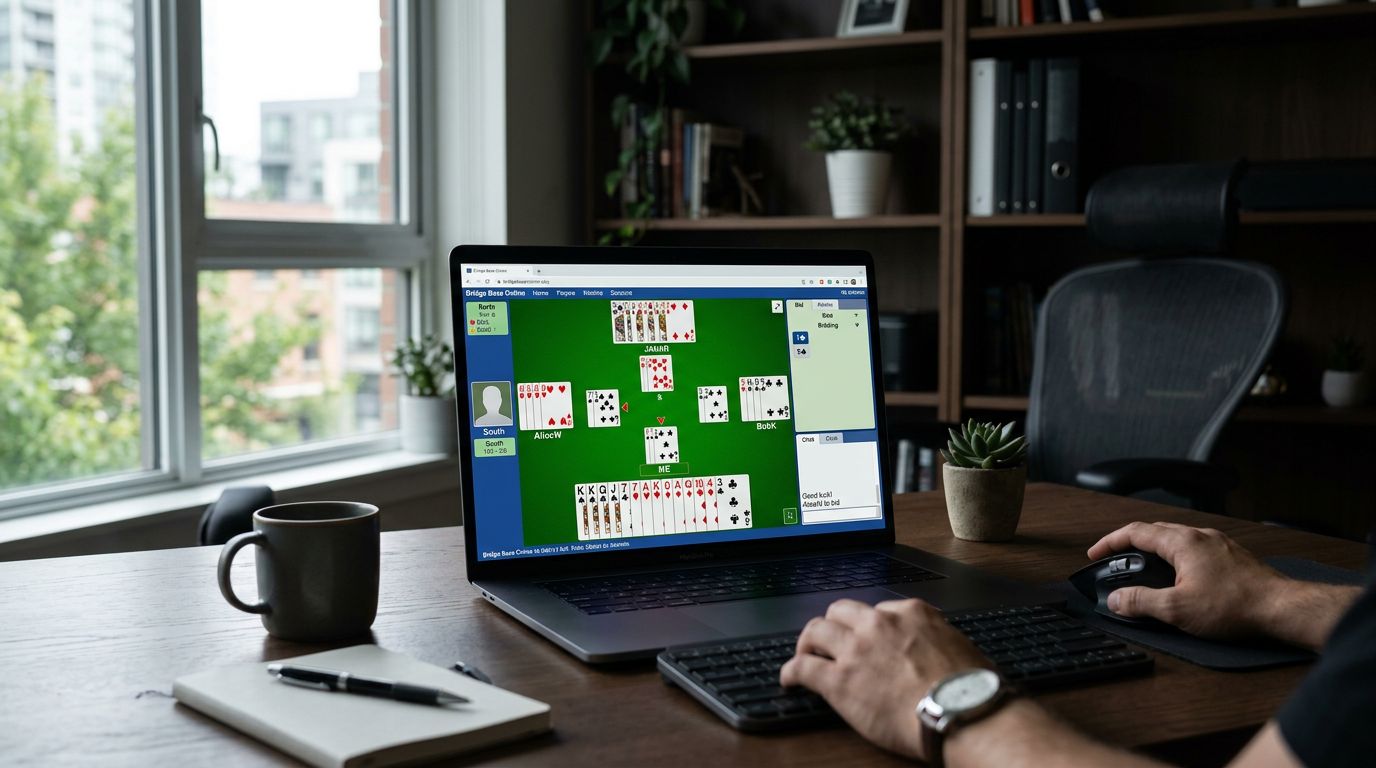
Online Bridge Etiquette
Online bridge has the same etiquette rules as face-to-face bridge, plus some new ones the internet created. Don’t be slow, don’t berate your partner, don’t claim you disconnected when you just don’t like your result.
The person on the other end is human. They might be new, they might be having a bad day, they might just be trying to enjoy bridge. Make the game better, not worse.
Tempo: Playing at Reasonable Speed
This is the biggest complaint in online bridge. Slow players ruin games.
Think on your own time. When opponents are playing, think about what you’ll do when it’s your turn. Don’t wait until everyone’s looking at you to start thinking.
Routine actions should be quick. Following to a trick with a singleton? Just play it. Opening lead from a clear sequence? Play it within 5-10 seconds.
Complex decisions can take time. Tough bidding decision with multiple reasonable options? Take 30 seconds to think. Intricate endplay as declarer? Think it through. But not on every single trick.
Balance speed with accuracy. Playing fast and making stupid mistakes helps nobody. Playing slow on obvious decisions is worse.
Different platforms show thinking time differently. BBO shows a clock ticking. RealBridge shows who’s thinking. Funbridge doesn’t matter because you’re alone. But the principle stays the same: don’t be slow.
What’s Too Slow?
Way too slow:
- 30+ seconds to follow suit with one card
- 2+ minutes on every single bid
- Taking breaks mid-hand to check your phone
- Consistently slowest player at the table
Acceptably slow:
- 30-60 seconds on genuinely difficult bids
- Thinking through complex endplay before committing
- Occasional longer thinks when hand is tricky
Good pace:
- Routine plays in under 10 seconds
- Most bids in under 20 seconds
- Difficult decisions under 60 seconds
- Whole hand takes 3-5 minutes normally
If people are complaining you’re slow, you’re slow. Speed up.
When Slow Play is Okay
You’re genuinely new and learning. Everyone was new once. Try to keep up, but learning takes time. Most players understand.
The hand is legitimately complex. Squeezes, coups, difficult trump management - okay to think.
You’re declarer planning the play at trick one. Take your time getting it right.
You’re deciding between a close 3NT and 5♦ that both might make. Think it through.
But if you’re tanking over whether to open 1♠ with 14 HCP and five spades, you’re just slow.
Chat Etiquette: Don’t Be a Jerk
Online anonymity makes people ruder than they’d ever be at a table. Don’t be that person.
Things You Can Say
After the hand:
- “Nice play” when partner or opponent made a good play
- “Sorry, my mistake” when you messed up
- “Good game” at the end
- “Thanks for the game”
- Questions about agreements if something wasn’t clear
During the hand:
- Alerts and explanations (required)
- Questions about opponent’s agreements
- “Please wait” if you need a moment
- Director calls when appropriate
Things You Shouldn’t Say
Criticizing partner:
- “Why would you lead that?”
- “That’s the worst bid I’ve ever seen”
- “Do you even know how to play bridge?”
- Any variant of “you’re terrible”
Criticizing opponents:
- “That was lucky”
- “You don’t deserve to win”
- “How did you not find that play?”
During the hand:
- Comments about the current hand (wait until it’s over)
- Hints to partner (“careful here”)
- Complaints about cards
- Discussing previous boards while current one is playing
Ever:
- Personal insults
- Swearing at people
- Accusations of cheating without evidence
- Threats or harassment
The Partner Criticism Rule
Don’t criticize partner. Ever. Even when they do something objectively terrible.
“Why did you lead the ace?” sounds like a question but it’s criticism. Partner knows it was wrong. Saying it just makes them feel worse.
If you want to discuss what happened, wait until the session is over and phrase it neutrally: “What were you thinking on that lead?” Not: “That lead was idiotic.”
Better yet, just don’t. Move to the next hand.
Your random pickup partner doesn’t owe you perfect bridge. They’re not getting paid. They’re trying to have fun. Let them.
When Chat is Actually Helpful
Explaining your methods to opponents prevents misunderstandings. “That’s a weak jump shift in our methods” helps everyone.
Asking about opponent’s methods is fine. “What’s that 2NT bid?” is a legitimate question.
Thanking partner for a good play or nice game builds positive atmosphere. “Good defense” makes people happy.
Apologizing when you make a clear error shows you’re self-aware. “Sorry, I should have known you were out of spades” is fine.
But most chat should happen after the hand is completely over, not in the middle of play.
Disconnections: Real vs Fake
Internet problems happen. Actual disconnections are understandable. Fake disconnections to escape bad results are cheating.
Real Disconnections
Your internet drops, your browser crashes, your power goes out. These happen. When you disconnect:
Reconnect as quickly as possible. Most platforms hold the game for a few minutes.
Explain when you return. “Sorry, internet dropped” is fine. People understand.
Don’t abuse the reconnection time. If you disconnect on every hand where you’re going down, everyone knows you’re faking.
Accept the consequences. Sometimes you can’t reconnect in time. You get a bad score. That’s life.
Fake Disconnections
Some players disconnect when they’re about to go down in a contract or when opponents are making a game. Then claim “internet problems.”
This is obvious. Everyone knows what you’re doing. Directors can see patterns. It’s cheating.
If you have chronic internet problems that cause frequent disconnections, fix your internet or don’t play online. It’s not fair to your partner and opponents.
What to Do if Opponent Disconnects
Wait a reasonable time. A couple minutes for them to reconnect. The platform usually enforces this.
Call the director if needed. If the wait is excessive, director can make a ruling.
Don’t assume they’re faking. Maybe their internet actually died. Maybe their kid needed something urgent. Give benefit of the doubt the first time.
Report pattern disconnections. Someone disconnects every time they’re going down? Report to platform administrators with specific hands.
Most platforms track disconnection patterns and will ban players who abuse it.
Alerts and Explanations
Online bridge requires you to alert and explain just like face-to-face. Maybe more so, since opponents can’t ask for clarification at the table.
What to Alert
Any bid that’s not natural. Artificial bids, conventional bids, unusual agreements - alert them all.
Your 2♣ response to 1NT is Stayman? Alert it.
Your 2NT response shows a limit raise? Alert it.
Your 3♥ is a splinter? Definitely alert it.
When in doubt, alert it. Over-alerting is better than under-alerting.
How to Explain
Be clear and specific. “Transfer to spades” is better than “conventional.”
“Weak jump shift, 3-7 HCP” is better than “weak.”
“Four or five hearts, forcing to game” is better than “heart bid.”
Give enough information that opponents understand what the bid shows. They’re entitled to know your agreements.
Asking About Opponent’s Bids
You can ask about any bid that’s not clearly natural. Click the bid, ask for explanation.
“What does 2♦ show?” is fine.
“Is that forcing?” is fine.
Don’t be a pest about obvious bids, but asking for clarification on their methods is your right.
If the explanation seems wrong (partner and opponent don’t agree on what a bid means), director can sort it out later.
Claims and Concessions
Claiming works like at the table, but you need to be more explicit since people can’t see your cards.
How to Claim
Click the claim button. State your line clearly.
“I have all the trumps, I’m pulling them and claiming the rest” is clear.
“I’m finessing the queen, if it works I make the rest” is clear.
“I make the rest” with no explanation is lazy. Say how.
Accepting or Disputing Claims
If the claim is obviously correct, accept it. Don’t be difficult about clear claims.
If you see a way declarer can go wrong, you can dispute. Director will rule.
Don’t dispute claims just to be annoying. “Well technically you didn’t explicitly say you’d cash the ace before the king” is being a jerk when it’s obvious.
Conceding
If you’re going down and it’s obvious, concede. “I’m down two” and move on.
Don’t make people play out cold contracts just because you can. If you’re in 3NT and they have four cashing tricks off the top, concede.
Playing fast when you’re beat is courtesy. Everyone wants to move to the next hand.
Undo and Misclicks
Most platforms allow undo for obvious misclicks. Use it fairly.
When to Allow Undo
You meant to click 3♥, accidentally clicked 3♠. That’s a misclick. Allow undo.
Partner clicked a card to play, clearly meant a different one. Allow undo.
Obvious fat-finger errors deserve undo. We’re playing bridge, not “can you click the right pixel.”
When to Deny Undo
They bid 3NT, saw your double, now want to “undo.” That’s not a misclick, that’s regret. Deny it.
They played a card, saw what happened, now want to undo. Too late. That’s not a misclick.
They want to undo after seeing additional information from the next player’s action. Nope.
Asking for Undo
If you misclick, immediately ask for undo. “Sorry, misclick, meant 2♥” is fine.
Don’t abuse it. One undo per session due to genuine misclick is fine. Five undos means you need to click more carefully.
If someone denies your undo request for what was clearly a misclick, they’re being difficult. But it’s their right.
Director Calls
Online directors handle issues just like table directors. Call them when needed.
When to Call the Director
Rule violations: Opponent did something against the rules and won’t fix it.
Technical problems: The software is doing something wrong, game is frozen, something broken.
Disputes: You and opponents can’t agree on what happened or what should happen.
Ethical concerns: Something seems wrong but you’re not sure.
Scoring errors: The score recorded doesn’t match what happened.
When Not to Call the Director
Partner made a bad play. That’s bridge, not a director issue.
You don’t like the ruling. Accept it and move on (though you can appeal in serious games).
Opponent was mean in chat. Use the report function for behavior issues.
You changed your mind about your bid. Too bad, you bid it.
Directors are there to resolve issues, not to adjudicate every disagreement or fix your mistakes.
How to Call the Director
Most platforms have a “Call Director” button. Click it, explain the issue clearly and neutrally.
“Opponent claims to have opened 1NT but the bid shows 1♥, what’s the ruling?”
Not: “This idiot bid the wrong thing and won’t admit it.”
State facts, not opinions. Director will sort it out.
Partnership Etiquette
When you sit down with a partner (random or regular), some basic etiquette makes the game better.
Before You Start
Agree on basic methods if you’re playing with someone new. “We playing SAYC? Two-over-one? Any special agreements?”
Quick system discussion prevents misunderstandings. Two minutes before starting saves problems later.
During the Game
Don’t kibbitz. If you’re watching a game, don’t comment on the play while it’s happening. Wait until the hand is over.
Trust partner’s decisions. They might be wrong, but they’re their decisions to make.
Support after mistakes. “Unlucky” or “tough hand” is better than silence after partner goes down in cold game.
After the Game
Thank your partner. Even if it went poorly, thank them for playing.
Constructive discussion is fine if both want it. “Want to talk about that 3NT hand?” is okay if partner wants to discuss. Don’t force post-mortems.
Add good partners to friends list. Found someone pleasant to play with? Add them, play again sometime.
Platform-Specific Etiquette
BBO-Specific
Vugraph chat: Don’t spam the chat during broadcasts. Commentators and experts use it for analysis.
Money games: Pay your debts promptly. Don’t play money games with strangers unless you’re prepared for possible scams.
Teaching tables: If you join as student, listen to the teacher. If you join as teacher, actually teach.
RealBridge-Specific
Video: Keep your camera on. That’s the whole point. Position it so people can see your face, not your ceiling.
Audio: Mute when you’re away from the table. Nobody needs to hear your conversation with your spouse.
Background: Doesn’t need to be fancy, but avoid chaos behind you. Professional enough that people aren’t distracted.
Appearance: Dress like you’re going to the club. Not formal, but not pajamas.
Funbridge-Specific
No etiquette needed! You’re playing alone against robots. Be as slow or chatty or grumpy as you want. The robots don’t care.
Reporting Problem Players
All platforms have reporting systems. Use them for genuinely bad behavior, not minor annoyances.
What to Report
Abusive chat: Personal insults, threats, harassment. Save screenshots if possible.
Cheating: Suspicious patterns, evidence of collusion, obvious computer use in human events.
Chronic slow play: Someone consistently holding up every game they play.
Fake disconnections: Pattern of disconnecting when about to go down.
Serious rule violations: Deliberately breaking rules for advantage.
What Not to Report
Bad play: Being bad at bridge isn’t reportable.
One rude comment: Everyone has bad moments. Pattern of abuse is different from one snippy remark.
Disagreements: You think their 3NT bid was terrible? That’s opinion, not reportable.
Beating you: Winning isn’t cheating, even if they’re much better than you expected.
Reports should be for serious issues. Platforms investigate, and false reports waste their time.
The Golden Rule
Treat other players how you’d want to be treated at a face-to-face table.
Be polite. Be reasonably quick. Explain your bids. Accept that people make mistakes. Don’t be a jerk.
Online bridge can be anonymous, but that’s not an excuse for rudeness. The username on the other end is a person trying to enjoy bridge just like you.
Play well, play fairly, play nicely. Everything else follows from that.
If you wouldn’t say it to someone’s face at the club, don’t type it online. If you wouldn’t do it at the table, don’t do it on BBO. If you’d be embarrassed if the director saw it, don’t do it.
Online bridge works best when everyone treats it like real bridge with real people. Because it is.
Now go play. Be nice. Make your bids. Don’t be slow. And if someone’s rude to you, ignore them and move on to the next hand.
The cards don’t care about chat drama. Neither should you.