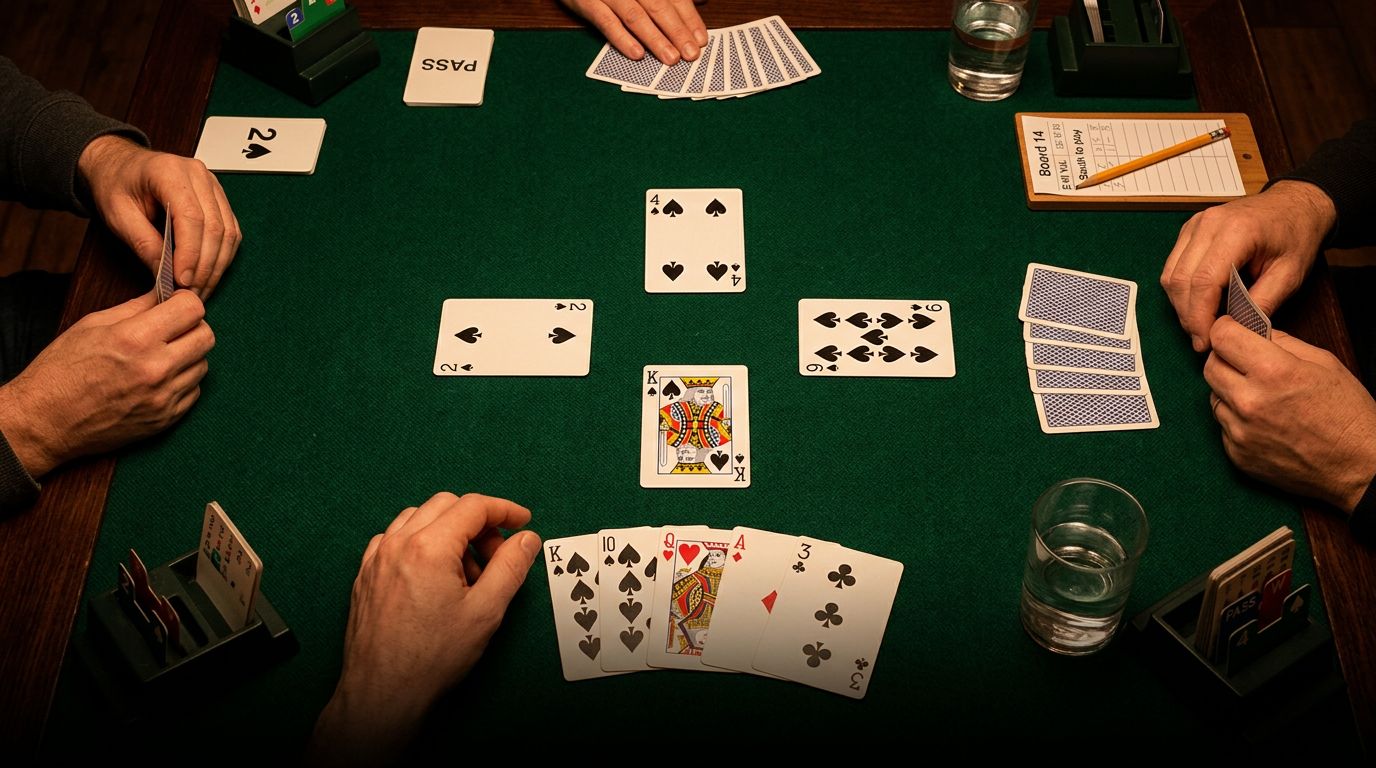
The Rule of Restricted Choice
You’re declaring 4♥ with this trump holding:
Dummy: ♥ AJ1093
You: ♥ 8542
You lead the 2 toward dummy. RHO plays the queen. You win the ace. Both opponents follow small on the next round.
Now you’re back in hand. You lead toward dummy again. RHO plays low.
Do you finesse the 10 (playing RHO for Q alone) or play for the drop (playing RHO for KQ doubleton)?
Most players get this wrong. They figure RHO had KQ and played one of them. They play for the drop.
Wrong.
The correct play is to finesse the 10. And the reason why is one of the most beautiful pieces of logic in bridge: the Rule of Restricted Choice.
The Basic Concept
When an opponent plays one of two equal honors, they’re more likely to have been forced to play it (because it was singleton) than to have chosen it from equals.
In the example above, RHO played the queen. Either:
- RHO had Q alone (forced to play it)
- RHO had KQ (chose the queen from equals)
If RHO had KQ, they could have played the king instead. The fact that they played the queen, and not the king, makes it more likely they didn’t have a choice. They had Q alone.
Finesse the 10.
The Math
Here’s the breakdown for the holding AJ1093 opposite xxxx, missing KQ:
Before the first round, the possible layouts are:
| LHO | RHO | Probability |
|---|---|---|
| KQ | , | 26% |
| K | Q | 24% |
| Q | K | 24% |
| , | KQ | 26% |
You lead toward dummy, RHO plays the queen. This eliminates some layouts:
- RHO definitely has the queen
- That rules out “LHO has Q”
- That rules out “LHO has KQ”
The remaining possibilities:
| LHO | RHO | Initial Probability | After Q Appears |
|---|---|---|---|
| K | Q | 24% | 24% |
| , | KQ | 26% | 13% |
Wait, why does KQ drop to 13%?
Because RHO with KQ could have played either the king or the queen. Half the time they play the king, half the time they play the queen. Since they played the queen, we’re only seeing half of the KQ layouts.
Meanwhile, RHO with Q alone always plays the queen. We see 100% of those layouts.
So after seeing the queen, the odds are:
- RHO has Q alone: 24 out of 37 (about 65%)
- RHO has KQ: 13 out of 37 (about 35%)
Finesse the 10. It works 65% of the time.
Why This Feels Wrong
Your brain wants to say: “RHO played the queen. That means they have the queen. It doesn’t tell me whether they also have the king.”
And that’s true. But here’s the key: the fact that they played the queen specifically (and not the king) is information.
If RHO had KQ, they’d play the king half the time. The fact that you’re looking at the queen, not the king, makes it more likely they didn’t have both.
Think of it this way: you walk into a room and see someone flip a coin. It lands heads. You ask, “Did you flip that coin, or was it already sitting there heads-up?”
If they flipped it, heads was 50%. If it was already sitting there, heads was 100%. The fact that it’s heads makes it more likely it was sitting there.
That’s Restricted Choice.
The Classic Example: Missing KQ
This is the textbook case, and it comes up constantly.
Dummy: ♠ AJ109
You: ♠ xxxx
You lead low toward dummy. RHO plays the king. You win the ace.
Later, you lead low toward dummy again. RHO plays low.
Do you finesse the jack or play for the drop?
Finesse the jack.
RHO either had:
- K alone (forced to play it): 24%
- KQ (chose the king from equals): 13% (half of 26%)
Finessing wins 65% of the time. Playing for the drop wins 35% of the time.
When Restricted Choice Applies
Restricted Choice kicks in when:
- You’re missing two equal honors (KQ, QJ, J10)
- An opponent plays one of them
- You have to decide whether they had both or just one
Common situations:
Situation 1: AJ10x Opposite xxxx (Missing KQ)
RHO plays the queen. Finesse on the next round.
Situation 2: AQ10x Opposite xxxx (Missing KJ)
RHO plays the jack. Finesse on the next round.
Situation 3: KJ9x Opposite xxxx (Missing AQ)
RHO plays the queen. Finesse on the next round (if you can).
Situation 4: AJ9xx Opposite xxx (Missing KQ10)
This is trickier. RHO plays the 10. Should you finesse the 9 on the next round?
Yes. RHO either had 10 alone or Q10 or K10. If they had Q10 or K10, they could have played the honor. The fact that they played the 10 makes it more likely they were forced to.
When Restricted Choice Does NOT Apply
Case 1: Opponent Had No Choice
Dummy: ♥ AJ109
You: ♥ Kxxx
You lead the king, RHO plays the queen.
Restricted Choice does not apply here. RHO had to play the queen (second hand high, or at least high enough to matter). They weren’t choosing between equals.
Case 2: You’re Missing Three Honors
Dummy: ♠ A109
You: ♠ xxxx
You lead low toward dummy, RHO plays the jack. You win the ace.
Should you finesse the 10 on the next round?
Maybe. But Restricted Choice doesn’t cleanly apply because RHO could have had KQJ, KJ, QJ, or J alone. The math is more complex.
In practice, you still usually finesse (it’s better than nothing), but the edge isn’t as clear as in the KQ case.
Case 3: Opponent Is Known to Have Length
If RHO opened 1♠ and showed 5+ spades, and you’re missing the ♥KQ in a different suit, Restricted Choice still applies. But you adjust for the fact that RHO has fewer hearts (because they have lots of spades).
This gets into vacant places (covered in another article). The takeaway: Restricted Choice is a starting point, not the final answer.
The Psychology of Restricted Choice
Good defenders know about Restricted Choice. So they try to mess with you.
If RHO has KQ, they might always play the queen (or always play the king). Now when you see the queen, you can’t assume it’s random. They might be sending a message.
Some players play “queen denies, king shows.” Others play the opposite. Others randomize.
The point is: against strong opponents, Restricted Choice is less reliable. But it’s still better than guessing blind.
Against weak opponents, Restricted Choice is golden. They play their equals randomly, and the math works perfectly.
The Deep Dive: Why “Half of 26%” Becomes 13%
This is the part that confuses people. Let’s walk through it slowly.
Before RHO plays, there are 4 possible layouts:
- LHO has KQ, RHO has nothing: 26% of the time
- LHO has K, RHO has Q: 24% of the time
- LHO has Q, RHO has K: 24% of the time
- LHO has nothing, RHO has KQ: 26% of the time
You lead toward dummy. RHO plays the queen.
This eliminates layouts 1 and 3 (RHO doesn’t have the queen in those).
Now we’re left with:
- Layout 2 (RHO has Q): 24%
- Layout 4 (RHO has KQ): 26%
But wait. In layout 4, RHO could play either the king or the queen. Let’s split layout 4 into two sub-cases:
- Layout 4a: RHO has KQ and plays the queen: 13%
- Layout 4b: RHO has KQ and plays the king: 13%
You’re observing layout 4a (RHO played the queen). You’re not observing layout 4b (RHO played the king).
So the relevant layouts are:
- Layout 2 (Q alone): 24%
- Layout 4a (KQ, played Q): 13%
Total: 37%. Of that, 24/37 is Q alone, 13/37 is KQ.
Finesse.
Common Mistakes
Mistake 1: Playing for the Drop Because “They Might Have Both”
Yes, they might have both. But the math says they probably don’t. Trust the math.
Mistake 2: Applying Restricted Choice to Non-Equals
RHO plays the 9 from 109. You think, “They might have J109. I’ll finesse.”
No. The 10 and 9 are not equals. Restricted Choice doesn’t apply.
Mistake 3: Forgetting About the Rest of the Hand
You finesse because of Restricted Choice…and lose 2 trump tricks, going down in a cold contract.
Always ask: what happens if the finesse loses? If you can’t afford to lose, find another line (even if it’s lower percentage).
Mistake 4: Ignoring the Bidding
RHO opened 1NT showing 15-17. You’re missing 6 HCP in a suit (the KQ). If RHO has KQ, they’re up to 21 HCP. Impossible.
LHO has the king. Finesse the other way.
Restricted Choice is a guideline, not a law. Use your brain.
The Monty Hall Connection
Restricted Choice is mathematically identical to the Monty Hall problem.
In Monty Hall, you pick door 1. Monty opens door 3, revealing a goat. Should you switch to door 2?
Yes. Because Monty’s choice of door 3 is information. If the car is behind door 2, Monty had to open door 3. If the car is behind door 1, Monty could have opened door 2 or door 3.
The fact that he opened door 3 makes it more likely he was forced to (because the car is behind door 2).
Same logic. Same math.
Restricted Choice in Defense
This works on defense too.
You’re defending 4♠. Partner leads the ♥K. Declarer wins the ace. Later, declarer leads a heart toward dummy’s QJ.
Do you assume partner has the king alone, or KQ?
By Restricted Choice, partner is more likely to have K alone. Plan your defense accordingly.
Sharpen Your Strategy with Brian
Want to put these strategic concepts into practice? Brian analyzes your bridge hands and explains the optimal line of play. Try Brian free →
The Practical Takeaway
When an opponent plays one of two equal honors, finesse on the next round. It’s a 2:1 favorite.
You won’t win every time. But over the long run, you’ll win 65% of the time instead of 35%.
That’s the difference between an average player and a good one.
Trust the math. Finesse.