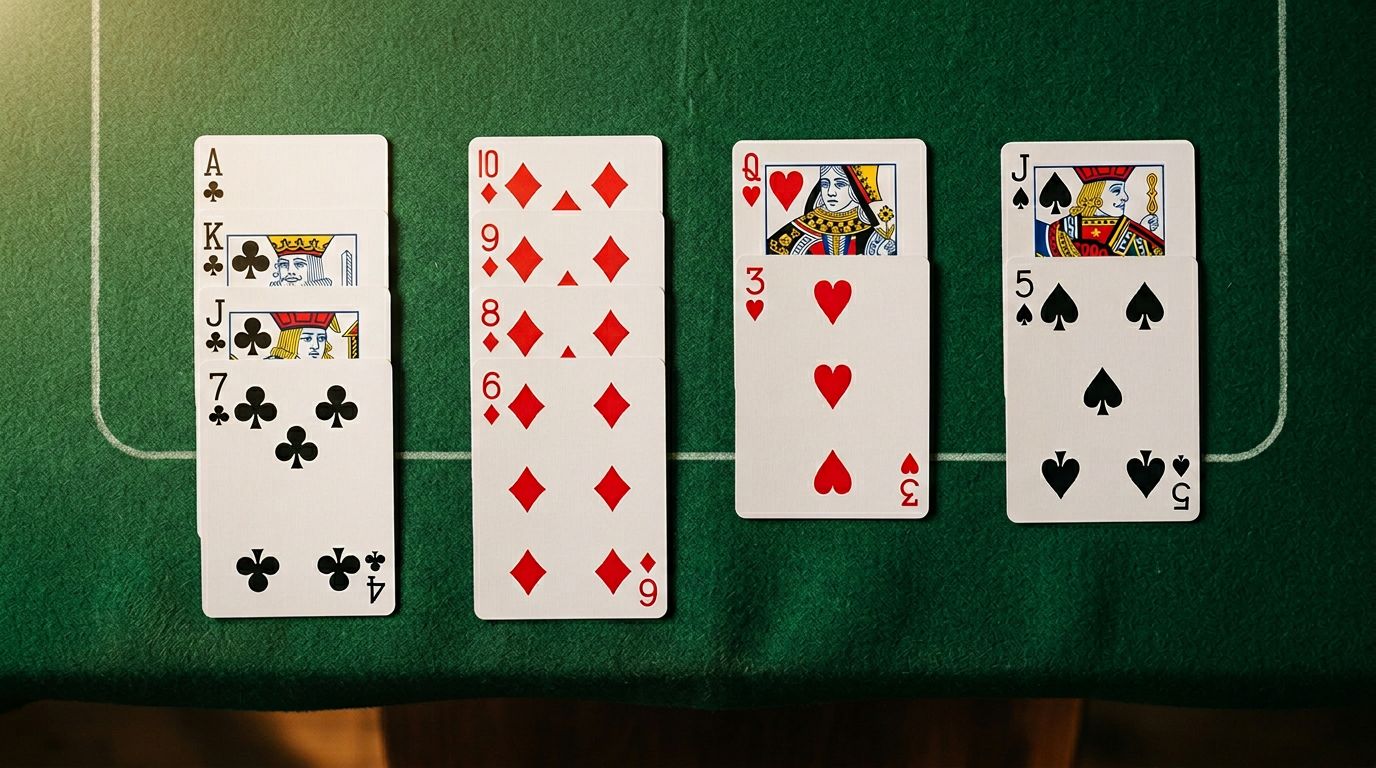
Suit Distribution Probabilities
You’re declaring 4♠ with 9 trumps between your hand and dummy. You’re missing 4 spades. How will they split?
If you answered “probably 2-2,” you’re wrong. They’ll split 2-2 only 40% of the time. They’re more likely to split 3-1 (50%) or even 4-0 (10%).
These numbers matter. They determine whether you finesse or play for the drop. Whether you draw trumps or ruff out a suit. Whether you make your contract or go down.
Every good player has these percentages memorized. Not because we’re math nerds, but because they come up every single hand.
The Basic Principle: Even Splits Are Rare
Here’s what beginners get wrong: they assume cards split evenly. Five outstanding cards split 3-2. Four outstanding cards split 2-2. Six outstanding cards split 3-3.
But bridge isn’t that neat. Random distribution favors slightly uneven splits.
Think about it this way: there are more ways to deal 3 cards to one opponent and 2 to the other than to deal exactly 2-2. The math bears this out.
The Table You Need to Memorize
Here are the key distributions and their probabilities:
5 Outstanding Cards
| Split | Probability |
|---|---|
| 3-2 | 68% |
| 4-1 | 28% |
| 5-0 | 4% |
What this means: When you’re missing 5 cards, expect them to break 3-2 about 2 times out of 3. But don’t be shocked when they go 4-1, it happens more than 1 in 4 times.
4 Outstanding Cards
| Split | Probability |
|---|---|
| 3-1 | 50% |
| 2-2 | 40% |
| 4-0 | 10% |
What this means: Missing 4 cards, a 3-1 break is actually more common than 2-2. And 4-0, while unlikely, happens often enough that you need to handle it.
6 Outstanding Cards
| Split | Probability |
|---|---|
| 4-2 | 48% |
| 3-3 | 36% |
| 5-1 | 15% |
| 6-0 | 1% |
What this means: When you’re missing 6 cards and need them to split evenly, you’re counting on 36%. That’s barely more than 1 in 3. Often, you need a better line.
3 Outstanding Cards
| Split | Probability |
|---|---|
| 2-1 | 78% |
| 3-0 | 22% |
What this means: Missing only 3 cards, you’re in good shape. They’ll almost always split, with 3-0 being the only real danger.
7 Outstanding Cards
| Split | Probability |
|---|---|
| 4-3 | 62% |
| 5-2 | 31% |
| 6-1 | 7% |
| 7-0 | <1% |
What this means: Seven outstanding cards will usually split 4-3, but 5-2 happens often enough to plan for.
Why These Numbers Matter: Practical Examples
Example 1: Eight-Card Fit, Missing the Queen
You have 8 cards in a suit with AKJ10xxx opposite xx. You’re missing the queen.
Should you finesse or play for the drop?
Answer: Play for the drop.
You’re missing 5 cards. They’ll split 3-2 about 68% of the time. If they do, and the queen is in the 3-card holding, it’ll drop when you cash the ace and king.
The probability of a 3-2 split with the queen in the 3-card holding is about 40%. That beats the 50% finesse.
But wait, there’s more. Even if the queen doesn’t drop (because it’s doubleton), you haven’t lost anything. You can still finesse on the third round if needed.
Playing for the drop gives you two chances: the drop itself, and then the finesse as a backup.
Example 2: Nine-Card Fit, Missing the King
You have 9 trumps: AQJxxx opposite xxx. You’re missing the king.
Should you finesse?
Answer: No. Play the ace.
You’re missing 4 cards. They’ll split 2-2 about 40% of the time. If the king is doubleton (20% of all layouts), it drops under the ace.
But here’s the kicker: even if it doesn’t drop, you still have the finesse later. Lead toward the queen on the second round. You get two chances.
The finesse alone is 50%. Playing the ace first is nearly 52% (20% immediate drop + 32% finesse if it doesn’t drop). Small edge, but edges add up.
Example 3: Establishing a Long Suit
Dummy has KQ10xxx in diamonds, you have xx. You’re in 3NT and need 3 diamond tricks.
You can afford to lose 2 diamonds, but not 3. How do you play it?
Answer: Cash the king. If both follow, lead toward the queen.
You’re missing 6 diamonds. They’ll split 4-2 about 48% of the time, 3-3 about 36% of the time.
If they’re 3-3, you can establish the suit by losing 2 tricks. If they’re 4-2, you’re in trouble unless you can ruff out the 4th round (or you have enough tricks elsewhere).
The point is: you know going in that the suit will split evenly only 36% of the time. Plan accordingly.
Example 4: Trump Safety Play
You’re in 6♥ with 10 hearts between your hand and dummy: AKJ109x opposite xxx. You’re missing the queen.
You can afford to lose 1 heart, but not 2. How do you play?
Answer: Cash the ace. If both follow, lead toward the jack.
You’re missing 3 hearts. They’ll split 2-1 about 78% of the time. If the queen is singleton (26% of layouts), it drops under the ace.
If it doesn’t drop, lead toward the jack. If LHO has Qx, you finesse. If RHO has Qx, you lose one but make the contract.
This line picks up singleton queen (26%) plus any 2-1 break where you guess right (52%), for a total success rate over 75%. That beats a simple finesse (50%).
The Math Behind the Numbers
You don’t need to understand the math to use these percentages, but here’s the basic idea:
Card distribution follows the hypergeometric distribution. When you’re missing N cards, the number of ways they can split depends on combinations.
For example, 5 outstanding cards can split:
- 3-2: LHO gets 3, RHO gets 2 (or vice versa). There are lots of ways to pick 3 cards from 5, so this is common.
- 4-1: LHO gets 4, RHO gets 1 (or vice versa). Fewer ways to do this.
- 5-0: All 5 to one opponent. Only 2 ways this happens (all to LHO or all to RHO).
The formula involves factorials and binomial coefficients, but you don’t need to calculate it at the table. Just memorize the percentages.
Common Mistakes
Mistake 1: Assuming Even Splits
“I need diamonds to be 3-3 to make this.”
No. You need to plan for diamonds being 4-2, because that’s more likely. Maybe you can ruff the 4th round. Maybe you need to discard your diamond losers elsewhere. Don’t count on 36%.
Mistake 2: Ignoring the 4-0 Break
You have AKQJx in a suit. You cash the ace, both opponents follow. You cash the king, both follow. You play the queen…and RHO ruffs.
Wait, what? You had 9 cards in the suit. The missing 4 split 4-0.
This happens 10% of the time. When you have a long suit and a short suit, someone might be 4-0 in one and compensating in the other. Watch the count signals.
Mistake 3: Finessing With 9+ Cards
You have 9 cards including the AKQ. You’re missing the jack.
Don’t finesse. The jack will drop 91% of the time (either immediately or on the third round). Finessing is 50%. Play for the drop.
Mistake 4: Not Counting
You’re in 4♠. Spades split 3-1. Later in the hand, you need to guess where the ♥K is.
Think: LHO started with 3 spades, RHO started with 1. If both opponents followed to 3 rounds of clubs, LHO has 10 cards in hearts and diamonds, RHO has 9. LHO is slightly more likely to hold any given missing card.
This is called vacant places, and we’ll cover it in detail in another article. For now, just remember: distribution in one suit affects probabilities in other suits.
Advanced: Restricted Choice
Here’s a weird one: you’re missing the KQ in a suit. You have AJ109x opposite xxx.
You lead toward the ace-jack, RHO plays the king. You win the ace. You come back to hand and lead toward the J109. RHO plays low.
Should you finesse (playing the jack) or play for the drop (playing the 9)?
Answer: Finesse.
The king was either singleton (in which case the finesse works) or RHO had KQ doubleton (in which case the drop works).
But here’s the thing: if RHO had KQ, they could have played either the king or the queen on the first round. The fact that they chose the king makes it twice as likely they were forced to play it (because it was singleton) rather than choosing it from KQ.
This is the Principle of Restricted Choice, and it’s one of the most misunderstood concepts in bridge. We’ll cover it in depth in another article.
For now, just know: when an opponent plays an honor, they’re more likely to have been forced to play it than to have chosen it from equals.
The 50% Rule
Here’s a shortcut: when you’re missing an odd number of cards, the most even split is always close to 50%.
- Missing 3: 2-1 is 78% (a bit higher because you’re missing so few)
- Missing 5: 3-2 is 68%
- Missing 7: 4-3 is 62%
- Missing 9: 5-4 is 59%
Notice the pattern? As you miss more cards, the probability of an even split decreases, approaching 50%.
This makes intuitive sense. With many outstanding cards, lots of different distributions become possible.
The Practical Takeaway
You don’t need to memorize every percentage. Focus on these:
- 3-2 split happens 68% of the time (missing 5 cards)
- 2-2 split happens only 40% of the time (missing 4 cards)
- 3-3 split happens only 36% of the time (missing 6 cards)
- With 8+ cards, play for the drop (finessing is usually wrong)
- 4-0 happens 10% of the time (missing 4 cards, be ready for it)
These five facts will guide 90% of your declarer decisions.
When to Deviate
Probabilities assume you know nothing about the opponents’ hands. But you usually know something.
If an opponent opened 1♠ and showed 5 spades, they have fewer cards in the other suits. If you’re missing 5 hearts, they’re less likely to have 3 of them (and their partner is more likely).
This is called a priori vs a posteriori probabilities. Start with the math (a priori), then adjust based on what you learn (a posteriori).
Good declarers use the percentages as a starting point, then refine them based on the auction and play.
Sharpen Your Strategy with Brian
Want to put these strategic concepts into practice? Brian analyzes your bridge hands and explains the optimal line of play. Try Brian free →
The Bottom Line
Random card distribution isn’t even. Even splits are less common than you think. Memorize the key percentages, and you’ll make better decisions.
The numbers don’t lie. But they’re just the beginning. Combine them with counting, bidding inferences, and table presence, and you’ll beat the odds more often than you’d expect.
That’s the game.