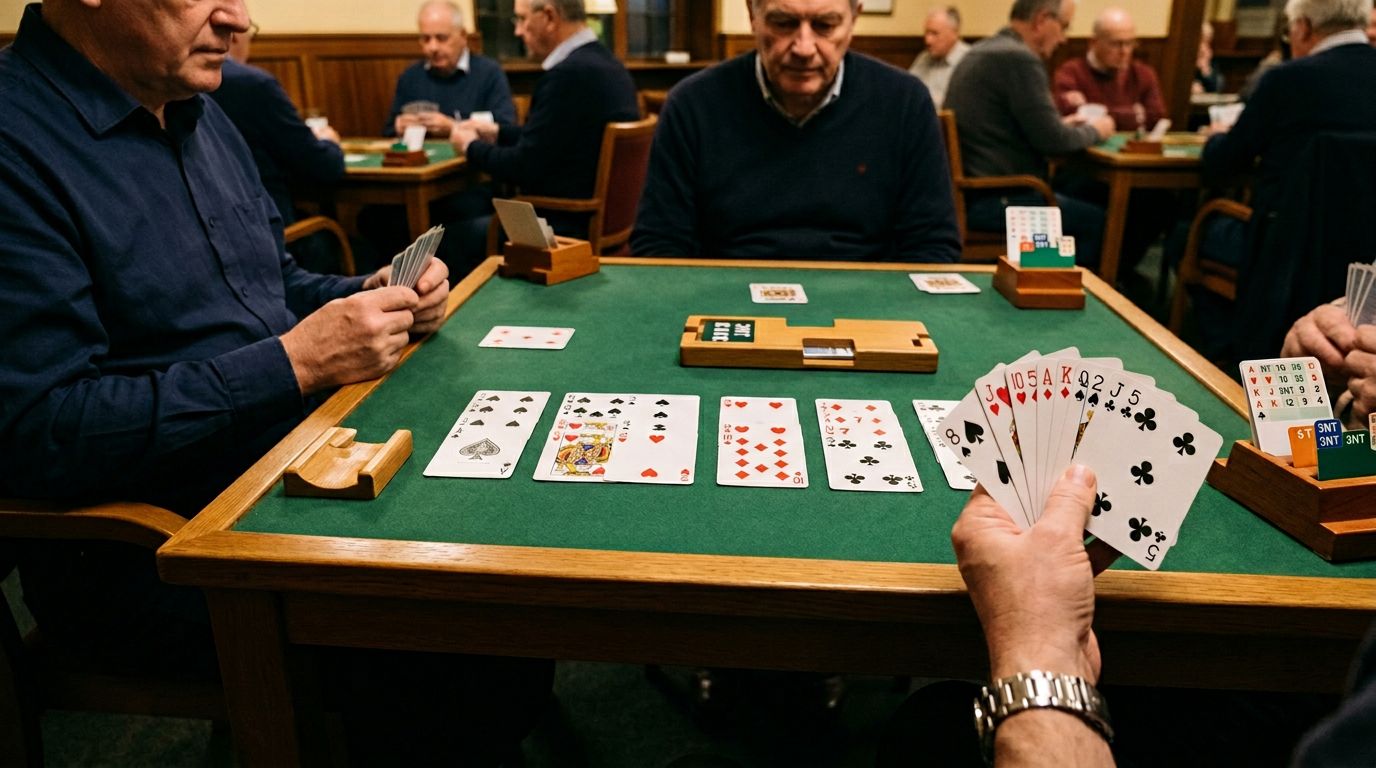
Opening Leads in Bridge: The Only Decision You Make Blind
The opening lead in bridge is unique. It’s the only play you make without seeing dummy. No information from partner’s signals. No count of the hand. Just you, the auction, your thirteen cards, and a decision that often determines whether the contract makes or fails.
Get it right and you might beat an unbeatable contract. Get it wrong and you hand declarer tricks they couldn’t earn themselves. Opening leads bridge strategy separates lucky defenders from consistent winners.
The pressure is real. But there are principles that work. Let’s talk about what to lead and why.
Why Opening Leads Matter
Every other card you play in bridge comes with information. You see dummy. You see partner’s signals. You count declarer’s tricks. You know the score.
Not the opening lead. You’re blind.
That makes it the hardest play in bridge and the most important. A good opening lead can set up your side’s tricks before declarer gets organized. A bad one hands declarer the contract on a silver platter.
Consider a simple case: you’re defending 3NT and you have a five-card spade suit. Lead it and you might establish three spade tricks before declarer can set up nine. Lead something else and declarer claims. One decision. Game made or game down.
The opening lead sets the tone for the entire defense. It’s your first message to partner about what you have and what you’re trying to do. Make it count.
Leading Against Notrump: Establish Your Long Suit
Against notrump contracts, the basic strategy is simple: lead your longest suit and try to establish it before declarer establishes theirs.
Notrump is a race. Declarer has 25-27 high card points between their hand and dummy. You and partner have the rest. Whoever sets up their long suits first usually wins.
Fourth-Best from Longest and Strongest
The standard opening lead against notrump is fourth-best from your longest suit.
If you have ♠KJ753, lead the ♠5. Count from the top: K (1st), J (2nd), 7 (3rd), 5 (4th). That’s your fourth-best card.
Why fourth-best? It tells partner you have length. It gives partner information via the Rule of 11. And it keeps your higher cards to beat dummy’s or declarer’s cards later.
If you have two five-card suits, pick the stronger one. Strength means honors, not just high cards. ♥KJ953 is stronger than ♠98765, even though the spades are “higher.”
Leading from Sequences
When you have a sequence (three cards in a row), lead the top card.
From ♠KQJ64, lead the ♠K.
From ♥QJ1083, lead the ♥Q.
From ♦J1097, lead the ♦J.
Why? Leading an honor promises the card directly below it. When you lead the king, partner knows you have the queen. When the queen holds the trick, partner knows you have the jack. This helps partner read the position and make good decisions.
Sequences are gold. They’re safe (you’re not giving anything away) and they’re clear (partner knows what you have). Always prefer leading from a sequence over leading from a broken suit.
What to Lead from Common Holdings (Notrump)
From sequences (safe): Lead top card: K from KQJx, Q from QJ10x, J from J109x, 10 from 109x.
From broken honors (risky): Lead 4th-best from KJxxx or Q10xx. These are speculative.
Avoid: Don’t lead from Axxx (lose your entry), Kxxx (gives away tricks), or Qxxx without the jack.
Rule: Sequences are safe. Broken honors are dangerous.
Leading Against Suit Contracts: Different Goals
Suit contracts change everything. Declarer has a trump suit. They can ruff your winners. The race isn’t about establishing long suits, it’s about cashing tricks before declarer draws trumps and claims.
Against suit contracts, your opening lead strategy shifts to:
- Lead partner’s suit if they bid one
- Lead a singleton (or doubleton) if you have trumps to ruff with
- Lead from a sequence if you have one
- Lead a trump when you want to stop dummy from ruffing
- Lead safe when you’re not sure what to do
Lead Partner’s Suit
This is the golden rule of suit contract defense. Partner bid a suit? Lead it.
If partner opened 1♥ and the opponents bid to 4♠, lead a heart. Even if you have a singleton. Even if you have a tempting alternative. Partner’s suit promises values there, and they’ll thank you for it.
From three small cards (743), lead the top: the 7.
From two cards (84), lead the higher: the 8.
From an honor and small cards (K84), lead the king.
From a doubleton honor (K4), lead the king.
Lead a Singleton (or Doubleton)
Singleton ♦ with three small trumps against 4♠? Lead it. If partner wins and returns one, you ruff the second round. If you get in again, you might score another ruff. Two tricks from a singleton.
This works when you have trump length (xxx or xxxx). With Axx of trumps, declarer draws them too fast.
Doubletons work the same: lead high, hope partner wins and returns it, ruff the third round.
Lead from a Sequence
No singleton? Partner didn’t bid? Lead from a sequence.
From ♣QJ104, lead the ♣Q. From ♥J1098, lead the ♥J. Safe and effective.
Lead a Trump
When the auction screams “dummy will ruff losers,” lead a trump to cut down ruffs. This is situational, only when dummy is short in a side suit.
When in Doubt, Lead Safe
No singleton, no partner suit, no sequence? Lead safe: from xxx (top), from a doubleton (top), or fourth-best from your longest suit. Avoid broken honors (Kxx, Qxx, Jxx)—they hand declarer free tricks.
What to Lead from Common Holdings (Suit Contracts)
Partner’s suit: Lead the honor from Kxx/Qxx/Jxx. Lead top from xxx or xx. Lead a singleton.
Your own suit: AKxx (ace), KQxx (king), QJxx (queen). Avoid leading from Kxxx or Axxx without a good reason.
Singletons/Doubletons: Lead the singleton. From doubleton, lead top.
Trumps: Lead low from xxx or xxxx. Don’t waste honors.
Listening to the Auction for Clues
The auction is a conversation. They’re telling you what they have. Listen.
Key Auction Clues
Long auction (1♦ - 1♠ - 2♦ - 2NT - 3♦ - 3NT): They’re stretching. Lead aggressively—attack your longest suit.
Fast auction (1♠ - 3♠ - 4♠): Limited values, good fit. Lead aggressively. Cash tricks before they draw trumps.
Weak notrump (1NT 12-14 - 3NT): Minimum points for game. Attack with your longest suit.
Splinter bid (1♥ - 4♦ showing club shortness): Don’t lead the short suit. Dummy will ruff. Try trumps instead.
Notrump then ran (1NT - 3NT - 4♠): Wild distribution. Lead passive. Don’t give away tricks.
Active vs. Passive Leads
Active means aggressive, trying to establish tricks before declarer gets organized.
Go active when declarer is in a shaky contract (weak notrump, stretched to game), when you need to cash fast, or when you have a strong suit worth establishing.
Passive means safe, not giving away tricks.
Go passive when declarer has a strong hand (2NT opener, slam), wild distribution, or when you have defensive tricks already.
The key question: Does declarer need my help to make this contract?
If yes (weak contract), go passive, don’t help.
If no (strong contract), go active, attack.
Example Hands with Lead Decisions
Example 1: Against 3NT, You Hold
♠ K8654
♥ 93
♦ A72
♣ Q105
Auction: 1NT (15-17) - 3NT
Lead: ♠5 (fourth-best from longest and strongest)
You have a five-card suit with an honor. This is exactly the hand you want to lead from. The spade king gives you an entry to cash your suit if it establishes. Lead the 5, hope partner has help, and try to run spades before declarer gets nine tricks.
Example 2: Against 4♥, You Hold
♠ Q1093
♥ 84
♦ 3
♣ KJ7542
Auction: 1♥ - 3♥ - 4♥
Lead: ♦3 (singleton)
You have a singleton and three small hearts. Perfect for a ruffing game. Lead the diamond, hope partner has the ace or king, get it back, ruff it. Then maybe you get in with a club honor and give partner another diamond ruff. This is why you play bridge.
Example 3: Against 4♠, You Hold
♠ 84
♥ KQ106
♦ J953
♣ A72
Auction: 1♠ - 2♠ - 4♠
Lead: ♥K (top of sequence)
You have a beautiful sequence in hearts. Lead the king. Partner will know you have the queen and can read the position. This is safe and might set up heart tricks before declarer draws trumps. Don’t lead the club ace, that’s rarely right from Axx.
Example 4: Partner Bid, You Hold
♠ 8
♥ K10642
♦ A1093
♣ 854
Auction: 1♦ (partner) - 1♠ - 2♠ - 4♠
Lead: ♦A (partner’s suit, ace from ace-king or lone ace)
Partner opened diamonds. Lead one. You have the ace, so lead it. This shows either AK or a singleton ace. Partner will read it from context. After the ace, if partner encourages (plays a high diamond), continue. If partner discourages, shift to something else (maybe the singleton spade hoping for a ruff).
Common Lead Mistakes
Mistake 1: Leading from an Ace Against Notrump
You have ♠A8653. Against 3NT, you lead the ace.
Why is this wrong? Because the ace is your entry. If you lead it and win the first trick, your suit might be established, but you have no way to get back in and cash it. Lead fourth-best (the 5), establish the suit, and keep the ace to get in later.
Exception: If you have AKxxx, leading the ace is fine. You have two entries.
Mistake 2: Leading Partner’s Suit the Wrong Way
Partner bid hearts. You have ♥K84 and lead the 4.
Wrong. From an honor, lead the honor. The king from K84 tells partner you have it and helps them read the position. Leading low suggests you don’t have an honor.
Mistake 3: Leading from Broken Honors Against Suits
You’re defending 4♠ and have ♦Kxx with no other obvious lead. You lead a diamond.
This hands declarer a free trick most of the time. If declarer has the ace in hand and the queen in dummy, you’ve just solved their problem. Lead something else. Top of a doubleton in a different suit. A trump. Anything but giving away a trick in the first second of the hand.
Mistake 4: Leading a Singleton Trump
You have a singleton ♥ and they’re in 4♥. You lead it.
This almost never works. You can’t ruff hearts when hearts are trumps. Lead something else.
Mistake 5: Wrong Tempo Against the Contract
Too passive against weak contracts: They limped into 3NT on 25 points. You lead “safe” from a doubleton. Wrong. Attack with your longest suit. Make them beat you.
Too active against strong contracts: They opened 2NT and bid 6NT. You lead from KJxxx. Bad. They have 33 points, lead passive and hope they have a problem you didn’t create.
Mistake 6: Ignoring the Auction
They bid 1♦ - 1♠ - 4♠ (splinter showing diamond shortness). You lead a diamond.
Dummy is short. Declarer will ruff. You just handed them tempo. Lead something else.
Sharpen Your Strategy with Brian
Want to put these strategic concepts into practice? Brian analyzes your bridge hands and explains the optimal line of play. Try Brian free →
The Deep Principle
Opening leads are about information asymmetry. You’re blind. Declarer gets to see dummy. You need to maximize what you learn and minimize what you give away.
Every lead sends a message to partner. Make sure it’s a message you want to send.
Every lead either helps or hurts. There’s no neutral. A passive lead helps when declarer is strong. An active lead helps when declarer is weak. Context determines which.
The auction tells you what’s going on. They told you their points, their shape, their suits. They can’t hide that. Use it.
Partner’s bid is sacred. Unless you have a compelling reason (like a void in their suit and a better option), lead it. They trusted you with information. Honor that.
And remember: the opening lead is one card. It sets up the defense, but it doesn’t finish it. Partner will signal. You’ll see dummy. The hand will develop. Stay flexible.
But that first card? Make it count. It’s the only one you play blind. Make it the right one.