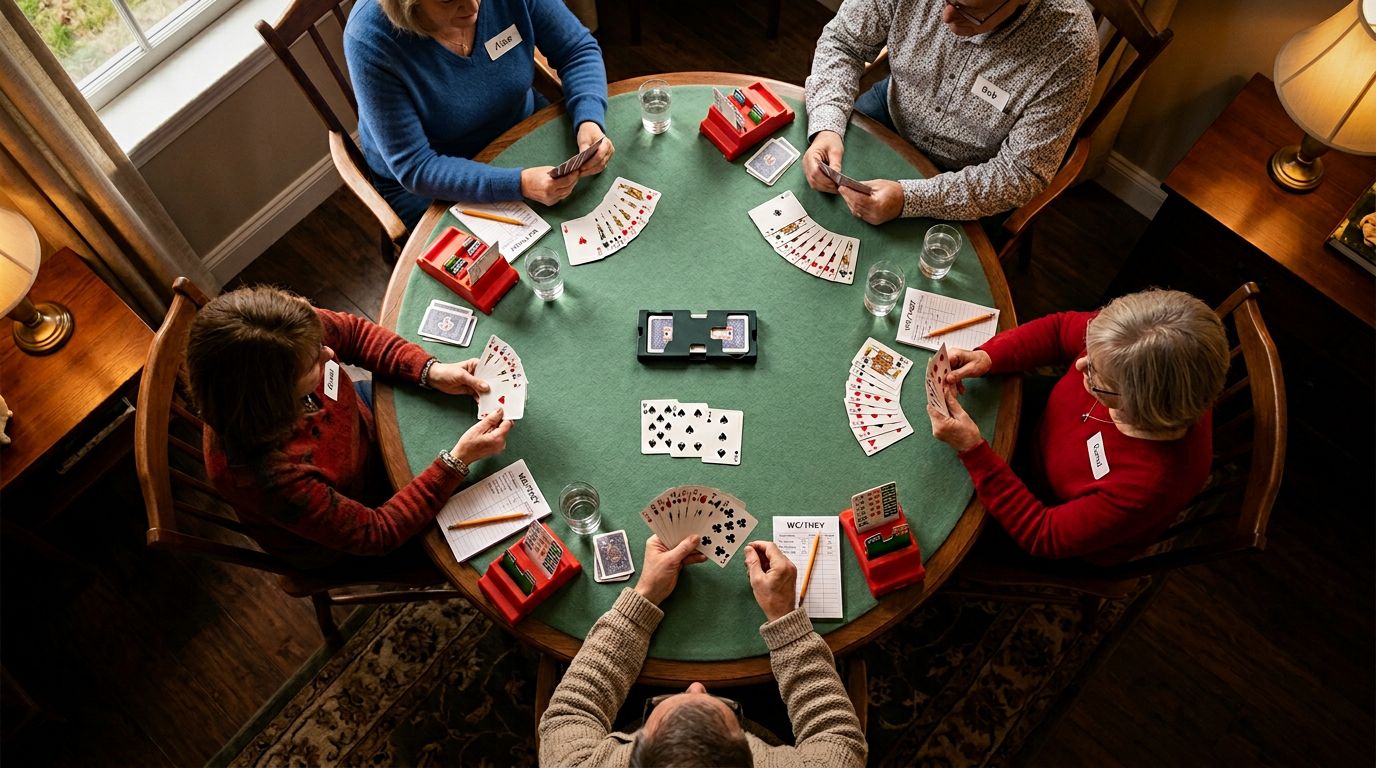
Your First Tournament: What to Expect at a Duplicate Game
You’ve played some club games, you know the basics, and now someone’s suggesting you try a tournament. Or maybe you’re thinking about entering a club championship game.
You’re nervous. That’s normal. Everyone’s nervous their first time.
Here’s exactly what happens, what’s expected of you, and why it’s less scary than you think.
What “Tournament” Means
First, some definitions. Bridge people use “tournament” loosely.
Club championship games Still at your local club, same people, but this one awards extra masterpoints and feels slightly more serious. This is the perfect first “tournament.”
Sectional tournaments Regional ACBL events, usually Friday-Sunday at a hotel or community center. Multiple sessions per day, different events, actual trophies. This is what most people mean by “tournament.”
Regional tournaments Bigger sectionals. More events, more masterpoints, better players. Still accessible to newer players.
National tournaments (NABCs) The big three annual championships. Thousands of players, week-long events, serious competition. Don’t start here.
For your first tournament, you want a club championship or a sectional 99er/299er event. Somewhere you’re grouped with people near your skill level.
Before the Game: Entry and Setup
You arrive 20-30 minutes before game time. There’s a table near the entrance where the director sits with a laptop.
What happens:
“Hi, we’d like to play in the 299er pairs game.”
“Names?”
You tell them. They find you in the system or add you. They’ll ask for your ACBL number (get this ahead of time by joining the ACBL or tell them you’re a guest). They assign you a table number and direction (North, South, East, or West).
You pay. Club games are $8-10. Tournaments are $10-15. They’ll take cash or card.
You get a convention card. More on this later.
Finding your table:
Tables are numbered. You’re table 7, North-South. Find table 7. Sit in either the North or South seat (they face each other). Your partner sits across from you.
Put your stuff (jacket, water bottle) somewhere out of the way. Cards come out of your pocket. Phone goes on silent and stays in your pocket.
The Convention Card
This is a pre-printed form where you mark which conventions you play. It’s intimidating the first time you see it because there are 60+ checkboxes for conventions you’ve never heard of.
What to actually fill out:
- Your names
- Your system (probably “Standard American” or “2/1”)
- Opening 1NT range (probably 15-17)
- Check “Stayman” if you play it
- Check “Jacoby Transfers” if you play it
- Check “Blackwood” (everyone plays this)
- Maybe “Weak Two Bids” if you do
Leave the rest blank. Seriously. You don’t need to fill out every box.
When opponents ask about your methods, this card is your reference. They can look at it anytime during the auction.
The partnership discussion:
Before the game starts, quickly confirm with your partner:
- “We’re playing 15-17 notrump, right?”
- “Stayman and Jacoby transfers?”
- “Weak twos?”
- “Anything else I should know?”
This 60-second conversation prevents most disasters.
How Duplicate Scoring Works (Simplified)
In rubber bridge or Chicago, you’re trying to make your contract for points. In duplicate, everyone plays the same hands, and you’re scored against how others played those same hands.
Example:
You’re North-South at table 7. You play board 12, make 3NT for 600 points.
Later, another North-South pair plays board 12 at table 3. They also make 3NT, also 600 points. You tie.
Another pair at table 5 only makes 2NT for 150 points. You beat them.
A pair at table 1 makes 4♥ for 620 points. They beat you.
Your score on board 12 is somewhere in the middle. Maybe 6 out of 12 matchpoints (if there are 13 tables total).
Why this matters:
Every hand is equally important. Making an overtrick can be the difference between top board and average. Going down one when everyone else goes down two is a good result.
This takes time to internalize. Just know that your result on each board is relative to what others did with the same cards.
The Physical Mechanics
Boards and Hands
Cards come in plastic or metal boards. Each board holds four hands (North, South, East, West) in separate pockets.
You pull out your hand (let’s say you’re North). Don’t touch the other three.
Count your cards. Should be 13. If not, tell the director immediately.
Look at your hand, sort it (spades, hearts, diamonds, clubs is standard).
Important: Don’t mix hands between boards. Board 5 cards stay in board 5. Dropping a card and putting it back in the wrong board causes chaos.
The Bidding
Most tournaments use bidding boxes. These are boxes full of cards showing every possible bid (1♣, 1♦, 1♥… Pass, Double, Redouble, Alert).
Pull the card for your bid, place it clearly on the table in front of you. Leave it there. The whole auction stays visible until the first lead.
If you need to alert: Pull the Alert card when you make the bid, or tap the table.
If you make a wrong bid: You can correct an inadvertent call if you do it immediately (“Sorry, I meant 2♠ not 3♠”). If the auction continues, it’s too late. Call the director.
The Play
Dummy goes down after the opening lead, just like in practice games.
Trick discipline: When you play a card, place it face-up in front of you. After all four players have played, agree on who won the trick.
Winner of the trick puts their card vertical (pointing toward them). Losers put their cards horizontal.
Stack your played cards neatly. You should have 13 cards in front of you at the end, some vertical (tricks you won), some horizontal (tricks you lost).
This system lets you reconstruct the hand if there’s a question later.
Claiming:
If it’s obvious you’re making the rest of the tricks, you can claim. “I have the rest” or “We’re taking six more.”
Show your hand, explain if necessary. Opponents can accept or contest the claim. If contested, call the director.
Don’t claim unless it’s truly obvious. “I think I have the rest” is not a claim. Show your cards and prove it.
End of the Hand
Director calls time (or you finish naturally). Quickly count tricks, agree on the result.
One player (usually North) fills out the traveling score slip. This slip travels with the board and shows what happened at every table.
What goes on the slip:
- Your table number
- Your pair numbers (printed on a card at your table)
- The contract (3NT, 4♠, etc.)
- Declarer (N, S, E, or W)
- Result (made, down 1, made with overtricks)
- Score (calculate using the scoring table, or your phone’s bridge app)
Put the slip back in the board. Cards go back in their correct pockets.
Moving:
The director will announce which direction moves and which boards move.
Typical system: East-West pairs move to the next higher table. Boards move to the next lower table. North-South stays put.
Take your convention card, personal belongings, and move. Leave the boards.
Rinse and repeat for 24-28 boards total (usually two rounds of 13-14 boards).
Common First-Timer Mistakes
Forgetting to alert You’ll do this. Everyone does. If you realize mid-auction, tell the director before the opening lead. They’ll inform the opponents.
Pulling cards from the wrong pocket You’re North. You grab South’s cards by accident. Suddenly you have 26 cards. Stop, call the director, sort it out.
Bidding out of turn The person on your right hasn’t bid yet, and you pull your card. Freeze. Call the director. They’ll fix it.
Leading out of turn Dummy starts to lead instead of declarer. Stop. Call the director. This is fixable but has rules.
Math errors on the scorecard You write 420 instead of 450. Someone will catch it. They’ll call the director. Director checks the facts, corrects the slip. No big deal.
Playing too slowly You’re taking five minutes per hand. The round won’t finish. The director will hurry you along. Speed up on the easy boards so you have time for the hard ones.
When to Call the Director
Always call the director if:
- Irregularity in the auction (wrong bid, bid out of turn)
- Irregularity in the play (lead out of turn, revoke)
- Board is mis-boarded (wrong number of cards)
- Dispute about the score
- You’re unsure about a ruling
- Opponents’ explanation doesn’t match their bid
Never hesitate to call the director. That’s their job. They won’t be annoyed.
The phrase is “Director, please” or just “Director.” They come over, you explain, they rule. Done.
What directors don’t do:
- Lecture you about mistakes
- Take sides
- Give bridge lessons mid-game
They’re referees. They apply the rules fairly and move on.
Handling Mistakes
You will make mistakes. You’ll revoke (fail to follow suit when you could have). You’ll pull the wrong card. You’ll mis-sort your hand and think you have four spades when you have three.
When you realize mid-hand: “Director, I think I revoked.” They come over, check the facts, assess a penalty if needed. Usually it’s one or two tricks.
When you realize after the hand: Too late. The result stands. Learn from it.
When your partner makes a mistake: Say nothing at the table. Zero. Zip. Not “Oh no,” not “Really?”, not a sigh. Poker face, finish the hand, move to the next table.
Between rounds, if you must discuss it, do so quietly and constructively. “I think you might have been out of hearts on that hand?” Not “Why did you trump my ace?!”
The Emotional Rollercoaster
Here’s what happens emotionally on your first tournament day:
Round 1: Nervous, slow, making mechanical errors. Opponents are patient (usually). You feel like you’re holding everyone up.
Round 2: Settling in. You remember to alert, you fill out the scorecard without help. One or two hands go well. You think, “Maybe I can do this.”
Midpoint: You have a disaster board. You go down in a cold contract, or opponents make a game you could have beaten. You feel terrible.
Late rounds: Fatigue sets in. The last few boards are a blur. You just want to finish.
After scoring: Results are posted. You finished somewhere in the middle (probably). Not great, not terrible. You earned 0.8 masterpoints. You survived.
Next day: You want to play again.
That’s the pattern for almost everyone.
Common Fears and Reality Checks
“Everyone will be better than me” At a 299er game, half the field is equally nervous. At a club championship, there’s a wide skill range. You won’t be the worst player in the room.
“I’ll slow everyone down” The first round, maybe. By round two you’ve got the rhythm. And honestly, there’s always someone slower than you.
“My partner will be mad at my mistakes” Possible, if you drew a jerk as a partner. More likely they’ll be kind because they remember being new. And if they are a jerk, you never have to play with them again.
“I’ll embarrass myself” Define embarrass. Will you make mistakes? Yes. Will anyone care tomorrow? No. Bridge players see mistakes constantly. Yours aren’t special.
“I don’t know enough conventions” You know Stayman and transfers? That’s enough. Advanced conventions are helpful but not required.
“The scoring is too complicated” You don’t need to understand matchpoints vs IMPs or Butler scoring on day one. Fill out the traveling scorecard, let the computer handle the rest.
What Success Looks Like
Success at your first tournament is not winning. Success is:
- Finishing all the rounds
- Understanding what happened most of the time
- Not needing the director every other hand
- Having at least two or three boards where you felt competent
- Being willing to play again
If you check those boxes, you succeeded.
After the Game
Results get posted. You can see your percentage (45%, 52%, 38%, whatever) and how you did on each board.
Looking at results is educational:
- Board 7, you bid 3NT and made 4. Most pairs made 4, so you got a bad score. Maybe 3NT was the wrong contract.
- Board 14, you went down one in 4♠. So did six other pairs. Average result. The hand was just hard.
- Board 22, you made 3NT when most pairs stopped in 2NT. Top board. You’ll remember this one.
Don’t obsess over results, but looking at the comparison helps you learn what normal bridge looks like.
Masterpoints:
You earned some fractional masterpoints (0.5, 1.2, whatever). These go on your ACBL record. Nobody cares about your masterpoint total except you. But watching it grow is satisfying.
Preparing for Your Second Tournament
What to fix:
- One specific thing. Maybe it’s remembering to alert. Maybe it’s bidding more carefully. Pick one area.
What to keep:
- The conventions you know. Don’t add five new conventions before the next game. Master what you have.
What to change:
- If your partner was a bad fit, find a different one. If the game time didn’t work, try a different session. If you hated matchpoint scoring, try a Swiss or IMP event.
What to repeat:
- Show up. Play. Learn. The only way to get comfortable in tournaments is to play tournaments.
Learn Bridge with Brian
New to bridge? Brian is an AI bridge coach that explains concepts in plain language and helps you practice with real hands. No judgment, infinite patience. Try Brian free →
The Real Secret
Tournaments feel intimidating because they’re new. The procedures, the boards, the scoring, the pace.
By your fifth tournament, it’s routine. By your tenth, you’ll be the one helping the new person at your table.
Everyone at that tournament, even the Life Masters, played their first tournament once. They were nervous too. They made mistakes too. They survived.
So will you.
Show up. Play bridge. Everything else is just logistics.