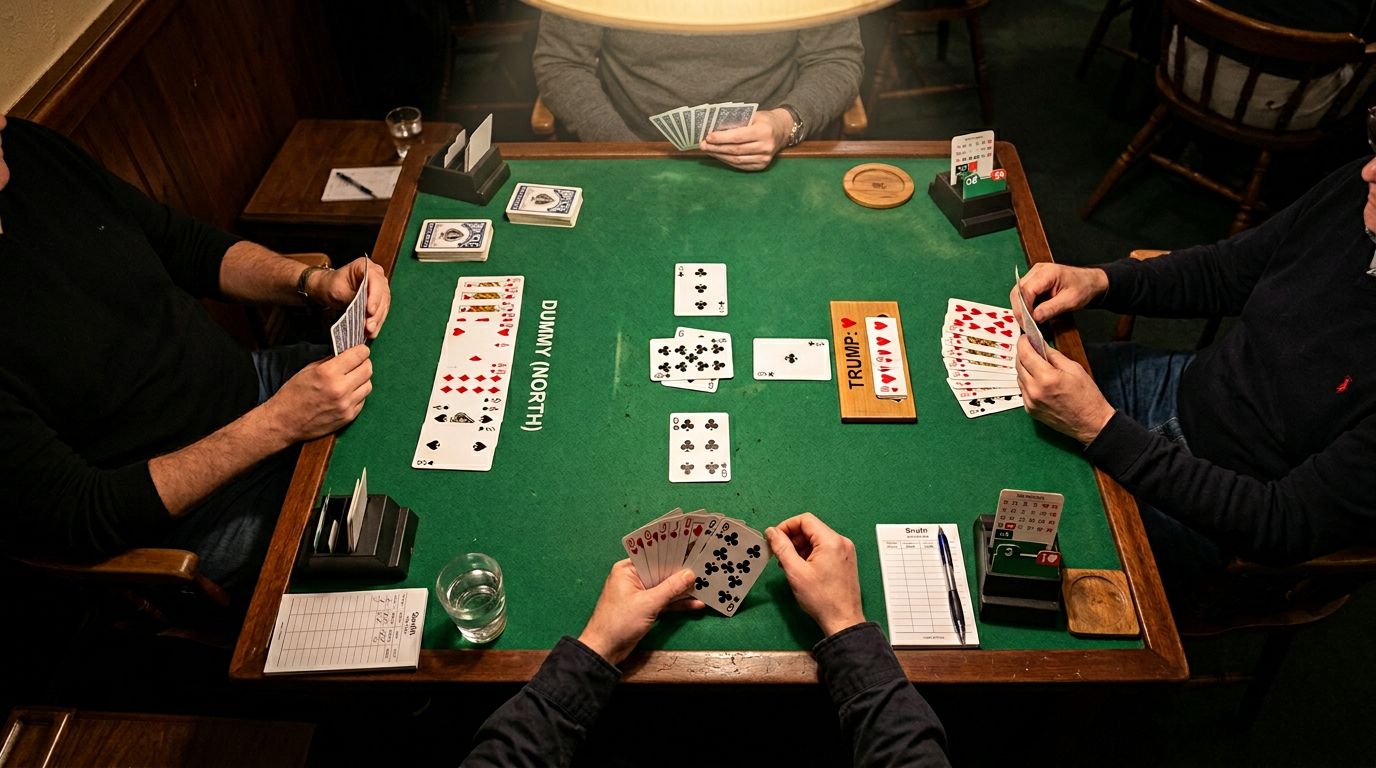
Trump Promotion in Bridge: Creating Tricks from Thin Air
Trump promotion is one of the most satisfying defensive techniques in bridge. You’re creating trump tricks that didn’t exist at the start of the hand. Declarer counts their trump holding and thinks they’re solid. Then you force them to ruff, or you ruff high yourself, and suddenly partner’s queen-third becomes worth a trick.
The basic idea is simple: make declarer (or dummy) ruff with a high trump, and your side’s intermediate trumps get promoted. If declarer has ♠AKJ and you can force them to use the ace or king to ruff, partner’s ♠Q suddenly becomes a winner.
What Is Trump Promotion?
Trump promotion happens when you force the declaring side to use high trumps on cards that aren’t winners, which promotes your side’s lower trumps into tricks.
Think about it this way. You hold ♠Q73 in the trump suit. Declarer has ♠AKJ106. Under normal circumstances, your queen is worthless. Declarer will just pull trumps and your queen falls under the king or ace.
But what if partner leads a side suit and declarer has to ruff? And what if you overruff with the queen, forcing declarer to use a higher honor later? Or what if you can keep leading that side suit, forcing declarer to use the ace, then the king, and suddenly your seven becomes the boss trump?
That’s trump promotion. You’re not creating tricks out of nothing, you’re creating them through forcing plays.
The Uppercut: Ruffing High to Help Partner
The uppercut is the most dramatic form of trump promotion. You ruff with a high trump (even though you know you’ll be overruffed) specifically to force declarer to use an honor, which promotes partner’s holding.
Here’s the classic setup:
Your Hand:
♠ 3
♥ 9752
♦ KQJ1098
♣ 64
Partner’s Hand (unknown to you):
♠ Q73
♥ 63
♦ 7543
♣ 9852
Declarer:
♠ AKJ106
♥ AK4
♦ A2
♣ AKQ7
Contract: 6♠
You lead the ♦K (top of sequence). Declarer wins the ace and starts pulling trumps. You’re out of spades immediately. Declarer continues with the ♠A (partner plays the three), then leads a heart to dummy to take another spade finesse.
But wait. Instead of pulling the last trump, declarer tries to cash some winners first. They lead a diamond from dummy. Here’s your chance.
Ruff with the ♥9! Yes, declarer will overruff with the ♥K or ♥A, but now partner’s ♠Q is promoted. Declarer can’t pull it without giving partner a trick.
If you ruff with a low heart instead, declarer overruffs cheaply with the ♥4, and nothing is promoted. The nine might seem worthless, but it’s the perfect uppercut card.
The key is recognizing when your seemingly useless trump can force declarer to use a high one, promoting partner’s holding. You need to visualize that partner might have something like the queen or jack behind declarer’s honors.
Trump Promotion Through Length
Sometimes you don’t need to ruff high yourself. You just keep leading a suit declarer is out of, forcing them to ruff over and over until your side’s trump length creates a trick.
This is called a forcing defense. You make declarer ruff so many times that they run out of trumps, and your side still has trump control.
Example Hand 2:
You hold:
♠ 84
♥ 75
♦ J3
♣ AKQ10976
Partner holds:
♠ QJ3
♥ 843
♦ 108762
♣ 54
Declarer opens 1♠, ends up in 4♠.
You lead the ♣A (partner plays the four), then the ♣K (partner plays the five). Declarer ruffs the second club. Good. Now declarer leads a spade to dummy’s ace, and another spade. Partner wins the ♠Q and should lead… a club!
This forces declarer to ruff again. Now declarer is down to the same number of trumps as partner. If declarer tries to pull the last trump, partner wins and cashes clubs. If declarer doesn’t pull trumps, they lose control of the hand.
The defense promoted partner’s ♠J into the setting trick, not through any single dramatic moment, but through relentless pressure. You made declarer use their trumps for ruffing instead of for drawing yours.
Defensive Trump Promotion Setups
The best trump promotions don’t happen by accident. You need to recognize the opportunity early and coordinate with partner.
Here are the situations to watch for:
1. You have trump spots but partner might have an honor. If you hold 10-9-8 of trumps and partner opened the bidding, they might have Q-x or J-x-x. An uppercut could be gold.
2. Declarer is ruffing in the short hand. When declarer is taking ruffs in dummy (or their hand if that’s shorter), each ruff potentially wastes a high trump. If you can overruff or force an overruff, you might promote partner’s holding.
3. You have a long, solid side suit. Perfect for forcing defense. If you can keep making declarer ruff, their trump holding gets shorter and shorter.
4. Partner led a suit you’re now void in. If partner leads a suit and you’re out after one round, consider whether partner might be trying to set up trump promotion. Give them a ruff if possible, and watch whether they ruff high.
Recognizing Promotion Opportunities During Play
You can’t always see the full hand, so you need to look for clues:
Count declarer’s trumps. If they opened 1♥ and rebid hearts, they probably have five or six. If you can make them ruff twice in hand, they’re getting short.
Watch dummy’s trumps. If dummy has three trumps and declarer is ruffing there, dummy might run out. Then your side controls trumps.
Listen to the bidding. If declarer stretched to bid game, they might have minimal trumps. A forcing defense could wreck them.
Notice declarer’s pitch. If declarer discards from a suit instead of ruffing, they’re protecting their trump length. That tells you a forcing defense might work.
Partner’s signals matter. If partner plays high-low in a suit (showing a doubleton), they might be setting up a position where they can ruff and you can overruff dummy, or vice versa.
Example Hand 3: The Classic Uppercut
North (Dummy):
♠ A64
♥ KQ5
♦ 876
♣ A1032
East (You):
♠ 83
♥ J109
♦ J10942
♣ 875
South (Declarer):
♠ KQJ1092
♥ A8
♦ AK
♣ KQ6
West (Partner):
♠ 75
♥ 76432
♦ Q53
♣ J94
Contract: 4♠ by South
Partner leads the ♥4 (fourth best). Dummy plays the queen, you play the jack, and declarer wins the ace. Declarer cashes the ♠K and ♠Q (partner follows both times), then leads the ♦A and ♦K.
Now declarer leads a third diamond from hand. Dummy is void, partner follows. This is your moment.
Ruff with the ♥10! Declarer can overruff with dummy’s king, but now partner’s ♥7 is promoted. When declarer tries to pull the last trump with the ♠A, partner’s ♠7 becomes high. Down one.
If you ruff with a small heart, declarer overruffs with the ♥5, and makes the contract easily. The uppercut with the ten is the only defense that works.
Example Hand 4: Forcing Declarer to Ruff
North (Dummy):
♠ K64
♥ 1032
♦ AQ5
♣ 9762
West (You):
♠ 72
♥ 98
♦ 973
♣ AKQ1085
South (Declarer):
♠ AQJ1093
♥ AKQ
♦ K2
♣ J3
East (Partner):
♠ 85
♥ J7654
♦ J10864
♣ 4
Contract: 4♠ by South
You lead the ♣A. Partner plays the four (encouraging, but you know it’s probably a singleton). You continue with the ♣K, and declarer ruffs.
Declarer cashes the ♠A, then leads the ♠Q to dummy’s king. Partner shows out! You started with two spades, partner started with two spades. Declarer has six.
When declarer leads a heart to hand, partner should duck. When declarer leads another club, partner ruffs with the ♠8! This forces declarer to overruff with the jack (or lose immediately).
Now you have ♠7 and declarer has ♠109. If declarer pulls your trump, you’re good. But declarer still has a trump in hand and one in dummy. The contract makes anyway in this layout, but if partner had started with ♠85, the forcing defense and partner’s uppercut would promote your ♠7 into the setting trick.
The point is you tried. You recognized that making declarer ruff, then having partner ruff high, gave you the best chance.
Common Mistakes
Missing the opportunity entirely. This is the biggest one. You have ♠J92 of trumps, and you ruff with the two when the nine would have promoted partner’s queen. Always think about whether a higher ruff might help.
Ruffing too high too early. If you ruff with your jack on the first round, and partner had the queen-ten, you just helped declarer. You need to count tricks and think about what partner might hold.
Wrong timing on forcing defense. You can’t force declarer to ruff if they have plenty of trumps and dummy has entries. You need to time it right, usually before declarer has drawn all your trumps.
Not giving partner count. If you’re planning a forcing defense, partner needs to know to continue the suit. Give standard count signals so partner knows you want them to keep going.
Forgetting about dummy’s trumps. Sometimes you’re promoting a trick, but declarer can just use dummy’s trumps to handle your promoted cards. You need to visualize the whole trump position.
Being too passive. Trump promotion requires aggression. You can’t sit back and hope. You need to attack with your long suit or set up the ruffing position.
Practice Your Card Play with Brian
Ready to apply these techniques at the table? Brian can walk you through hands that test your card play skills. Try Brian free →
When Trump Promotion Fails
Not every trump promotion works. Sometimes the layout just doesn’t cooperate.
Declarer has too many trumps. If declarer has eight trumps between the two hands and you force them to ruff once, they still have seven. They can draw yours and have trumps left over. You needed a miracle, not a forcing defense.
Wrong honors in the wrong places. You uppercut with the ten, but partner has the nine and declarer has the queen-jack. Nothing gets promoted because the honors aren’t positioned right.
Dummy has too many trumps. You’re forcing declarer to ruff in hand, but dummy has five trumps. Declarer just pulls trumps from dummy and your forcing defense goes nowhere.
No entry to the forcing suit. You have ♣AKQ10987, perfect for forcing. But after you cash two clubs and declarer ruffs, you never get in again. Partner can’t continue clubs because they don’t have one. The forcing defense dies.
Declarer avoids ruffing. Sometimes declarer sees the danger and pitches losers instead of ruffing. If they can afford to lose that trick, your promotion evaporates.
The truth is, trump promotion is an advanced technique that requires reading the position. You won’t always get it right. But when it works, when you see partner’s formerly worthless trump become the setting trick because you ruffed with the nine, it’s one of the best feelings in bridge.
Start looking for these positions. Count trumps. Think about forcing plays. And don’t be afraid to ruff high when it might help partner. That’s how you turn theory into tricks at the table.