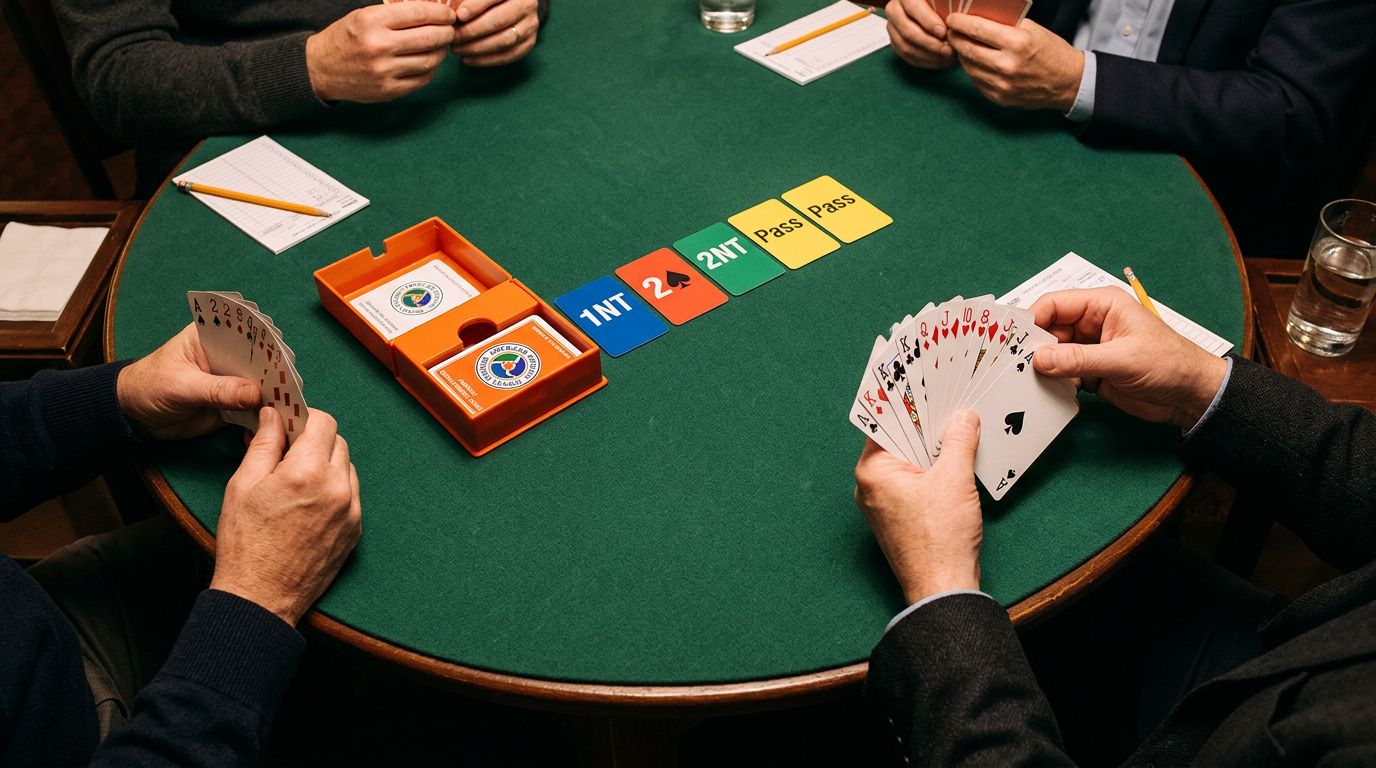
Weak Two Bids — Preemptive Opening at 2-Level (2♦ 2♥ 2♠)
If you’ve ever sat across from opponents who opened 2♥️ and watched your carefully planned auction fall apart, you’ve experienced the power of the weak two bid. It’s one of bridge’s most effective preemptive weapons, and once you understand how to wield it, you’ll be the one causing headaches at the table.
What Is a Weak Two Bid?
A weak two bid is a preemptive opening at the two-level in diamonds, hearts, or spades (2♦️, 2♥️, or 2♠️). The goal? Steal bidding space from your opponents and make their life difficult. When you open with a weak two, you’re telling partner: “I’ve got a decent six-card suit, but not much else. Let’s make it hard for them to find their fit.”
Think of it as strategic mischief. You’re not strong enough to push for game on your own, but you’re strong enough to crowd the auction and force the opponents to guess at a higher level.
Important note: 2♣️ is NOT a weak two bid. In standard bidding, 2♣️ is reserved for strong hands (22+ HCP or game-forcing hands). The weak two family only includes 2♦️, 2♥️, and 2♠️.
Requirements for Opening a Weak Two
The classic weak two bid has three main requirements:
1. A Six-Card Suit
You need exactly six cards in your suit. Not five (that’s too weak for preemption), and typically not seven (that’s usually a three-level preempt). The six-card length gives you enough playing strength to be annoying but not so much that you’ve misdescribed your hand.
2. 5-10 High Card Points
This is the sweet spot. You’re too weak to open at the one-level (which promises 12+ HCP), but you have enough high cards that your suit has some teeth. Most weak twos fall in the 6-9 HCP range.
If you have 11+ HCP with a six-card suit, open at the one-level instead. You’re too strong for a weak two.
3. Suit Quality
Here’s where judgment comes in. Your six-card suit should have some substance - ideally at least two of the top three honors (A, K, Q) or three of the top five honors. You don’t want to preempt with ♠️J-8-6-5-4-2 and find partner raising you to game based on wasted values.
The “two of the top three” guideline:
- ♥️A-Q-10-8-6-3 ✅ (has A and Q)
- ♠️K-Q-J-9-4-2 ✅ (has K and Q)
- ♦️J-9-7-6-5-3 ❌ (weak suit, risky)
Outside your long suit, you want scattered values - not a strong four-card side suit that suggests you should open at the one-level for more bidding flexibility.
Which Suits Can You Open?
As mentioned, weak two bids are available in three suits:
- 2♦️ = Weak two in diamonds
- 2♥️ = Weak two in hearts
- 2♠️ = Weak two in spades
The 2♣️ opening is off-limits because it’s conventionally used for strong hands (the “strong two clubs” opening that shows 22+ HCP or a game-forcing hand).
In practice, 2♥️ and 2♠️ are the most common and effective weak twos because the major suits are where opponents most want to compete. A 2♥️ opening can completely derail their search for a spade fit. The 2♦️ weak two exists but is slightly less obstructive since it leaves more room for the opponents to find majors.
Responding to Partner’s Weak Two
When partner opens with a weak two, you’re the captain of the ship. Partner has narrowly defined their hand (6-card suit, 5-10 HCP), so you make the decisions.
Pass
This is your most common action. If you don’t have a fit and don’t have a strong hand, just pass and hope the preempt worked. Partner already described their hand completely.
Raise the Suit
Raising partner’s suit is about competing and preempting further, not inviting game. With three-card support and minimal values, you can raise to the three-level to make things even harder for the opponents.
With four-card support and some points, you might even jump to game. Remember the Law of Total Tricks: with a nine-card fit, you can often afford to bid to the nine-trick level (3-level), and with ten trumps, the ten-trick level (4-level) is often safe.
Example responses to partner’s 2♠️:
- With ♠️K-8-3 and 8 HCP → Bid 3♠️ (competitive raise)
- With ♠️K-8-4-2 and 11 HCP → Bid 4♠️ (game based on fit)
2NT Feature Ask
The 2NT bid is artificial and asks partner: “Do you have a maximum weak two (8-10 HCP) and do you have a feature (an ace or king in a side suit)?” This is useful when you’re considering game but need more information.
Partner responds:
- 3♣️/3♦️/3♥️ = Maximum with a feature (ace or king) in that suit
- Rebid the suit at 3-level = Minimum weak two (5-7 HCP)
New Suit
Bidding a new suit is natural and forcing. This shows a strong hand (usually 16+ HCP) where you want to explore game or slam. Partner should support your suit with 3+ cards or rebid their suit.
The Ogust Convention
The Ogust Convention is an alternative to the feature-asking 2NT. It’s more focused on hand quality rather than specific features. After partner’s weak two, 2NT asks about both point count AND suit quality.
Partner responds:
- 3♣️ = Minimum points (5-7 HCP), poor suit
- 3♦️ = Minimum points (5-7 HCP), good suit
- 3♥️ = Maximum points (8-10 HCP), poor suit
- 3♠️ = Maximum points (8-10 HCP), good suit
A “good suit” typically means two of the top three honors (A-K, A-Q, or K-Q).
Example:
You open 2♥️ with ♥️K-Q-J-8-6-3, ♠️7-4, ♦️8-2, ♣️Q-9 (8 HCP). Partner bids 2NT (Ogust). You respond 3♠️ showing maximum points and a good suit.
Many partnerships prefer Ogust because it gives more precise information about hand quality than the feature ask. Discuss with your partner which method you’ll use.
Vulnerability Considerations
Vulnerability dramatically affects your weak two strategy. The stakes are different when you’re vulnerable versus not vulnerable.
Not Vulnerable vs Vulnerable Opponents
This is party time. You can be aggressive with marginal weak twos because:
- If you’re doubled and go down 2-3 tricks, it’s only -300 or -500
- If they can make a vulnerable game (600-620), you still win the trade
- You have maximum preemptive effect
You can shade your requirements: maybe 5 HCP instead of 6, or a slightly weaker suit.
Vulnerable vs Not Vulnerable Opponents
This is danger zone. Be conservative because:
- Going down doubled can cost -500 or -800 (larger penalties when vulnerable)
- Their non-vulnerable game is only worth 400-420
- You can easily turn a profit for them
Stick to sound weak twos: 6-9 HCP, good suits, real values.
Both Vulnerable or Both Not Vulnerable
These are neutral situations. Use standard requirements and judgment. The math works out fairly even, so preempt when you have a decent hand but be aware of downside risk.
Quick guide:
- Favorable vulnerability (you not vul): Be aggressive
- Unfavorable vulnerability (you vul): Be conservative
- Equal vulnerability: Use normal standards
Example Hands
Let’s look at four hands and decide whether to open with a weak two:
Example 1: Clear Weak 2♠️
Hand: ♠️A-Q-J-9-6-3 ♥️8-2 ♦️7-4 ♣️J-10-3
HCP: 8
Decision: Open 2♠️
This is textbook. Six spades with A-Q-J (excellent suit quality), 8 HCP in the sweet spot, and scattered jacks outside. Perfect weak two.
Example 2: Open 1♥️ Instead
Hand: ♥️K-Q-10-8-6-3 ♠️A-4 ♦️K-9-3 ♣️7-2
HCP: 11
Decision: Open 1♥️
You have a great six-card heart suit, but 11 HCP is too much for a weak two. You’re strong enough to open at the one-level, which gives you and partner more room to explore. Don’t preempt yourself.
Example 3: Pass (Suit Too Weak)
Hand: ♦️J-9-7-6-5-3 ♠️K-8 ♥️A-3 ♣️10-6-2
HCP: 8
Decision: Pass
Even though you have 8 HCP and six diamonds, your suit is trash. You have zero of the top three honors. If partner raises based on fitting honors or you get doubled, this could be a disaster. Weak twos should have suit quality.
Example 4: Vulnerable, Be Conservative
Hand: ♠️K-J-10-8-6-3 ♥️7-2 ♦️Q-4 ♣️9-8-3
HCP: 6
Decision: Depends on vulnerability
- Not vulnerable: Open 2♠️ (acceptable at favorable colors)
- Vulnerable: Pass (only 6 HCP, suit has no ace or queen, too risky vulnerable)
This is a borderline hand where vulnerability matters. The suit is decent but not great (K-J-10), and 6 HCP is minimum. At favorable vulnerability, take a shot. At unfavorable vulnerability, pass.
Common Mistakes and When NOT to Open a Weak Two
Even experienced players sometimes abuse the weak two bid. Here are the most common mistakes:
Mistake 1: Weak Two with a Strong Four-Card Side Suit
Hand: ♠️A-Q-J-9-6-3 ♥️K-Q-10-8 ♦️7-2 ♣️4
Problem: You have a strong four-card heart suit alongside your spades.
Open 1♠️ instead. With a good second suit, you want flexibility to show both suits. A weak two shuts down the auction before you can show the hearts, and you might miss a heart fit or have bidding options in a competitive auction.
Mistake 2: Weak Two with Seven Cards
Hand: ♥️K-Q-J-9-8-6-3 ♠️7-2 ♦️8-4 ♣️10-3
Problem: You have seven hearts, not six.
With a seven-card suit at 6-9 HCP, open 3♥️ (three-level preempt), not 2♥️. The seven-card holding is worth the extra level of preemption, and you’ll misdescribe your hand if you open 2♥️.
Mistake 3: Weak Two in First or Second Seat with Defensive Values
Hand: ♦️A-Q-J-9-6-3 ♠️K-8 ♥️A-4 ♣️10-6-2
Problem: You have three defensive tricks (two aces and likely a diamond trick).
In first or second seat, be cautious with defensive-heavy hands. You might preempt partner out of making a bid when you can actually defeat their contract. This hand is borderline - some would open 2♦️, but with three defensive tricks, many experts would pass.
In third seat (after two passes), this consideration matters less because partner is likely weak.
Mistake 4: Psychic Weak Twos
Hand: ♠️K-10-9-6-3 ♥️A-8-2 ♦️J-4 ♣️9-6-3
Problem: Only five spades.
Don’t open 2♠️ with a five-card suit hoping to get away with it. When partner has three-card support and raises, or asks about your hand quality with 2NT, your five-card “suit” will collapse. Partnerships are built on trust, and weak twos should be reliable.
Mistake 5: Weak Two with Void or Second Suit
Hand: ♥️A-K-J-9-6-3 ♠️— ♦️Q-J-10-8 ♣️8-4-2
Problem: You have a void in spades and a four-card diamond suit.
This hand has too much shape for a weak two. The void and second suit mean you have playing tricks beyond just your hearts. Open 1♥️ to preserve flexibility. You might want to show diamonds later or compete effectively with distribution.
Related Articles
Practice This Convention with Brian
Want to test your understanding of this convention in realistic hands? Brian, the Bridgetastic AI, can deal you practice hands, walk you through the bidding, and explain when this convention applies, and when it doesn’t. Try Brian free →
Making the Weak Two Work for You
The weak two bid is a powerful tool, but like any weapon, it works best when used with discipline and judgment. Stick to the requirements - six-card suit, 5-10 HCP, good suit quality - and adjust for vulnerability. When you open a weak two, you’re making a tactical strike, not a strategic retreat.
Your opponents will hate it, your partner will know what you have, and you’ll win boards you had no business winning. That’s the beauty of the weak two bid.
Now get out there and start preempting. Just remember: with great power comes great responsibility. Use your weak twos wisely, and they’ll serve you well for years to come.