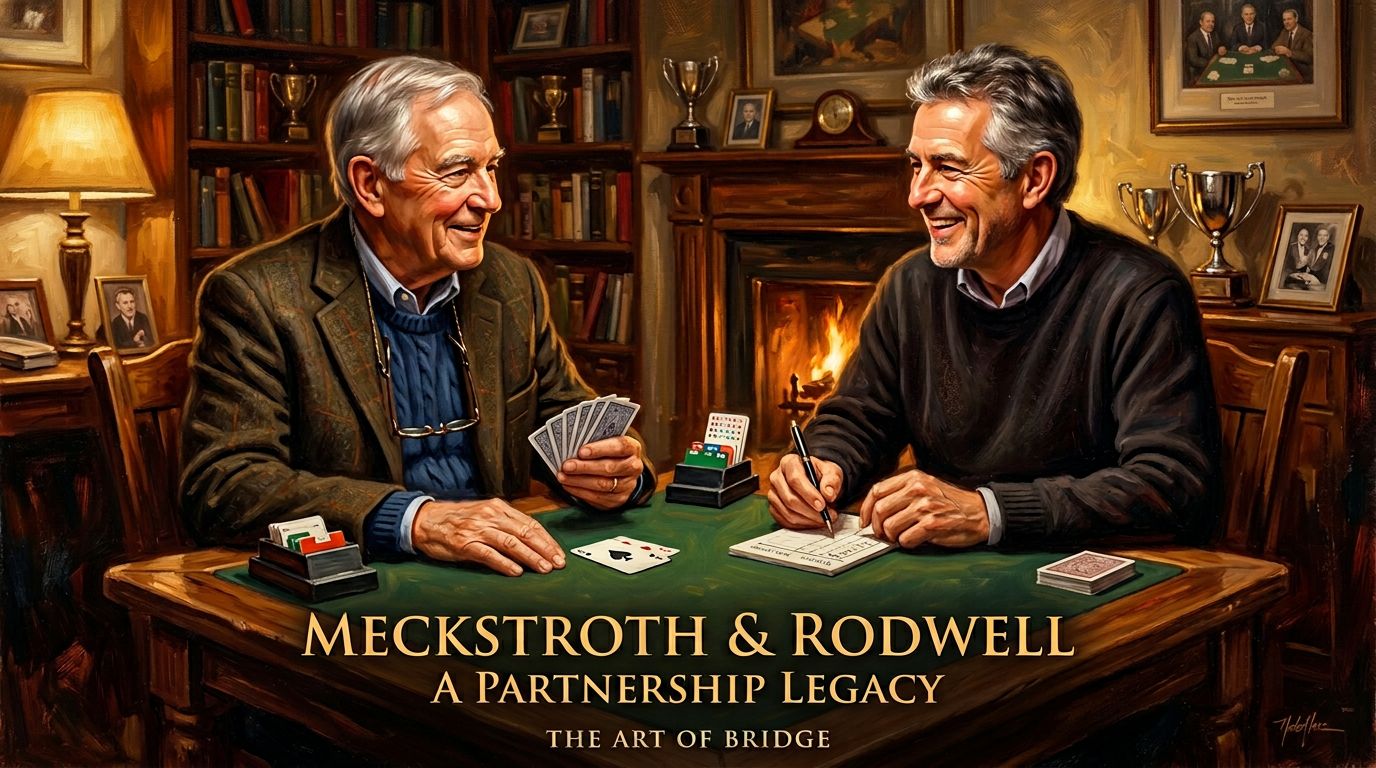
Meckstroth Rodwell
If you’re looking for the most successful bridge partnership in American history, you don’t need a long search. Jeff Meckstroth and Eric Rodwell have been playing together since 1978. They’ve won more than 15 world championships together. They’ve dominated American bridge for four and a half decades. And they’re still doing it.
What makes this partnership remarkable isn’t just the trophy count. It’s the longevity combined with sustained excellence. Plenty of pairs win a world championship or two, then break up or decline. Meckstroth and Rodwell have stayed together through changing eras of bridge, evolving their methods, maintaining their edge. That doesn’t happen by accident.
How It Started
They met in Louisville in 1974. Rodwell was already an established player, a mathematician with a systematic approach to the game. Meckstroth was younger, a natural card player with aggressive instincts and lightning-fast table presence. They played casually for a few years, testing compatibility.
The serious partnership started in 1978. From the beginning, the dynamic was clear: Rodwell would handle system development and theoretical analysis. Meckstroth would execute at the table with aggressive judgment and superior card reading. Theory meets practice. Precision meets instinct.
That combination has worked for 45 years.
The System
You can’t talk about Meckstroth-Rodwell without talking about their bidding system. They’ve spent decades developing, refining, and pushing the boundaries of what’s possible with a bidding structure.
They started with Precision (1♣ strong, 1♦ artificial), then evolved it into what’s now known as RM Precision. The system includes forcing club openings, complex relay structures, and ultra-precise hand definition. When they bid a slam, they often know each other’s exact distribution and nearly all the key cards. That’s not luck. That’s system.
Some critics call it overengineered. Too many conventions, too many memorized sequences, too dependent on flawless partnership coordination. They’re not wrong about the demands. Playing RM Precision at their level requires thousands of hours of study and practice. Miss a relay response, forget a structure, and the whole auction derails.
But here’s what the critics miss: Meckstroth and Rodwell don’t miss. They’ve played together so long and practiced so thoroughly that the complex sequences are automatic. They can focus mental energy on judgment and card reading because the system is already in muscle memory.
Their system innovation hasn’t been just about their own success. They’ve influenced how world-class pairs think about bidding structure. The idea that you can relay to extremely precise hand descriptions, the notion that complicated systems are worthwhile if practiced enough - these are now mainstream at the top levels. Twenty years ago, they weren’t.
The Playing Styles
At the table, they’re almost opposites in style but perfectly complementary in result.
Meckstroth plays fast, relies on instinct, and has phenomenal visualization. Give him three seconds and he can see the whole hand. He’s known for brilliant declarers play under pressure and aggressive competitive decisions. When a hand needs a double-dummy line or a reading of exactly where the missing queen is, Meckstroth finds it.
Rodwell plays more deliberately. He works through logic, considers all the inferences, and makes methodical decisions. His defense is technically perfect - he knows the right card to play in every position. Where Meckstroth flashes, Rodwell grinds. Both get to the same answer, different paths.
This difference could cause friction. Fast players get impatient with slow ones. Methodical players mistrust instinctive ones. But they’ve learned to balance it. Meckstroth accepts that some hands require Rodwell’s deliberate approach. Rodwell trusts Meckstroth’s quick reads. After 45 years, they know what the other is thinking.
The Results
The trophy case tells the story. More than 15 world championships together. Multiple Bermuda Bowls, World Team Olympiads, and Transnational Opens. Domestically, they’ve won essentially every major American championship multiple times: Spingolds, Vanderbilts, Reisingers, Grand Nationals.
In 2009, they were inducted into the ACBL Hall of Fame. In 2018, they won the Bermuda Bowl in Orlando. Meckstroth was 65, Rodwell was 67. Still winning world championships after 40 years together. That’s not sentimentality or past glory. That’s current dominance.
The consistency is almost boring. Expect them to be in the final of every major tournament. Expect them to execute complex sequences flawlessly. Expect them to grind out close matches through superior technique. They’ve been doing it since 1978, and they keep doing it.
Famous Hands
One of their most famous defensive performances came in the 1981 Spingold Finals. Declarer was in 6♠ with what looked like 12 straightforward tricks. But Meckstroth and Rodwell found the only defense: a specific sequence of discards that forced declarer into an impossible position. Down one in a cold slam because they read the position perfectly and coordinated flawlessly.
In the 2017 Bermuda Bowl, they bid a grand slam in notrump on a hand where most pairs stopped in six. The difference? Their relay structure showed Rodwell that Meckstroth had exactly the right cards. No guessing, no hoping - they knew. Made seven. That’s what decades of system development gets you.
But not every hand is a triumph. In the 2003 Bermuda Bowl semifinals against Italy, Meckstroth went down in a cold game through a misread of the position. It happens. Even to the best. They lost that match. Came back the next cycle and won.
The Professional Era
Meckstroth and Rodwell were among the first American players to fully professionalize. They played for sponsors (most notably Nick Nickell’s teams for many years), took paying clients, and made bridge their full-time career.
This changed American bridge. Before them, most top players had day jobs. They played bridge seriously but not professionally. Meckstroth-Rodwell showed you could make a living from the game if you were good enough and treated it seriously enough.
Playing for Nickell’s teams gave them financial stability and access to world championship competition. The Nickell team won world titles in 1995, 2000, 2003, 2004, 2011, 2015, and 2017. Meckstroth and Rodwell were the constant through all those victories, the foundation partnership other players built around.
The Difficult Parts
Forty-five years together means they’ve been through difficult periods. Losses in close matches. Disagreements about bidding methods. Times when the partnership felt stale or results weren’t coming.
They’ve also dealt with outside criticism. Accusations of slow play (particularly Rodwell). Questions about whether their system gives them an unfair advantage. Controversy over specific technical rulings. Being at the top makes you a target.
Their relationship has had tense moments. Both are intense competitors who care deeply about winning. After a bad result, the table talk can get sharp. They’ve snapped at each other, criticized each other’s plays, and had to work through partnership friction.
But they keep showing up. Keep practicing, keep playing, keep winning. That’s the test of a real partnership - not whether you have conflicts, but whether you work through them because the partnership is worth it.
What Makes It Work
The obvious answer is success. Winning makes everything easier. When you’re collecting world championships, you tolerate each other’s quirks.
But plenty of successful pairs break up. The deeper answer is complementary skills and mutual respect. Rodwell is the best theorist in modern bridge. Meckstroth might be the best pure card player. Neither could achieve what they’ve achieved separately. They know that.
There’s also shared commitment to excellence. Both are obsessive about getting better, analyzing hands, finding edges. That shared intensity keeps them aligned even when personalities clash. They’re not just partners, they’re collaborators in pushing bridge technique forward.
And after 45 years, there’s genuine friendship. They know each other’s families, share history outside bridge, have been through life events together. That foundation makes the partnership resilient when bridge creates stress.
The Legacy
Meckstroth-Rodwell’s legacy is already secure. Most successful American partnership ever. Innovators in system development. Proof that longevity at the highest level is possible if both partners commit to it.
They’ve influenced a generation of younger players who studied their methods and adopted relay structures. The modern trend toward complex, precise systems in world championship play owes a lot to their success with RM Precision.
They’ve also set the standard for professional bridge partnerships. Show up prepared, execute flawlessly, treat every match seriously. That’s the Meckwell model.
Still Going
In their late 70s now, Meckstroth and Rodwell keep playing world championship bridge. Their game has evolved - they’ve streamlined some sequences, simplified some structures - but the core remains. Precise bidding, excellent card play, and partnership trust built over decades.
The world championship wins might be coming less frequently. Younger players are pushing hard, bringing energy and modern methods. But count out Meckstroth-Rodwell at your own risk. They’ve been defying expectations for 45 years.
The kid from Louisville who loved card games and the mathematician from New Jersey who loved bridge theory formed a partnership in 1978. Forty-five years later, they’re still winning together. That’s not just success. That’s a blueprint for how great partnerships work when both players commit to it fully.
Fifteen world championships and counting. Not bad for a couple of guys who just wanted to play better bridge together.