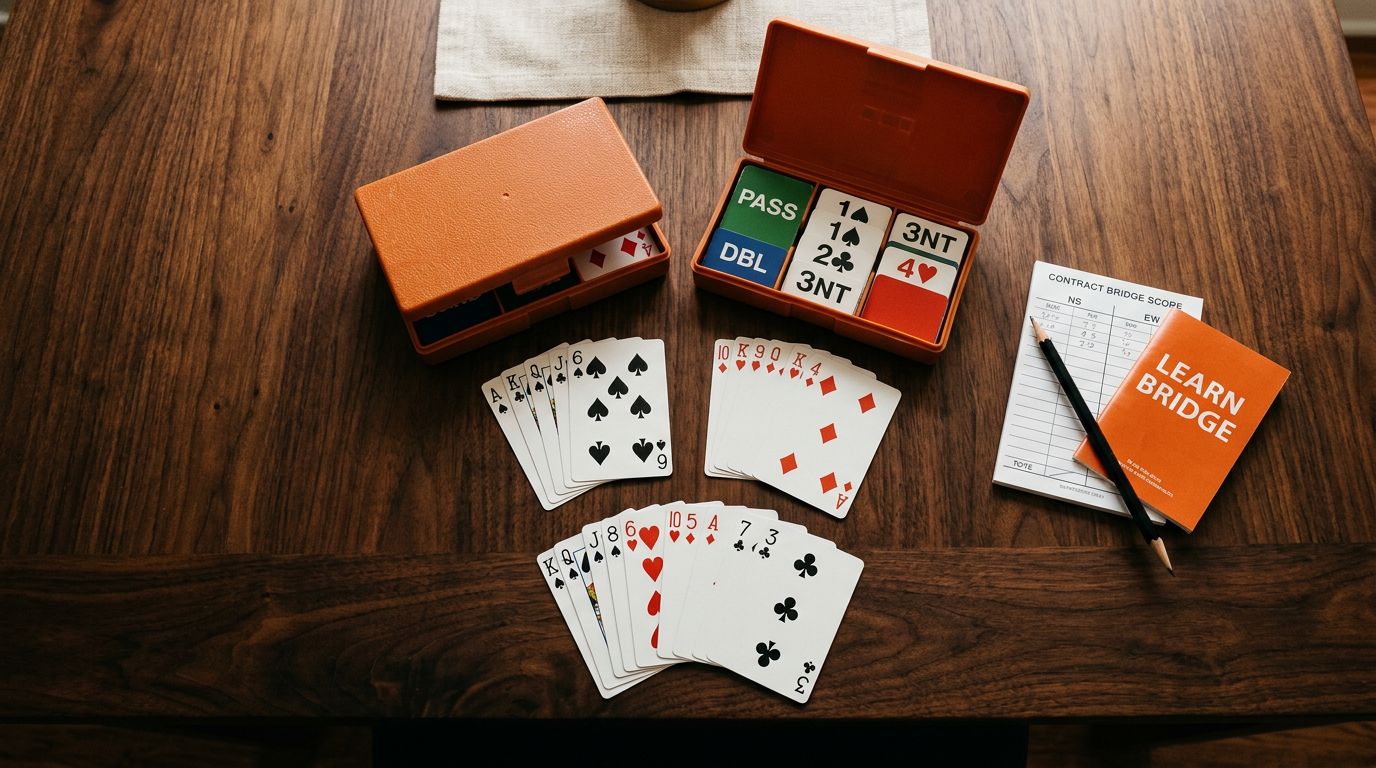
Bidding Boxes in Bridge: What They Are and How to Use Them
If you’ve played bridge at a tournament or club, you’ve seen those plastic boxes sitting at each seat filled with colored cards. If you haven’t used one yet, don’t worry. Bidding boxes are simple tools that change how you communicate your bids, and once you get the hang of them, you’ll wonder how anyone managed without them.
What Is a Bidding Box?
A bidding box is a small plastic container holding cards that represent every possible bid in bridge. Instead of saying “one spade” out loud, you pull out the 1♠ card and place it on the table. Instead of announcing “three notrump,” you slide out the 3NT card.
Think of it as a silent auction. The cards do the talking.
Before bidding boxes became standard, players announced their bids verbally. “One heart.” “Pass.” “Double.” “Two notrump.” This worked fine most of the time, but it created problems. Voices carry different inflections. A hesitant “pass” sounds different from a confident one. A quick “three notrump” versus a slow one. These aren’t supposed to give your partner information, but they do.
Bidding boxes eliminate that issue. Every bid looks the same whether you’re confident or uncertain, whether you have a maximum or minimum. The cards don’t hesitate, don’t rush, don’t reveal anything beyond the bid itself.
Why Bridge Uses Bidding Boxes
The main reason is fairness. Bridge has strict rules about unauthorized information, and vocal bidding creates too many opportunities for accidental signals. Your tone, speed, volume, and timing can all convey information that your partner shouldn’t have.
With bidding boxes, all that disappears. A 1NT bid looks identical whether you have 15 points or 17, whether you have stoppers in every suit or just scraped together your values.
There’s also consistency. In a room with 20 tables, verbal bidding gets loud. Players mishear bids. “Four hearts” sounds like “four notrump” when someone three tables over is arguing about a ruling. With bidding boxes, everyone can see the cards clearly. No confusion, no misunderstandings, no need to ask “what did you bid?” every other round.
Plus, bidding boxes help newer players. You can see the entire auction laid out in front of you. It’s easier to review the bidding, easier to remember what happened, easier to think through the implications. The visual record stays there until someone makes the opening lead.
What’s Inside a Bidding Box
A standard bidding box contains cards for every possible call:
Bidding cards: One of each bid from 1♣ through 7NT. That’s 35 bidding cards (7 levels times 5 denominations).
Pass cards: Usually seven of them, since you might need to pass several times in a competitive auction.
Double cards: Typically two or three, though you rarely need more than one.
Redouble cards: Two of these, again rarely needing more than one.
Alert cards: Red cards marked “Alert” or “Stop” to notify opponents of artificial bids or jump bids that require a pause.
The cards are organized in order, stacked so the lowest bids are in front. When you pull out a card, the ones behind it come along automatically, creating a cascading display of the auction. This is intentional. It keeps the bidding visible and in sequence.
The cards sit in slots with the printing visible. You don’t shuffle through them or search. You just reach in, grab the card you need, and pull it out smoothly. The box design makes this simple once you know where everything sits.
Different manufacturers make slight variations. Some boxes have four alert cards instead of two. Some have extra pass cards. The basics remain the same.
Bidding Box Etiquette and Technique
Using a bidding box correctly isn’t complicated, but there are rules.
Pull cards from your own box. This seems obvious, but newer players sometimes reach across the table. Don’t. Each player uses their own box.
Remove cards smoothly and deliberately. Don’t yank them out or slam them down. Pull the card forward in one motion and place it in front of you, slightly to your right so the next person’s bid goes to their right of yours. This creates a neat row of bids going clockwise around the table.
Don’t hesitate differently with different hands. This is the tricky part. You should take roughly the same time whether you have an obvious bid or a close decision. Pulling a card instantly shows you had an easy choice. Taking 30 seconds and then passing tells a story. Try to maintain consistent tempo.
Leave your bids on the table until the opening lead. Don’t pull them back early. The auction needs to stay visible for everyone, especially dummy who might need to review it before the hand starts.
Use the alert card when required. If your bid is artificial or conventional, place the red alert card on top of it. Your opponents can ask what it means. Don’t explain unless they ask.
Remove only one card at a time (with its trailing cards). Don’t pull out multiple separate bids in anticipation. The auction might not go where you expect.
Common Bidding Box Mistakes
New users make predictable errors.
Pulling the wrong card. You meant to bid 2♠ but grabbed 2♥ by accident. The rules are strict here: if you pull a card far enough that partner could see it, that’s your bid. You can’t take it back. Pay attention.
Knocking over the box. Happens more than you’d think. Keep the box stable and don’t rush. If you do knock it over, call the director. Don’t try to fix it yourself.
Forgetting to alert. Your 2♣ response to 1NT is Stayman, which is alertable in some jurisdictions. If you forget the alert card, opponents can call the director for a possible adjustment. Know your system’s alertable bids.
Touching cards without pulling them. If you touch a card and move it forward slightly, is that a bid? Maybe. The rules say you can’t fidget with the cards or give false signals. If it looks like you started to bid something and changed your mind, the director might rule you made that bid.
Blocking partner’s view. Place your cards neatly in front of you, not scattered everywhere. Partner and opponents should all be able to see the auction clearly.
Bidding Boxes in Online Bridge
Online bridge doesn’t use physical bidding boxes, obviously. But the concept translates directly. You click buttons or select from dropdown menus instead of pulling cards.
The same principles apply. Your bids appear on screen, the auction builds visually, and everyone can review it. Online platforms actually solve some bidding box problems. You can’t pull the wrong card by mistake. You can’t knock anything over. The software won’t let you make an impossible bid like 3♣ after partner opened 4♥.
But online bidding creates its own issues. Timing tells still exist. A fast pass versus a slow pass still gives information. Some players even claim the mouse movement patterns reveal thinking. Most platforms add random delays to minimize this, but it’s not perfect.
The visual display helps newer players more online than in person. You can often hover over bids to see explanations. The system automatically marks alerts. You can review the auction at any point with a click.
The History of Bidding Boxes
Bidding boxes are a relatively recent invention. Bridge existed for decades with only verbal bidding.
The Swedish Bridge Federation introduced the first bidding boxes in 1962. A player named Eric Jannersten built the prototype, frustrated with the unauthorized information problems in vocal bidding. The Swedish federation tested them and liked the results.
They caught on slowly. Most bridge organizations resisted change. Players had bid verbally forever. Why fix what wasn’t broken?
The World Bridge Federation approved bidding boxes for international competition in 1970. That legitimized them. The American Contract Bridge League started allowing them in the 1970s but didn’t require them until much later.
By the 1990s, bidding boxes became standard at serious tournaments worldwide. Clubs followed. Now you’d be hard-pressed to find a sanctioned duplicate game that doesn’t use them.
The irony is that bidding boxes were controversial when introduced. Players complained they were awkward, slow, unnecessary. Older players especially resisted. “We’ve been doing fine for 40 years,” they argued.
Now nobody wants to go back. Bidding boxes are so standard that verbal bidding feels weird and old-fashioned. The vocal auction is reserved for casual kitchen bridge, not serious competition.
Where Bidding Boxes Are Required
Any ACBL-sanctioned tournament requires bidding boxes. You can’t show up to a sectional, regional, or national and bid verbally. The rules mandate bidding boxes at all duplicate games.
Most bridge clubs require them too, even for casual games. The club owns the boxes and provides them at each table. You don’t bring your own unless you’re playing at home.
World Bridge Federation events require bidding boxes. The Olympics, world championships, international competitions all use them. There’s no exception for any level of play.
The only place verbal bidding survives is casual bridge. Home games, rubber bridge, Chicago-style games with friends. If you’re not tracking masterpoints and nobody’s keeping official records, bid however you want.
Some newer bridge variants and online-only formats experiment with different interfaces, but they’re all variations on the bidding box concept. The idea of silent, visual bidding has won completely.
If you’re learning bridge and haven’t used bidding boxes yet, you will. They’re not optional equipment. They’re fundamental to modern competitive bridge, as essential as cards and tables. Get comfortable with them early and they’ll become second nature fast.