Funbridge Complete Guide
Funbridge built a bridge platform for 2026, not 2001. Gorgeous mobile app, play whenever you want, no need to find partners or opponents. Just you, your phone, and unlimited bridge practice.
The concept is simple: play against robots, compare your score to thousands of other players who played the same hands. Did you find the winning line most people missed? Did you botch a cold game? The scoring tells you exactly where you stand.
This makes Funbridge perfect for practice, learning, and playing bridge when your schedule doesn’t match anyone else’s. Waiting for your flight? Play a tournament. Lunch break? Play three boards. Can’t sleep at midnight? Funbridge doesn’t care.
The Funbridge Model: Solo Bridge Competition
You don’t play against other humans directly. You play against robot opponents with a robot partner. Everyone plays the same deals. Your score gets compared to everyone else who played those boards.
Scoring is matchpoint-based against the field. Make 3NT when 60% of players went down? You score well. Go down in 4♠ when 70% made it? You score poorly.
This means the quality of your decisions matters, not whether you beat the specific robots at your table. The robots play the same for everyone. What matters is how you play.
The format eliminates the partnership problem. No need to find a partner who’s free at the same time. No frustration over partner’s mistakes. Your score reflects your decisions, nobody else’s.
You play when you want. Morning, evening, middle of the night - doesn’t matter. Tournaments run on schedules (new ones start hourly or daily), but you play your boards whenever you want during the tournament window.
Getting Started: Download and Setup
Funbridge is primarily a mobile app. Download it from iOS App Store or Google Play. Desktop version exists too, but the app is where Funbridge shines.
Create an account. Email, password, your name. Basic registration.
Free version gives you limited play. You can try the app, play some boards, see if you like it. Full tournaments and unlimited play require a subscription.
Subscription costs about $7-10/month depending on which tier you choose. Premium unlocks everything - unlimited tournaments, all learning features, full access.
The price is reasonable if you play regularly. Less than one in-person game at most clubs, but you get unlimited practice.
Choose your conventions. Funbridge uses Standard American by default, but you can customize. Five-card majors, weak notrump, strong notrump - set it to match how you play.
Set your skill level honestly. Funbridge uses this to recommend appropriate challenges and lessons. Beginner, intermediate, advanced, expert - pick what fits. You can change it later.
The Interface: Beautiful and Intuitive
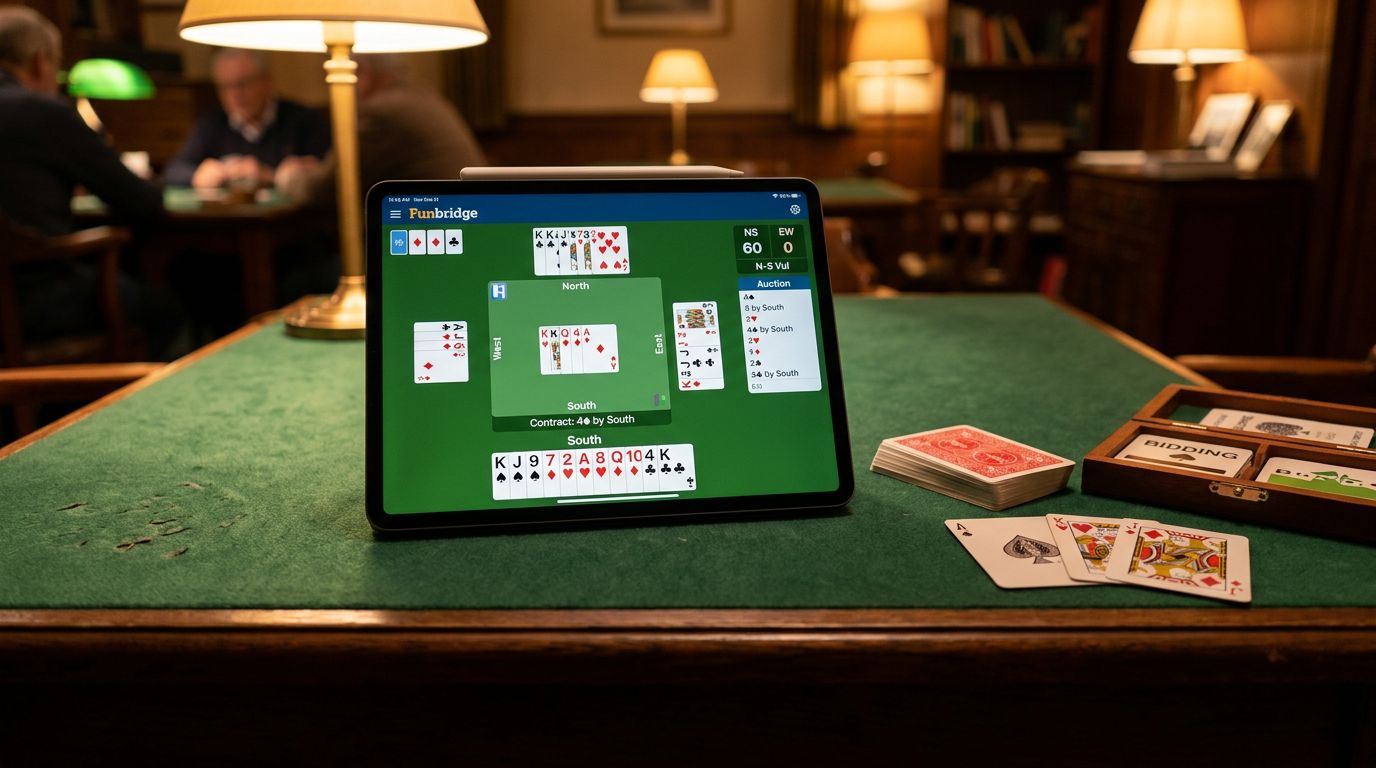
Cards are large and clear. Suits are properly colored - red hearts and diamonds, black spades and clubs. Easy to read on phone screen.
Bidding box appears at the bottom. Tap your bid. Alert and explanation buttons are right there.
Play happens by tapping cards. Tap the card in your hand you want to play. Simple.
The animations are smooth. Cards move naturally, tricks collect cleanly, everything flows. This sounds minor but it makes the app pleasant to use.
Hand analysis shows after each board. See the full deal, review your bidding and play, check optimal lines. This is where learning happens.
Settings let you customize lots of details. Card backs, table color, animation speed, sound effects. Make it yours.
Tournament Formats
Series Tournaments are the main format. Play a set of boards (usually 6-12) over the course of a day or week. Everyone plays the same boards. Rankings update as people finish.
You get one free attempt per tournament. Play your boards, get scored against the field, see your ranking. Premium subscribers can replay tournaments to improve their score.
Tournaments start regularly. New ones every hour or every day depending on format. Always something available to play.
Challenges are themed tournaments. “Slam bidding,” “Trump management,” “Endplay techniques” - each challenge focuses on specific skills. Great for targeted practice.
Exclusive Tournaments run for premium subscribers. Typically harder deals, better competition, bigger fields.
Team Challenges let you form teams with friends and compete against other teams. Still playing solo, but your scores combine with teammates.
Rankings show your percentile. “You scored 58%” means you beat 58% of the field. “You scored 92%” means you crushed it. Simple and clear.
The Robots: What You’re Playing Against
Funbridge robots play Standard American. They know the common conventions. Stayman, Jacoby, Blackwood, basic stuff works fine.
The robots are competent but not perfect. They’ll make the obvious plays and bids. They won’t find brilliant defenses or creative lines.
Robot quirks exist. Sometimes they make weird leads. Occasionally they miss signals. Overall they’re better than BBO robots, not as good as experts.
For practice purposes, the robots work great. They provide consistent opposition. Everyone faces the same robots, so the comparison is fair.
Your robot partner plays the same for you as for everyone else. If your partner makes a weird play, everyone’s partner made that play. Doesn’t hurt your ranking.
The robots defend reasonably well. They’ll cash their tricks, find normal switches, avoid obvious errors. Don’t expect brilliant defenses.
Learning Features: Getting Better
Hand replay shows optimal lines after you play. See how to make that contract you went down in. Understand why that different bid sequence works better.
The analysis shows percentages. “72% of players made 3NT” tells you it’s very makeable. “31% made 4♠” tells you it was tough.
Lessons and exercises teach specific techniques. “Finessing,” “Trump management,” “Competitive bidding” - each lesson has explanation and practice boards.
Work through lessons systematically or jump to topics you struggle with. All included with premium subscription.
Statistics track your progress. See your average scores over time, identify weak areas, watch improvement. Good motivation.
Funbridge tells you when you found the winning line versus the field. “You were one of only 23% who played the ace first” - that kind of feedback helps you learn.
Problem deals let you practice specific situations. Set up scenarios, play them out, see the answer. Good for working on techniques.
Bidding on Funbridge
You can customize your bidding system within limits. Funbridge supports common conventions but not extremely unusual methods.
Stayman, Jacoby transfers, Texas transfers, Blackwood, Gerber, Michaels, Unusual 2NT - all work fine.
Complicated relay systems or highly artificial methods might not be supported. Funbridge assumes you’re playing something reasonably standard.
Your robot partner bids according to the system you’ve set. Tell Funbridge you play weak notrumps, your robot will open 1NT accordingly.
Alerts work. When you make an artificial bid, explain it. The robots don’t care, but it’s good practice.
The bidding analysis after hands shows you what would happen with different auctions. “If you bid 2♥ here instead, the auction would go…” Helps you understand alternatives.
Play and Card Management
Declarer play is where most learning happens. You play the contract, Funbridge shows you optimal play afterward.
See the percentage of players who made the contract. “84% made 4♠” means you should too. Going down means you missed something.
Review shows you the winning line. “If you finesse the queen instead of playing for the drop, you make it.” Next time you’ll remember.
Defense is harder to analyze because you can’t see partner’s hand while playing. But post-hand analysis shows what defense defeats the contract.
Playing quickly is fine. Nobody’s waiting. Take your time on tricky hands, play fast on obvious ones.
Comparing Against the Field
This is Funbridge’s core feature. You’re not trying to beat your specific opponents. You’re trying to beat the field.
Matchpoint scoring means finding the extra trick matters. Making 3NT+1 when everyone else makes 3NT even scores well. Going down when everyone makes it scores terrible.
Bidding the optimal contract matters. Everyone’s in 3NT making four, you’re in 4♥ making five? You score poorly because you’re in the wrong contract, even though you made more tricks.
This teaches you to bid like everyone else when standard is right, and find better contracts when standard is wrong.
The field varies in quality. Some experts, lots of intermediates, some beginners. Your scores reflect how you compare to this mixed field, not to experts only.
Over time you can track if you’re improving. Averaging 52% is slightly above average. Averaging 60% is doing well. Averaging 45% means you’re making mistakes the field avoids.
Solo Practice Benefits
No partnership politics. Your score is your score. Can’t blame partner, can’t get frustrated at their mistakes.
Play at your own pace. Fast through easy hands, slow on complex ones. Nobody’s waiting or rushing you.
Complete flexibility. Play one board or twenty. Start a tournament, play three boards, finish it later. Life interrupts? No problem.
Consistent opposition. The robots play the same for everyone. Fair comparison of your decisions.
Immediate feedback. See the analysis right after playing. Learn while the hand is fresh in your mind.
This format is perfect for busy people. Bridge when you have ten minutes, not just when you can commit to two hours.
What Funbridge Doesn’t Do
No human opponents. If you want the psychological element of bridge against real people, Funbridge doesn’t provide it.
No voice or video. You’re alone with your phone. Social element is entirely missing.
Limited partnership play. You can’t team up with a friend and play as a real partnership. It’s solo only.
No ACBL masterpoints. Funbridge tournaments don’t count toward life master ranks or ACBL standings.
Can’t play unusual bidding systems. You’re limited to supported conventions. If you play something exotic, you’ll have to adapt.
Robot partners and opponents mean some things you’d do against humans don’t work. Psychological bids, reading opponents, table presence - none of that matters.
Funbridge vs BBO vs RealBridge
Funbridge wins for:
- Solo practice (no partner needed)
- Mobile play (best phone app)
- Flexibility (play anytime)
- Learning features (built-in lessons and analysis)
- Convenience (start and stop whenever)
BBO wins for:
- ACBL tournaments (masterpoints)
- Human opponents (real psychology)
- Player variety (huge field)
- Watching top players (vugraph)
RealBridge wins for:
- Social interaction (video/voice)
- Club atmosphere (regular games with faces)
- Partnership play (real partnerships matter)
Use Funbridge for daily practice and improvement. Use BBO for competitive play and masterpoints. Use RealBridge for social bridge with friends.
Many good players have all three. Each serves different needs.
Cost Analysis
Free version: Very limited. Good for trying the app, not for regular play.
Premium subscription ($7-10/month): Unlimited tournaments, all learning features, full access. Worth it if you play regularly.
Compare to alternatives:
- BBO free casual play, pay per tournament ($5-15 each)
- RealBridge free for players, pay club entry fees ($5-15 per game)
- Funbridge flat monthly fee, unlimited play
If you play several times a week, Funbridge subscription pays for itself compared to paying per game elsewhere.
Mobile Optimization
Funbridge is designed for phones. Everything works smoothly on small screens.
Tablet is nice for bigger cards and less squinting. iPad or Android tablet makes the experience more comfortable.
Desktop version exists but feels like a phone app stretched to computer size. Not as polished as BBO’s desktop interface.
Most Funbridge players use phones. App is optimized for it, and phones are always with you. Bridge in your pocket.
Battery drain is modest. You can play for an hour without killing your phone. Longer sessions, might want a charger handy.
Works offline for some features. Download tournaments, play without internet, sync scores later. Good for flights or places with spotty service.
Improvement Tracking
Funbridge shows your score trends over time. See if you’re improving, plateauing, or regressing.
Break down performance by category. Bidding accuracy, declarer play, defense - see where you’re strong and weak.
Compare to other players at your level. Are you average for your skill rating? Above? Below?
The feedback helps identify what to practice. Weak in competitive auctions? Focus on those lessons. Great at declarer play but poor defense? Work on defense challenges.
This makes Funbridge excellent for systematic improvement. You get data on your game, not just general feeling.
Tips for Better Funbridge Scores
Play all your boards. Rankings punish incomplete tournaments. Finish what you start.
Review every hand. The analysis is there for a reason. See what you missed, understand optimal lines.
Don’t rush. You have time. Think through each decision like it’s a real game.
Focus on normal contracts. Finding the weird 6-2 fit that makes doesn’t help if the field is in the normal 4-4 fit. Bid with the field unless you see something better.
Count the hand. Robots don’t give false signals, but they do give honest ones. Count points and distribution.
Take the sure tricks. Going down because you tried for overtricks scores terribly. Make your contract first.
Learn from your mistakes. If you score 23% on a board, figure out why. Don’t just move to the next one.
Is Funbridge Right for You?
If you want to practice bridge daily without scheduling games or finding partners, Funbridge is perfect.
If you’re trying to improve systematically and like measurable progress, the learning features help a lot.
If you travel frequently or have unpredictable free time, the flexibility is unbeatable.
If you need ACBL masterpoints or want human competition, Funbridge isn’t enough by itself.
If you hate playing against robots, Funbridge will frustrate you.
For most players, Funbridge is a supplement, not a replacement. Use it for practice and learning. Use other platforms for competitive play and social bridge.
But for pure convenience and quality practice, Funbridge is the best option available. Download it, subscribe, start improving. Your phone is now a bridge club that’s always open.