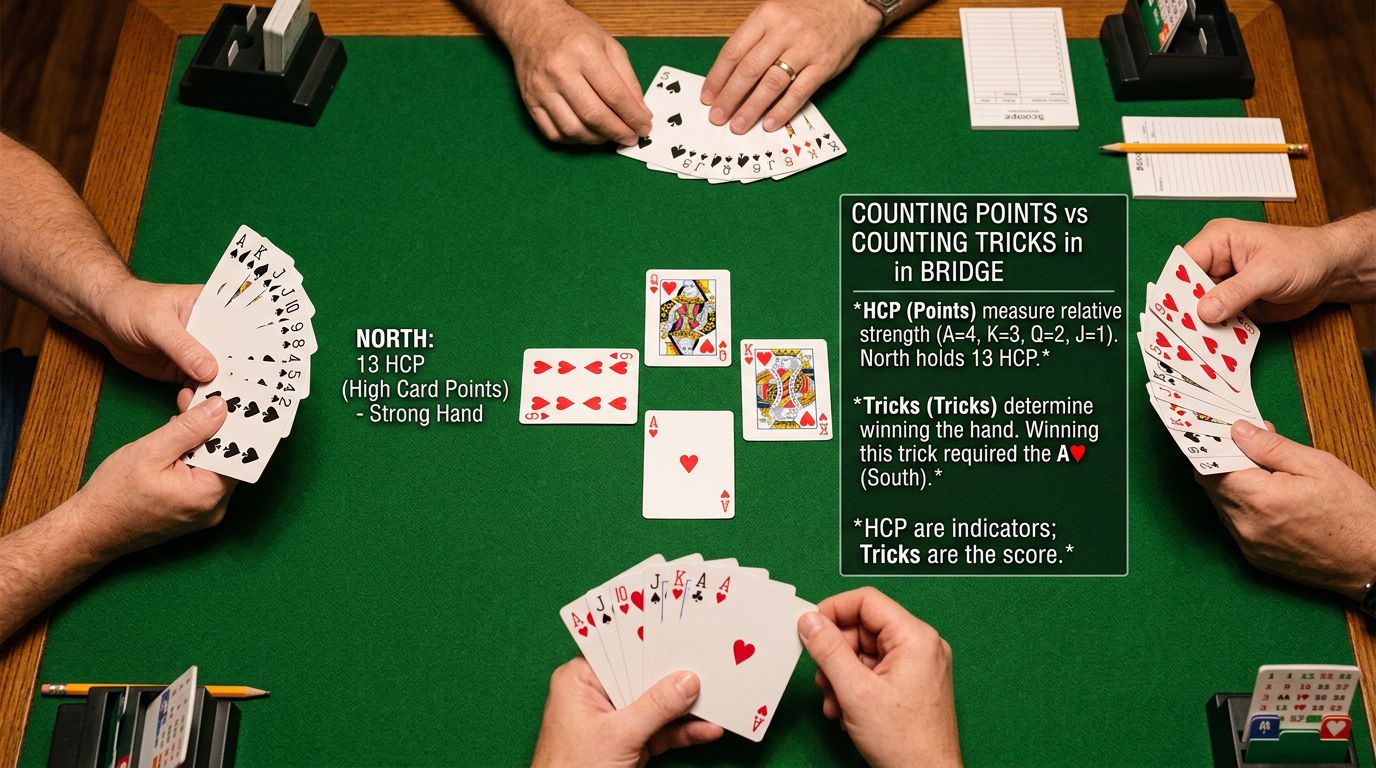
Counting Points vs Counting Tricks in Bridge: Why Tricks Win
You learned to count high card points on day one. Ace = 4, King = 3, Queen = 2, Jack = 1. Add them up, bid when you have enough. Simple, right?
That system works fine for beginners. But if you’re still thinking primarily in points rather than tricks, you’re leaving tricks on the table. Here’s why.
The Problem with Points
Points are a shortcut. They correlate with trick-taking ability, but they’re not the same thing. A hand with 16 HCP might take 6 tricks or 10 tricks depending on the distribution and fit with partner’s hand.
Consider these two hands:
Hand A:
♠ AKQ
♥ A32
♦ K432
♣ 432
Hand B:
♠ AKQ7654
♥ A32
♦ 32
♣ 32
Both hands have 16 HCP. But Hand B will take way more tricks in a spade contract. That seventh spade isn’t worth any points in traditional counting, but it’s worth gold when you’re declarer.
What Tricks Actually Tell You
Tricks are the real currency of bridge. You need 13 for a grand slam, 12 for a small slam, 10 for game in a major, 11 for game in a minor, 9 for 3NT. Everything else is just estimation.
When you count tricks, you’re asking: “How many can I actually take?” Not “What does my hand theoretically promise?”
In notrump, this means counting quick tricks. In a suit contract, it means counting winners and losers. Different questions, different answers.
When Point-Counting Fails
Long Suits Get Undervalued
Take this hand:
♠ 32
♥ 86
♦ AKQJ1098
♣ 32
That’s 10 HCP. Many players would pass as dealer. But you have 7 running tricks in diamonds. Open 3♦ or even 4♦, and make life hell for the opponents. Points say “minimum hand.” Tricks say “destructive weapon.”
Fit Changes Everything
You hold:
♠ KJ32
♥ 2
♦ KJ1087
♣ 543
That’s 9 HCP. If partner opens 1♥, you have a minimum response with questionable support. But if partner opens 1♠, you’ve got 4-card support, a singleton heart, and diamond length. You’re worth way more than 9 points now. The fit creates extra tricks through ruffs and distribution.
Controls Matter More Than Bulk
For slam bidding, points can be actively misleading. Would you rather have:
♠ AK32 (6 HCP, two controls)
or
♠ QJ32 (3 HCP, zero controls)
The AK prevents the opponents from cashing two quick tricks. The QJ doesn’t. For slam purposes, aces and kings are worth way more than their point value suggests.
How to Think in Tricks
In Notrump: Count Quick Tricks
When partner opens 1NT (15-17), ask yourself: “How many tricks can we take off the top?”
You hold:
♠ KQ3
♥ 865
♦ AJ1098
♣ 32
That’s 10 HCP, traditionally enough for game. But count your tricks: maybe 2 in spades, 0 in hearts, maybe 3-4 in diamonds if they break, 0 in clubs. You’re looking at 6-7 tricks, and partner has about 7-8. That’s 13-15 total, not the 9 you need. Invite rather than jumping to 3NT.
In a Suit: Count Losers
Once you’ve found a fit, count your losers instead of your points. You can afford 3 losers for game, 1 loser for a small slam, 0 for a grand.
Partner opens 1♠, you hold:
♠ KJ32
♥ A2
♦ K8765
♣ 32
Count losers: 0 in spades (partner has at least 5), 1 in hearts (you have the ace), 2 in diamonds (even with the king), 2 in clubs. That’s 5 losers. With an average opening bid, partner has about 7 losers. Together, you’re at 12 losers or 1 trick short of game. Invite, don’t force.
Making the Switch
Start with small decisions. When you’re declaring, before you play from dummy on trick one, count your tricks. Not your points. Your tricks.
“I have 3 spades, 2 hearts, 1 diamond if the king is onside, 3 clubs. That’s 9 if everything works.”
Or: “I have 2 spade losers, 1 heart loser, 2 diamond losers. Can I get rid of one before they cash them?”
Do this enough, and trick-thinking becomes automatic. You’ll still use points for initial decisions, but once dummy comes down, it’s all about tricks.
Common Mistakes
Mistake 1: Counting Distribution Points Too Early
Adding points for short suits (3-2-1 for doubleton-singleton-void) is fine, but only after you’ve found a fit. Don’t add them to your opening bid. A singleton is worth something when you can ruff in partner’s long suit, but it’s not worth anything when you’re playing in notrump or your own long suit.
Mistake 2: Ignoring Intermediates
Points don’t account for tens and nines, but tricks do. Compare:
♠ AQ32
♠ AQ109
Same point count, but the second holding takes more tricks because the ten and nine help develop the suit.
Mistake 3: Overvaluing Quacks
Queens and jacks (quacks) in short suits often don’t pull their weight. The ♥Qx is 2 HCP, but it rarely takes a trick. It might reinforce partner’s honor holding, but by itself, it’s not much. Compare that to the ♥Q in a 5-card suit where you can develop the suit for tricks.
Mistake 4: Forgetting About Tempo
Sometimes you have the tricks but not the timing. In notrump, the opponents might cash 5 tricks before you get a chance to cash your 9. Points don’t tell you anything about tempo. Thinking in tricks forces you to consider: “Can I get there first?”
The Real World Example
You’re South, vulnerable vs not, and you hold:
♠ QJ109876
♥ 3
♦ A2
♣ 543
RHO opens 1♥. What do you do?
Point-counter thinks: “I have 7 HCP, not enough to overcall at the 2-level.”
Trick-counter thinks: “I have 6 spade tricks and an ace. That’s 7 tricks. I’ll bid 3♠ and see what happens.”
The trick-counter is right. This hand is worth a preempt. You’ll probably go down one or two if partner has nothing, but you’ve made life miserable for the opponents. They might have a heart game or even slam, and now they’re guessing. That’s worth way more than 7 HCP suggests.
When Points Still Matter
Don’t throw points out entirely. They’re useful for:
- Opening bid decisions: The range of 12-14 HCP is a reasonable proxy for “has enough tricks to compete.”
- Notrump ranges: 15-17 for 1NT, 20-21 for 2NT gives partner a framework.
- Slam tries: 33 combined points is a decent starting point for exploring slam.
But once you’re past the initial bid, start thinking tricks. The auction and the dummy give you real information. Use it.
Sharpen Your Strategy with Brian
Want to put these strategic concepts into practice? Brian analyzes your bridge hands and explains the optimal line of play. Try Brian free →
The Bottom Line
Points are training wheels. Tricks are the bike.
Learn to count tricks, and you’ll make better bidding decisions, better opening leads, better play decisions. You’ll stop worrying about whether that jack bumps you from 11 to 12 HCP and start asking the question that matters: “Will this hand take tricks?”
That’s the difference between playing bridge by memorized rules and actually understanding the game.