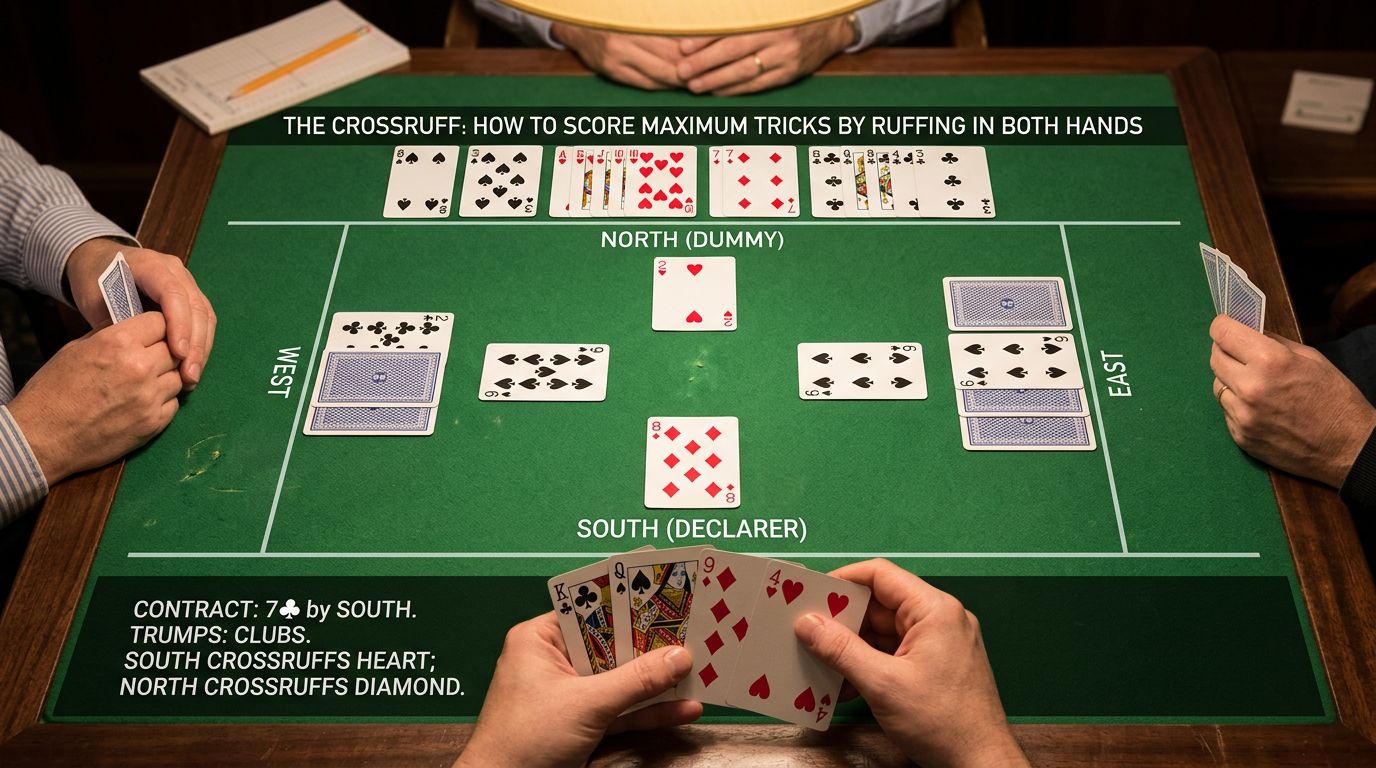
The Crossruff: How to Score Maximum Tricks by Ruffing in ...
The crossruff is one of the most satisfying plays in bridge. Instead of drawing trumps like you normally would, you deliberately leave them out there while you ruff back and forth between your hand and dummy. When executed properly, you can score far more tricks than you’d get by drawing trumps and running a long suit.
But the crossruff is also one of the trickiest techniques to master. Get it wrong, and you’ll watch helplessly as defenders overruff you or cash side-suit winners you forgot to take. Let’s dive into everything you need to know about this powerful declarer play.
What Is a Crossruff?
A bridge crossruff is a declarer play technique where you score your trumps separately by ruffing in both hands instead of drawing the opponents’ trumps. You ruff a suit in one hand, then ruff a different suit in the other hand, going back and forth like a shuttle.
Here’s the basic pattern:
- You’re short in one suit in your hand
- You’re short in a different suit in dummy
- You have plenty of trumps in both hands
- You ruff dummy’s short suit in your hand
- You ruff your short suit in dummy
- You repeat this process, scoring each trump separately
The beauty of the crossruff is that each small trump becomes a trick. That ♠3 you might normally throw away? On a crossruff, it takes a trick just like the ace would.
When to Use Crossruff vs. Draw Trumps
The standard advice in bridge is “draw trumps early and often.” So when should you abandon this fundamental principle and crossruff instead?
Consider a crossruff when:
-
You have shortness in both hands - Ideally, you’re void or singleton in one suit in your hand and void or singleton in a different suit in dummy.
-
You have plenty of trumps in both hands - You need enough trumps to keep ruffing back and forth. Usually at least 4-4 or 5-3 in the trump suit.
-
You can’t set up a long suit - If dummy has ♥AKQ32 with entries, you’d normally draw trumps and run hearts. But if you have no entries to dummy after drawing trumps, crossruffing might be better.
-
Drawing trumps leaves you short of tricks - Count your tricks if you draw trumps: maybe you have 8 sure tricks in a 4♠ contract. But if you crossruff, you can score 5 trump tricks separately plus 5 side-suit winners = 10 tricks.
-
The opponents have a long suit to run - This one’s tricky. If they have ♦AKQ987 ready to cash, you might need to crossruff quickly before they get in.
Stick with drawing trumps when:
- You have a long, solid side suit to run
- You have plenty of tricks without ruffing
- The crossruff would let opponents pitch their losers
- You don’t have enough trumps to sustain a crossruff
The decision often comes down to counting. Count your tricks both ways and pick the line that gets you to your contract.
Requirements for a Successful Crossruff
Not every hand with short suits is suitable for a crossruff. You need several elements to come together:
1. Shortness in complementary suits
The key word is “complementary” - you need to be short in different suits in each hand. If you’re short in ♥ in both hands, you can’t crossruff because you’d have nowhere to return to.
Ideal pattern:
- Your hand: ♠AKJ54 ♥3 ♦A652 ♣KQ4
- Dummy: ♠Q32 ♥A854 ♦7 ♣A8732
You can ruff ♦ in dummy and ruff ♥ in your hand.
2. Enough trumps
You need sufficient trumps to sustain the crossruff. If you have 7 trumps total and need to ruff 6 times, you’re living dangerously. One bad break and you’re in trouble.
Generally, you want 8+ trumps between the two hands for a full crossruff.
3. Trump quality matters less than usual
Here’s the good news: you don’t need high trumps for a crossruff. Even small trumps score tricks when you’re ruffing. That said, having some high trumps helps prevent overruffs (more on that later).
4. Control of the other suits
This is crucial and often overlooked. You need to be able to cash your side-suit winners at some point. If the opponents can grab the lead and cash 4 quick tricks, your brilliant crossruff doesn’t matter.
Cashing Side Winners First: The Golden Rule
Here’s the most important rule of crossruffing: cash your side-suit winners BEFORE you start ruffing.
Why? Because once you start crossruffing, you lose control. Let’s say you’re merrily ruffing back and forth, and you’re down to this position:
Your hand: ♠AK ♥- ♦K ♣- Dummy: ♠Q ♥A ♦- ♣-
You need all 4 remaining tricks. You ruff a ♣ in hand with the ♠K. Now you’re stuck. You can’t get to dummy to ruff another ♥ because the only entry is the ♥A - but if you play that, you can’t ruff anything!
Meanwhile, that ♦K you were planning to cash later? You never got to cash it. You go down in a cold contract.
The correct technique:
- Before ruffing anything, cash your ♦K
- Cash dummy’s ♥A
- Cash any other side winners you have
- THEN start crossruffing
Think of it this way: every time you ruff, you’re using up an entry. Eventually, you’ll run out of entries. So take your side-suit tricks while you still can move between the hands.
Exception: Sometimes you have so many side winners that you’d get trumped if you tried to cash them all. In that case, you might cash some, start ruffing, then cash more when you get the chance. But this is advanced territory.
Common mistake: Declarer sees the beautiful crossruff and gets excited. They ruff once, twice, three times - then realize they never cashed the ♦AK sitting in dummy. Too late! They’ve run out of entries and go down.
Dangers of Crossruffing: Watching for Overruffs
The crossruff has a built-in vulnerability: you’re deliberately leaving trumps out in the defenders’ hands. They can use those trumps to overruff you.
What’s an overruff?
You ruff with the ♠5. The next player plays the ♠7 (an overruff) and wins the trick. Your ruff didn’t score after all.
How to avoid overruffs:
1. Ruff with high-enough trumps
If you have ♠AKJ54 in hand and ♠Q32 in dummy, ruff in dummy with small trumps (where you have to) but ruff in your hand with the ♠J or higher if someone might overruff.
2. Watch the spots
Pay attention to which small trumps are still out. If you have ♠K53 in dummy and you’ve seen the ♠2, ♠4, and ♠6 played, you can safely ruff with the ♠3. But if you haven’t seen those cards yet, someone might overruff.
3. Use your high trumps strategically
Sometimes you should ruff with the ♠A even though it feels wasteful. Better to guarantee the trick than to risk an overruff.
4. Count trumps
Keep track of how many trumps are still out. If opponents started with 5 trumps and you’ve seen 4, there’s only one left - you know who has it and can play accordingly.
When an overruff doesn’t matter:
Sometimes you can afford to be overruffed. If you’re in 4♠ and you’re making 11 tricks, who cares if they overruff once? You still make your contract with an overtrick.
But if you’re in a tight contract, every trick matters. That’s when you need to be careful about ruffing high enough.
Partial Crossruffs: The Hybrid Approach
Most real-world hands aren’t pure crossruffs. Instead, you’ll use a partial crossruff - a combination of ruffing in one or both hands and drawing some trumps.
Common partial crossruff scenarios:
1. Draw one or two rounds of trumps, then crossruff
If trumps are 3-2, you might draw two rounds (leaving one small trump out) then crossruff. This prevents overruffs while still letting you score most of your trumps separately.
2. Crossruff for a few rounds, then draw trumps
You ruff twice in each hand, scoring 4 trump tricks. Now you’re up to 9 tricks and you only need one more. Draw the remaining trumps and claim.
3. Ruff in one hand only
Technically not a crossruff, but related: you ruff several times in dummy while using your trumps in hand to draw the opponents’ trumps. This is called a “dummy reversal” and it’s powerful when dummy is shorter in trumps.
How to decide:
Count your tricks. If you need every trump to score separately, do a full crossruff. If you can afford to use 2-3 trumps to draw theirs, do a partial crossruff.
The partial crossruff is often safer because you reduce the risk of overruffs while still scoring extra trump tricks.
Example Crossruff Hands
Let’s look at some real examples where the crossruff shines.
Example 1: The Classic Crossruff
Contract: 4♠
Dummy (North)
♠ Q 8 4
♥ A K 8 5
♦ 3
♣ A 7 6 5 2

Declarer (South)
♠ A K J 9 2
♥ 3
♦ A K 7 5 2
♣ K 4
Opening lead: ♦Q
You have a singleton ♥ in your hand and a singleton ♦ in dummy. Perfect for a crossruff!
Counting tricks the “normal” way: Draw trumps, and you have 5 spade tricks, 2 hearts, 2 diamonds, 2 clubs = 11 tricks easily.
But wait - what if trumps are 4-1? Then you might only score 4 spade tricks, and you’re down to 10 tricks. Plus you have no entries to dummy after drawing trumps, so you can’t even enjoy those hearts.
Counting tricks via crossruff: Cash ♦A, ♦K, ♥A, ♥K, ♣A, ♣K (6 tricks). Now ruff a ♦ in dummy, ruff a ♥ in hand, ruff a ♦ in dummy, ruff a ♥ in hand (4 more tricks) = 10 tricks total.
The correct line:
- Win ♦A
- Cash ♦K (critical - don’t forget this!)
- Cash ♣K
- Cross to ♣A
- Cash ♥A
- Cash ♥K
- Ruff a ♥ with ♠2
- Ruff a ♦ with ♠Q
- Ruff a ♥ with ♠9
- Ruff a ♦ with ♠8
- Ruff a ♥ with ♠J
- Eventually take ♠A and ♠K
You make 11 tricks easily.
Example 2: The Failing Crossruff
Contract: 4♠
Dummy
♠ 7 6 4
♥ 2
♦ A 8 6 4 3
♣ A Q 5 2

Declarer
♠ A K Q J 10
♥ A K Q 6 5
♦ 7
♣ K 4
This looks like a crossruff - singleton ♦ in your hand, singleton ♥ in dummy. But it’s a trap!
If you try to crossruff, you’ll ruff ♦ in hand and ♥ in dummy. But dummy’s trumps are the ♠764 - pathetically small. The opponents will gleefully overruff every time you try to ruff in dummy.
The correct line: Draw trumps! You have 5 solid spade tricks plus 5 solid heart tricks = 10 tricks. Don’t get fancy. Sometimes the straightforward line is best.
Common Crossruff Mistakes
Mistake #1: Forgetting to cash side winners
We’ve hammered this point, but it bears repeating. Cash those aces and kings BEFORE you start ruffing!
Mistake #2: Ruffing with unnecessarily high trumps
If you have ♠AKJ5 in hand and ♠Q32 in dummy, don’t ruff in hand with the ♠A if the ♠5 will do. Save your high trumps for when you need them.
Mistake #3: Starting the crossruff from the wrong hand
You need to end up in the right hand to draw any remaining trumps or cash that last side winner. Think ahead about which hand you want to be in at the end.
Mistake #4: Not counting trumps
Crossruffing without counting trumps is like driving blindfolded. Keep track of how many are out and who has them.
Mistake #5: Crossruffing when drawing trumps is better
Just because you can crossruff doesn’t mean you should. Always count your tricks both ways before committing to a line.
Mistake #6: Letting defenders pitch their losers
While you’re merrily ruffing back and forth, defenders are discarding. If you take 8 tricks to execute your crossruff, they’ve made 8 discards. They might pitch all their losers in the suit you were planning to attack later.
Mistake #7: Running out of trumps
You calculated you needed to ruff 5 times but you only have 7 trumps total. Oops - you also need to draw at least one round of trumps, and you need a trump to lead at trick 13. The math doesn’t work. Abandon the crossruff.
Sharpen Your Strategy with Brian
Want to put these strategic concepts into practice? Brian analyzes your bridge hands and explains the optimal line of play. Try Brian free →
Mastering the Crossruff
The crossruff is a beautiful play when it works. There’s something deeply satisfying about scoring your ♠3 as a full trick, then doing it again with the ♠4 and ♠5.
The keys to crossruff success:
✅ Recognize the pattern: short in different suits in each hand ✅ Count your tricks both ways before deciding ✅ Cash side winners FIRST ✅ Ruff high enough to avoid overruffs ✅ Keep track of outstanding trumps ✅ Consider partial crossruffs as a safer alternative
With practice, you’ll develop an instinct for when to crossruff. You’ll see that dummy with a singleton and think “Maybe I shouldn’t be so quick to draw trumps…”
And when you execute a perfect crossruff, making a contract that looked impossible, you’ll understand why this technique has been enchanting bridge players for generations.
Now get out there and start ruffing!