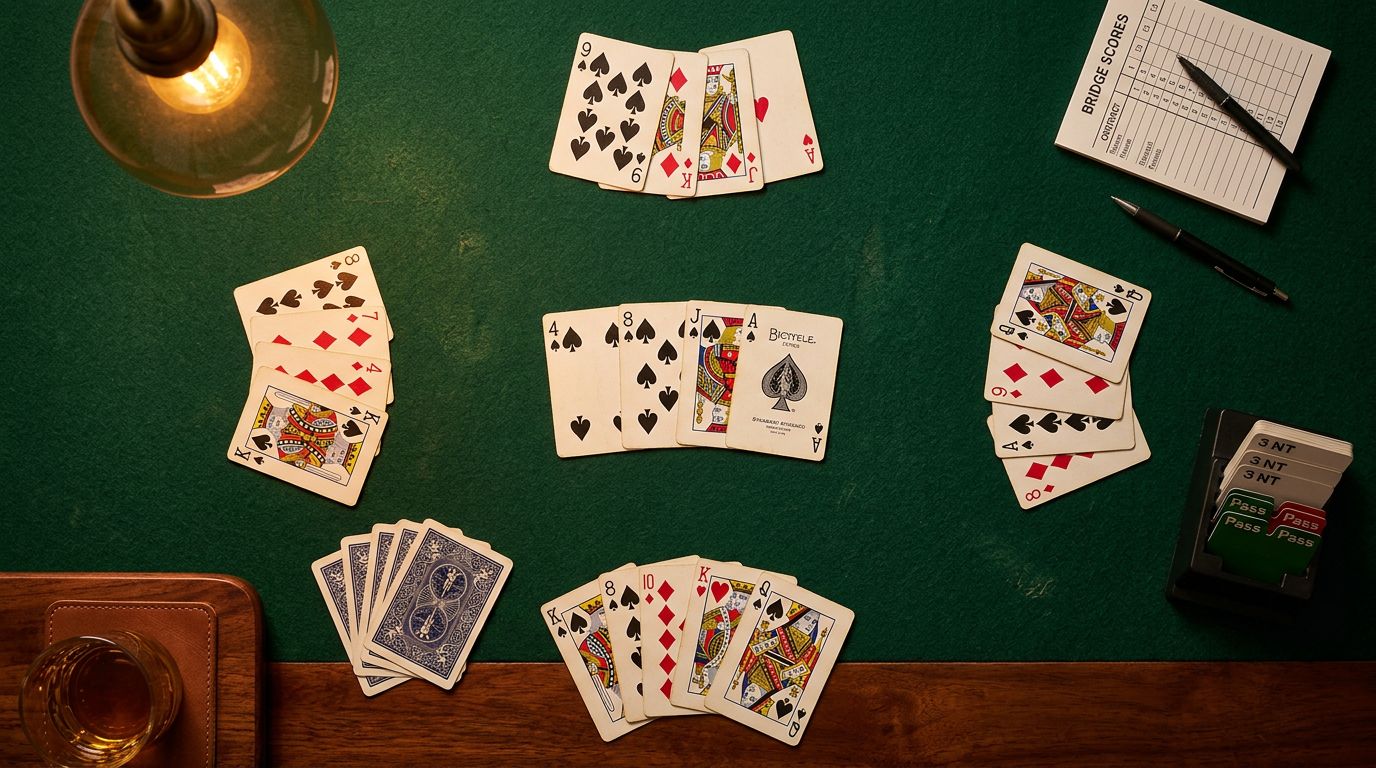
Bridge Signals: Legal Communication Between Defenders
You and your partner are defending. Declarer leads a suit. Your partner plays the 9. Is that just a card, or is it a message?
It’s a message.
Bridge signals are the only legal way defenders communicate during play. You can’t talk. You can’t gesture. You can’t kick your partner under the table. But you can play cards in a specific order, and that order tells a story.
Good defenders signal. Great defenders know when to signal and when to just play bridge. Let’s talk about both.
What Are Signals?
A signal is a card you play to give partner information. Not to win the trick. Not to stop declarer. To communicate.
The rules are strict. You can’t signal about your hand before the opening lead. You can’t use special gestures or timing tells. You can only use the cards you play, in the order you play them, when it’s legal to do so.
That’s it. That’s all you get.
But it’s enough. Three types of signals cover almost everything:
- Attitude signals, Do you like this suit or not?
- Count signals, How many cards do you have in this suit?
- Suit preference signals, Which suit should partner lead next?
Different situations call for different signals. Knowing which to use, and when to ignore all of them, separates defenders who guess from defenders who know.
Attitude Signals: High = Encouraging, Low = Discouraging
Attitude signals answer one question: Do you like this suit?
Partner leads a suit. You follow. The card you play tells partner whether you want more of this suit or not.
High card (7-8-9-10-J-Q-K) = encouraging. “I like this suit. Keep leading it.”
Low card (2-3-4-5-6) = discouraging. “I don’t like this suit. Try something else.”
Example: Encouraging vs. Discouraging
You’re defending 3NT. Partner leads the ♠K (from KQJx). Dummy has ♠74. You hold ♠A853.
Play the ♠8 (high, encouraging). Partner continues, you win your ace, return your fourth spade, and partner cashes the setting tricks.
If you’d played the ♠3 (discouraging), partner might shift, thinking spades are dead.
Conversely, if you held ♠854 with nothing helpful, play the ♠4. That tells partner to try something else.
What Makes a Signal “High” or “Low”?
Context. The ♠7 is high if you have 732. It’s low if you have KJ974. Partner reads your signal relative to the other cards that have been played.
If you play the 9 and the 8-7-6-5 are already gone, the 9 is low. If the 9 is the highest spot card visible, it’s high.
You work with what you have. Sometimes you can’t give a clear signal because your spot cards don’t cooperate. That’s bridge. Do your best.
Count Signals: High-Low = Even, Low-High = Odd
Count signals answer a different question: How many cards do you have in this suit?
High-low = even number. Play a high card, then a lower card. (9 then 3 = even.)
Low-high = odd number. Play a low card, then a higher card. (3 then 9 = odd.)
This helps partner know when a suit will break, when declarer is out of cards, or when to hold up an ace.
Example: Count in Action
You’re defending 3NT. Declarer runs a long ♣ suit from dummy. You have ♣93.
Play the 9, then the 3 (high-low = even).
Partner knows you have two clubs. Combined with dummy and their own holding, partner can count declarer’s exact length. This helps partner know when to pitch safely and when to hold critical cards.
Without count, partner guesses. With count, partner knows.
When to Give Attitude vs. Count
You can’t give both signals at once. Choose wisely.
Attitude when: Partner leads a suit (especially at trick one).
Count when: Declarer leads a suit (especially when running a long suit or partner needs to know when to take an ace).
The default: Attitude on partner’s lead. Count on declarer’s lead.
This distinction is critical. Mix them up and partner will misread the defense.
Suit Preference Signals: Which Suit Do You Want Next?
Suit preference signals answer: If partner gets the lead, which suit should they return?
This usually happens when:
- Partner is about to give you a ruff
- Partner is deciding which suit to shift to
- The current suit is obviously dead
High card = higher-ranking suit.
Low card = lower-ranking suit.
Example: Suit Preference When Ruffing
You’re defending 4♠. Partner leads the ♦A, then the ♦K. You’re about to ruff.
You have the ♣A and nothing in hearts.
Ruff with the ♠2 (low trump).
That’s suit preference for clubs (the lower-ranking suit). High ruff would ask for hearts. Partner sees your low ruff and leads a club when they get in. You win the ♣A, give partner another diamond ruff, and beat the contract.
The principle: high = higher suit, low = lower suit (excluding trumps and the suit being played).
Standard vs. Upside-Down Signals
Everything described so far is standard signals:
- Attitude: high = encouraging, low = discouraging
- Count: high-low = even, low-high = odd
- Suit preference: high = higher suit, low = lower suit
Some players use upside-down signals (also called reverse signals):
- Attitude: low = encouraging, high = discouraging
- Count: same as standard (high-low = even)
- Suit preference: same as standard
Why? Upside-down attitude signals let you encourage with your lowest card (2), which preserves your higher spot cards for later tricks. It’s a small edge.
But it requires partnership agreement. Don’t use upside-down unless you and partner explicitly agreed beforehand. Otherwise, you’ll encourage when partner thinks you’re discouraging, and you’ll watch tricks evaporate.
Most casual players use standard. Most serious partnerships use upside-down. Know which you’re playing.
When to Signal vs. When to Just Play Bridge
Here’s the secret nobody tells beginners: sometimes you shouldn’t signal at all.
Signals are for partner. But declarer sees them too. If your signal helps declarer more than partner, don’t give it.
When NOT to Signal
1. When declarer benefits too. If you’re giving count in a suit that declarer is also trying to read, you’re helping declarer as much as partner. Make declarer guess.
2. When you need your spot cards. Playing the 7 to encourage might leave you with K-3, vulnerable to a finesse later.
3. When you have a critical play. Winning the trick beats sending a message.
When TO Signal
1. When partner needs it and declarer doesn’t. Partner leads at trick one, your attitude helps partner, declarer gains nothing.
2. When the contract depends on it. Defending a slam, every signal matters.
3. When partner can’t see the answer. Partner holding up an ace needs your count.
The key question: Who benefits more, partner or declarer? If partner, signal. If declarer, don’t.
Example Hands with Signaling Decisions
Hand 1: Clear Attitude Signal
Contract: 3NT
Opening lead: ♠Q (partner)
Dummy:
♠ 73
♥ K84
♦ AQJ95
♣ K62
You hold:
♠ K942
♥ 1065
♦ 73
♣ Q1084
Dummy plays the ♠3. What do you play?
Answer: ♠9.
High and encouraging. You have the king. Partner continues spades, you win the king, return your fourth spade, and partner runs the suit. If you’d played the ♠2 (discouraging), partner might shift, and you’d lose your timing.
Hand 2: Count Signal
Contract: 4♥
Declarer leads ♣A from dummy. You hold ♣J962.
Answer: Play ♣6, then ♣9 (high-low = even).
Partner knows declarer has a doubleton and can count the hand accurately.
Hand 3: Suit Preference After Ruffing
Contract: 4♠
Partner leads: ♦A, then ♦K
You hold:
♠ 852
♥ A74
♦ 6
♣ 1098653
You ruff the second diamond. Which spade do you ruff with?
Answer: ♠8 (high trump).
Suit preference. You want hearts (the higher-ranking suit) because you have the ♥A. If partner gets in, they’ll lead a heart, you win the ace, give partner a third diamond ruff, and the contract fails.
If you ruffed with the ♠2 (low), partner would think you want clubs and might lead a club when they get in. Wrong suit.
Hand 4: When NOT to Signal
Contract: 3NT
Declarer leads: ♦K from hand (dummy has ♦AQ1032)
You hold:
♠ Q1084
♥ K95
♦ 74
♣ AJ63
Partner has ♦J986. If you give count (play the 7, high from doubleton), declarer knows the suit splits 4-2 and will play accordingly. If you play randomly (maybe the 4), declarer might misread the position and think diamonds are 3-3.
Answer: ♦4 (random, don’t help declarer).
Partner will figure out the diamond split eventually. Don’t give declarer information for free.
Common Signaling Mistakes
Mistake 1: Signaling When You Can’t Afford It
You have ♠K-8-3. Partner leads spades. You play the 8 to encourage. Later, declarer finesses against your king because they know you have it (you played high).
Better: Play the 3. Keep your 8 to guard the king. Partner can read your holding from context.
Mistake 2: Giving Count When Declarer Benefits
Declarer is playing a suit contract and is trying to figure out how trumps split. You give count (high-low from 4 trumps). Declarer sees it and plays accordingly, making the contract.
Better: Don’t signal. Make declarer guess.
Mistake 3: Wrong Signal for the Situation
Partner leads a suit at trick one. You give count (high-low) instead of attitude. Partner doesn’t know if you like the suit and shifts to something else. You lose the race.
Remember: Attitude on partner’s lead. Count on declarer’s lead.
Mistake 4: Forgetting What You Signaled
You played the ♥8 on the first round (starting high-low to show even). On the second round, you forget and play the ♥9 (higher than the 8). Partner thinks you have odd cards and miscounts the hand.
Be consistent. If you start high-low, finish low.
Mistake 5: Ignoring Partner’s Signal
Partner plays the ♠2 (discouraging) on your ♠K lead. You continue spades anyway because you like your suit. Partner had nothing. Declarer makes an overtrick.
Listen to partner. They can see their hand and dummy. You can only see your hand. If they discourage, shift.
Mistake 6: Signaling with the Wrong Card
You have ♣Q-J-10-3. Partner leads the ♣A. You play the ♣Q to encourage.
Wrong. The queen might be a card you need to win tricks. Play the ♣10 (high and encouraging, but doesn’t waste the queen).
Or if you have ♦9-6-4-2, partner leads diamonds, and you want to encourage. Play the 9. Don’t play the 6—it’s not clearly high. The 9 is unambiguous.
Sharpen Your Strategy with Brian
Want to put these strategic concepts into practice? Brian analyzes your bridge hands and explains the optimal line of play. Try Brian free →
The Deeper Principle
Signals are a language. Like any language, they work when both people speak it fluently and understand context.
The goal isn’t to signal perfectly every time. The goal is to help partner defend better than declarer can attack. Sometimes that means signaling. Sometimes it means hiding information from declarer. Sometimes it means breaking the “rules” because the situation demands it.
Good defenders signal clearly when it matters. Great defenders know when silence is louder.
And the best defenders? They remember this: Bridge is a partnership game. Every card you play sends a message. Make sure it’s the message you want to send.
Now go play some hands. Pay attention to partner’s cards. Think about what they’re telling you. And when it’s your turn, tell partner something useful.
That’s signaling in bridge. Simple in theory. Tricky in practice. And absolutely essential if you want to defend like a winner.